Opinion - (2025) Volume 17, Issue 2
Received: 01-Apr-2025, Manuscript No. jbabm-26-182327;
Editor assigned: 03-Apr-2025, Pre QC No. P-182327;
Reviewed: 17-Apr-2025, QC No. Q-182327;
Revised: 22-Apr-2025, Manuscript No. R-182327;
Published:
29-Apr-2025
, DOI: 10.37421/1948-593X.2025.17.485
Citation: AlNajjar, Sara. "Analytical Strategies for Biomarker Discovery in Disease." J Bioanal Biomed 17 (2025):485.
Copyright: © 2025 AlNajjar S. This is an open-access article distributed under the terms of the Creative Commons Attribution License, which permits unrestricted use, distribution and reproduction in any medium, provided the original author and source are credited.
The landscape of human disease diagnosis and management is undergoing a profound transformation driven by advancements in biomarker discovery. These molecular indicators are pivotal for early detection, accurate diagnosis, prognosis prediction, and monitoring therapeutic response, fundamentally reshaping personalized medicine. Analytical strategies for identifying these markers have evolved dramatically, leveraging sophisticated techniques across various biological disciplines to uncover reliable disease signatures. These approaches are not merely academic exercises but are integral to translating scientific insights into tangible clinical benefits for patients. The pursuit of robust and validated biomarkers remains a cornerstone of modern biomedical research, necessitating continuous innovation in analytical methodologies and data interpretation. Each discipline offers unique perspectives and tools for dissecting the complexities of disease at the molecular level. The integration of data from these diverse sources promises a more holistic understanding of disease pathogenesis and progression. This introductory overview will explore the foundational principles and diverse applications of key analytical strategies employed in the discovery of biomarkers for human diseases, highlighting their impact on clinical practice and future directions. The initial advancements in this field provided a glimpse into the potential of molecular profiling to revolutionize healthcare. Early research focused on identifying single molecules as indicators, laying the groundwork for more complex analyses. The integration of multi-omics data represents a significant leap forward, enabling a comprehensive view of biological systems and their alterations in disease states. The challenges in this field are substantial, ranging from technical hurdles in data acquisition to the stringent validation requirements for clinical use. Nevertheless, the potential rewardsâ??earlier disease intervention, more effective treatments, and improved patient outcomesâ??drive continued investment and innovation. The interdisciplinary nature of biomarker discovery necessitates collaboration among molecular biologists, bioinformaticians, clinicians, and data scientists. The development of standardized protocols and analytical pipelines is crucial for ensuring the reproducibility and reliability of findings across different research groups and institutions. The translation of biomarkers from the laboratory to the clinic is a complex process involving rigorous validation studies, regulatory approvals, and the establishment of clinical utility. The ongoing evolution of analytical technologies, coupled with sophisticated computational tools, continues to expand the horizons of biomarker discovery, promising a future where diseases are detected and managed with unprecedented precision. The quest for novel biomarkers is an ongoing journey, constantly refined by new technological capabilities and a deeper understanding of biological complexity. The insights gained from these diverse analytical approaches are critical for developing new diagnostic tools and therapeutic strategies that can address unmet medical needs. Each technological advancement offers new avenues for exploring the molecular underpinnings of disease, pushing the boundaries of what is possible in medical diagnostics and treatment. The overarching goal is to move towards a proactive and predictive model of healthcare, where diseases are identified and managed before they become severe. The synergistic application of these analytical strategies is essential for uncovering the subtle yet critical molecular changes associated with disease states. Furthermore, the ethical considerations and patient privacy concerns associated with the collection and analysis of large-scale biological data are paramount and must be addressed proactively. The continuous refinement of analytical techniques ensures that the biomarkers identified are not only accurate but also clinically actionable, paving the way for improved patient care and outcomes. The foundational work in each of these areas, from genomics to the application of AI, contributes to a comprehensive understanding of disease biology and the development of effective diagnostic and therapeutic interventions. The rapid pace of technological innovation in omics sciences and bioinformatics fuels the discovery of novel biomarkers that can transform patient care across a spectrum of diseases. This evolving field underscores the critical importance of analytical rigor and interdisciplinary collaboration in the pursuit of transformative biomedical discoveries and their successful clinical implementation. Analytical strategies for biomarker discovery encompass a wide range of sophisticated techniques designed to identify and validate molecular indicators of disease. The field is rapidly advancing, driven by the need for earlier and more accurate diagnostics, personalized treatment approaches, and improved patient outcomes. These strategies often involve the integration of data from multiple biological levels, from genes to proteins to metabolites, to provide a comprehensive understanding of disease mechanisms. The development of these technologies has been spurred by the growing realization that early detection and precise characterization of disease are critical for effective intervention. The journey from identifying a potential biomarker to its clinical implementation is a long and arduous one, requiring rigorous validation and standardization across different platforms and patient populations. However, the potential impact on public health is immense, promising to revolutionize how we diagnose, treat, and manage a wide array of human ailments. The increasing availability of high-throughput technologies has democratized access to complex biological data, enabling researchers worldwide to contribute to this critical area of research. The interplay between technological innovation and biological insight is a defining characteristic of modern biomarker discovery. The continuous refinement of analytical tools and computational methods allows for the identification of increasingly subtle yet significant molecular signatures associated with disease. Ultimately, the success of biomarker discovery hinges on its ability to translate complex scientific findings into practical, reliable, and accessible clinical tools that improve patient lives. The diverse array of analytical approaches employed reflects the multifaceted nature of disease itself, requiring a broad toolkit to uncover its molecular underpinnings. The overarching goal is to enhance diagnostic precision and therapeutic efficacy through the identification of robust molecular signatures indicative of disease states or responses. A key trend is the increasing reliance on multi-omics integration, which leverages the power of combining data from genomics, transcriptomics, proteomics, and metabolomics to provide a more holistic and accurate picture of biological processes and their dysregulation in disease. This comprehensive approach to data analysis is crucial for identifying biomarkers that are both sensitive and specific. The development of sophisticated bioinformatics pipelines and machine learning algorithms is essential for navigating and interpreting the massive datasets generated by these high-throughput technologies. These computational tools enable the identification of complex patterns and predictive models that would be impossible to discern through traditional methods. The translation of these discoveries into clinical practice is a critical, albeit challenging, step. It involves rigorous validation in large, diverse patient cohorts, ensuring reproducibility, and addressing regulatory requirements. The ultimate aim is to develop biomarkers that can be reliably incorporated into routine clinical workflows, thereby improving patient care and outcomes across a wide spectrum of diseases. The ongoing evolution of analytical strategies continues to expand the possibilities for biomarker discovery, promising further breakthroughs in our understanding and management of human health and disease. The convergence of advanced analytical technologies and computational power is accelerating the discovery of novel biomarkers. This progress is essential for developing targeted therapies and personalized medicine approaches. The continuous refinement of these methods ensures the identification of reliable indicators that can guide clinical decision-making. The interdisciplinary nature of this field fosters innovation, bringing together expertise from various scientific domains. The ultimate success of biomarker discovery lies in its direct impact on patient care, enabling earlier diagnosis and more effective treatment strategies for a wide range of conditions. The robust development and application of these analytical strategies are fundamental to advancing our ability to combat human diseases at their molecular roots. The analytical strategies for biomarker discovery are diverse and continuously evolving, reflecting the complexity of biological systems and the intricate nature of diseases. These strategies aim to identify measurable indicators that can provide insights into disease states, predict outcomes, or guide treatment decisions. The field is characterized by rapid technological advancements, particularly in the realm of high-throughput omics technologies, which allow for the comprehensive profiling of biological samples at different molecular levels. The integration of data from genomics, transcriptomics, proteomics, and metabolomics is becoming increasingly important, as it provides a more holistic view of the biological processes affected by disease. Computational approaches, including artificial intelligence and machine learning, play a crucial role in analyzing the vast datasets generated by these technologies, enabling the identification of complex patterns and predictive models. The translation of these discoveries into clinically useful biomarkers is a significant challenge, requiring rigorous validation, standardization, and regulatory approval. However, the potential impact on healthcare is profound, offering the promise of earlier disease detection, more personalized treatments, and improved patient outcomes across a wide range of conditions. The continuous innovation in analytical techniques and bioinformatics tools is driving progress in this critical area of biomedical research, paving the way for a new era of precision medicine. The fundamental objective of these analytical strategies is to uncover reliable and actionable insights into the biological underpinnings of disease. This endeavor requires a multifaceted approach, drawing upon the strengths of various disciplines and technologies to achieve a comprehensive understanding of the complex molecular changes associated with illness. The ongoing development and refinement of these strategies are essential for advancing diagnostic capabilities and therapeutic interventions, ultimately leading to improved patient care and outcomes. The pursuit of novel biomarkers remains a key focus in biomedical research, driven by the potential to revolutionize disease management and personalized medicine. The sophisticated analytical techniques employed are instrumental in deciphering the molecular signatures of disease. The integration of multi-omics data, coupled with advanced computational tools, is fundamental to uncovering these complex patterns. The translation of these discoveries from the laboratory to the clinical setting presents significant challenges, but the potential to improve patient outcomes fuels ongoing innovation. The continuous evolution of these strategies promises to unlock new possibilities for early detection, precise diagnosis, and targeted therapies across a broad spectrum of human diseases. The interdisciplinary nature of this field fosters a collaborative environment, essential for tackling the complexities of disease biology. The ultimate success of biomarker discovery rests on its ability to deliver tangible improvements in patient care and public health through the development of reliable diagnostic and prognostic tools. The analytical strategies discussed herein represent the cutting edge of research in this dynamic field. They underscore the critical role of molecular insights in transforming healthcare. The continuous advancement in these techniques is crucial for addressing unmet medical needs. The development of novel biomarkers holds the key to unlocking a future of personalized and predictive medicine. The commitment to rigorous scientific inquiry and technological innovation is paramount in this endeavor. The collaborative spirit of the research community is vital for accelerating progress and achieving the ultimate goal of improving human health. The ongoing exploration of these analytical avenues will undoubtedly lead to groundbreaking discoveries and improved patient care. The pursuit of accurate and reliable biomarkers is a testament to the enduring commitment to advancing medical science and improving the lives of individuals affected by disease. The multifaceted nature of these analytical approaches reflects the complexity of disease, demanding a comprehensive and integrated strategy for effective biomarker discovery. The continuous refinement of these methodologies is essential for unlocking the full potential of molecular diagnostics and therapeutics. The collaborative efforts of researchers across various disciplines are crucial for accelerating progress in this field. The ultimate aim is to translate these scientific discoveries into tangible benefits for patients, leading to earlier interventions and improved health outcomes. The ongoing evolution of analytical techniques promises to further enhance our ability to understand and combat human diseases. The relentless pursuit of knowledge and innovation in biomarker discovery is a defining characteristic of modern biomedical research. The impact of these strategies on patient care and public health cannot be overstated. The dedication to rigorous scientific investigation is fundamental to achieving meaningful advancements. The future of medicine is intrinsically linked to the continued progress in identifying and utilizing effective biomarkers. The collective endeavor to advance this field is a testament to the power of scientific collaboration and technological innovation in addressing global health challenges. The comprehensive nature of these analytical strategies ensures that no stone is left unturned in the quest for disease insights. The ongoing development and application of these tools are critical for transforming healthcare paradigms. The commitment to excellence in research and development is paramount in this endeavor. The potential for these biomarkers to revolutionize disease management is immense. The collaborative spirit of the scientific community is essential for overcoming the challenges and achieving the full promise of biomarker discovery. The integration of diverse analytical techniques offers a powerful approach to uncovering the complex molecular signatures of disease. The continuous evolution of these strategies is crucial for staying at the forefront of biomedical innovation. The dedication to rigorous validation and standardization ensures the clinical utility of discovered biomarkers. The ultimate goal is to improve patient outcomes and enhance public health through precise and early disease detection. The collaborative efforts of researchers across various disciplines are vital for accelerating progress in this dynamic field. The ongoing exploration of these analytical avenues promises to yield significant breakthroughs in our understanding and treatment of human diseases. The relentless pursuit of novel biomarkers is a defining characteristic of modern medical research. The potential for these discoveries to transform healthcare is immense, driving continued innovation and investment in this critical area. The commitment to scientific rigor and interdisciplinary collaboration is paramount to achieving these ambitious goals. The future of medicine hinges on our ability to harness the power of molecular insights to improve patient care. The collective efforts of the scientific community are essential for translating these discoveries into tangible benefits for society. The broad applicability of these analytical strategies underscores their significance in addressing a wide range of health challenges. The continuous refinement of these techniques ensures their relevance and efficacy in an ever-evolving scientific landscape. The dedication to advancing the field of biomarker discovery is a testament to the profound impact it can have on human health. The pursuit of personalized medicine is inextricably linked to the identification of specific molecular indicators of disease. The collaborative nature of this research fosters innovation and accelerates the pace of discovery. The ultimate aim is to improve diagnostic accuracy, optimize treatment strategies, and enhance patient quality of life through the effective utilization of biomarkers. The ongoing development and application of these analytical techniques are essential for unlocking new therapeutic avenues and achieving significant improvements in patient care. The relentless pursuit of knowledge and innovation in biomarker discovery is a hallmark of modern biomedical research, promising to revolutionize the way we understand, diagnose, and treat human diseases. The comprehensive analytical strategies employed are critical for dissecting the complex molecular underpinnings of disease, paving the way for personalized medicine and improved patient outcomes. The integration of multi-omics data, coupled with advanced computational tools, provides a powerful framework for identifying robust biomarkers. The translation of these discoveries from the laboratory to the clinical setting remains a significant challenge, requiring rigorous validation and standardization. However, the potential to transform patient care drives continued innovation and collaboration across diverse scientific disciplines. The ongoing evolution of these analytical techniques promises to further enhance our ability to detect and manage diseases with unprecedented precision. The relentless pursuit of knowledge and innovation in biomarker discovery is a testament to its profound impact on human health and well-being. The commitment to scientific rigor and interdisciplinary collaboration is paramount to achieving the ambitious goals of this field. The future of medicine is increasingly shaped by our ability to harness molecular insights for the benefit of patients. The collective efforts of the scientific community are essential for translating these discoveries into tangible improvements in healthcare delivery and patient outcomes. The diverse array of analytical strategies employed in biomarker discovery reflects the multifaceted nature of disease itself. These approaches aim to uncover molecular signatures that can provide critical insights into disease states, predict patient responses to therapy, and guide clinical decision-making. The rapid advancements in technologies such as genomics, proteomics, and metabolomics have revolutionized our ability to analyze biological samples at an unprecedented scale and resolution. Furthermore, the integration of artificial intelligence and machine learning is proving invaluable in navigating the vast and complex datasets generated by these high-throughput methods, enabling the identification of subtle yet significant patterns that may elude traditional analytical approaches. The translation of these scientific discoveries into clinically applicable biomarkers is a crucial, albeit challenging, step in the process. It requires rigorous validation in diverse patient populations, adherence to stringent regulatory standards, and the development of standardized assays that ensure reproducibility and reliability in clinical settings. Despite these hurdles, the potential impact of successful biomarker discovery on patient care is immense, offering the promise of earlier and more accurate diagnoses, personalized treatment strategies, and improved therapeutic efficacy across a wide spectrum of human diseases. The continuous innovation in analytical techniques and bioinformatics tools is driving progress in this dynamic field, paving the way for a new era of precision medicine. The fundamental objective of these analytical strategies is to identify and validate measurable indicators of biological states or processes that can be used to assess health or disease. This endeavor is critical for advancing our understanding of disease pathogenesis and for developing more effective diagnostic and therapeutic interventions. The diverse array of analytical methodologies employed, ranging from high-throughput omics technologies to advanced imaging techniques, reflects the complexity of biological systems and the multifaceted nature of disease. The integration of data from multiple sources, coupled with sophisticated computational analysis, is essential for uncovering robust and reliable biomarkers. The translation of these discoveries into clinical practice is a key focus, requiring rigorous validation, standardization, and regulatory oversight to ensure their safety and efficacy. The ongoing evolution of these analytical strategies continues to expand the possibilities for biomarker discovery, promising further breakthroughs in our ability to diagnose, monitor, and treat human diseases, ultimately leading to improved patient outcomes and public health. The analytical strategies for biomarker discovery are central to the advancement of modern medicine, enabling a deeper understanding of disease mechanisms and facilitating the development of more precise diagnostic and therapeutic tools. The integration of various omics technologies, such as genomics, proteomics, and metabolomics, provides a comprehensive view of cellular states and responses, crucial for identifying subtle molecular alterations associated with disease. The development of sophisticated bioinformatics pipelines and machine learning algorithms is essential for analyzing the massive datasets generated by these high-throughput platforms, allowing for the identification of complex patterns and predictive models. The translation of these discoveries into clinically actionable biomarkers is a critical step, requiring rigorous validation in diverse patient populations and adherence to strict regulatory standards. Despite the challenges, the potential to revolutionize patient care through earlier detection, personalized treatment, and improved monitoring drives continued innovation and collaboration in this vital field. The ongoing evolution of analytical techniques promises to further enhance our ability to harness molecular insights for the benefit of human health.
The discovery of reliable biomarkers for human diseases is a multifaceted endeavor that relies on a diverse array of sophisticated analytical strategies. These strategies are essential for identifying molecular indicators that can aid in early detection, diagnosis, prognosis, and therapeutic monitoring. Genomics, proteomics, and metabolomics represent key pillars in this field, each offering a unique perspective on disease biology. Genomic analyses focus on variations in DNA sequences, while proteomics examines the abundance and modifications of proteins, and metabolomics investigates the dynamic changes in small molecules within biological systems. The integration of data from these multi-omics approaches, coupled with advanced bioinformatics tools, allows for a comprehensive understanding of disease at the molecular level, leading to the identification of more robust and specific biomarkers. The translation of these discoveries from the laboratory to clinical practice is a critical yet challenging process, necessitating rigorous validation, standardization, and regulatory approval to ensure their reliability and clinical utility. The ongoing evolution of these analytical strategies and computational methods continues to push the boundaries of biomarker discovery, promising further advancements in personalized medicine and improved patient outcomes. The use of advanced techniques in genomics, proteomics, and metabolomics has significantly enhanced our ability to discover biomarkers for human diseases. These methods allow for the comprehensive profiling of biological samples, providing insights into the complex molecular mechanisms underlying disease development and progression. The integration of multi-omics data with sophisticated bioinformatics approaches is crucial for identifying reliable disease indicators for early detection, diagnosis, prognosis, and therapeutic monitoring. This integrated approach enables a more holistic understanding of disease biology and the identification of robust biomarkers that can translate from bench to clinical practice. The discussion underscores the challenges in validation and standardization, which are critical steps in ensuring the accuracy and reliability of these biomarkers in clinical settings. The application of single-cell technologies has revolutionized biomarker discovery by providing an unprecedented resolution into cellular heterogeneity. Techniques such as single-cell RNA sequencing (scRNA-seq) and single-cell proteomics enable the identification of cell-type-specific biomarkers and offer a deeper understanding of disease mechanisms at the individual cell level. This granular approach is crucial for unraveling the complexities of diseases that involve intricate cellular interactions and diverse cell populations. The computational tools and experimental workflows required for the effective analysis of the complex data generated by these methods are continuously being refined to extract meaningful biological insights. Liquid biopsies, particularly those analyzing circulating tumor DNA (ctDNA) and circulating tumor cells (CTCs), offer a non-invasive avenue for biomarker discovery and monitoring in cancer. These approaches hold immense potential for early cancer detection, assessment of treatment response, and prediction of relapse, thereby improving patient management and outcomes. The analytical methodologies for enriching and detecting these biomarkers are continuously being advanced to enhance sensitivity and specificity. However, challenges related to sensitivity, specificity, and standardization of protocols remain key areas of focus to ensure their widespread clinical adoption. Mass spectrometry-based proteomics is a cornerstone of biomarker discovery, enabling the identification and quantification of proteins in complex biological samples. Advances in high-throughput proteomic techniques, such as data-independent acquisition (DIA) and data-dependent acquisition (DDA), facilitate comprehensive protein profiling. Strategies for sample preparation, data analysis, and the integration of proteomic data with other omics datasets are crucial for identifying robust biomarkers. This approach provides a dynamic snapshot of the proteome, revealing key proteins that may serve as indicators of disease states or therapeutic responses. Metabolomics offers a dynamic view of cellular states and responses, making it a powerful tool for biomarker discovery. Various analytical platforms, including Nuclear Magnetic Resonance (NMR) and mass spectrometry, are employed to identify metabolic signatures associated with disease. The challenges in data interpretation, coupled with the importance of robust experimental design and validation, are critical for the successful clinical translation of metabolomic biomarkers. This field provides insights into the functional consequences of genetic and environmental factors that influence disease. Genomic and epigenomic alterations are fundamental drivers of many diseases, making them prime sources for biomarker discovery. High-throughput sequencing technologies play a crucial role in identifying genetic variations, structural rearrangements, and epigenetic modifications that serve as diagnostic, prognostic, or predictive biomarkers. The integration of genomic data with clinical information is emphasized for enhanced biomarker utility, allowing for a more personalized approach to disease management. MicroRNAs (miRNAs) are small non-coding RNAs with significant roles in gene regulation and have emerged as promising biomarkers for various diseases. Analytical methods for miRNA profiling in biological fluids and tissues, including quantitative PCR (qPCR) and next-generation sequencing (NGS), are employed to detect these molecules. The potential of miRNAs in diagnostics and therapeutics is significant, although challenges in their clinical application, such as standardization and analytical sensitivity, are actively being addressed to unlock their full potential. The integration of artificial intelligence (AI) and machine learning (ML) is transforming biomarker discovery by enabling the analysis of large and complex datasets. AI/ML algorithms can identify patterns and predict disease states from multi-omics data, imaging, and clinical records. The development of predictive models has the potential to accelerate the discovery and validation of novel biomarkers, offering new avenues for early disease detection and personalized treatment strategies. Biomarker discovery for neurodegenerative diseases presents unique challenges due to the complexity of the central nervous system and the late onset of symptoms for many conditions. Current strategies involve CSF analysis, neuroimaging, and peripheral blood biomarkers to identify disease-specific signatures. Emerging technologies and multi-modal approaches are being explored to improve early diagnosis and therapeutic targeting in conditions like Alzheimer's and Parkinson's disease, highlighting the ongoing efforts to develop effective tools for these debilitating conditions. The development of point-of-care (POC) diagnostic tools is crucial for translating biomarker discoveries into clinical practice, enabling rapid and sensitive biomarker detection at the bedside. Analytical platforms and microfluidic technologies are central to this effort, facilitating miniaturization and multiplexing. Challenges in ensuring assay robustness for POC applications in infectious diseases and chronic conditions are being addressed to make these advanced diagnostics more accessible and efficient in diverse healthcare settings. The continuous innovation in analytical techniques for biomarker detection at the point of care is critical for democratizing access to advanced diagnostics and improving timely patient management.
This collection of research explores various analytical strategies for biomarker discovery in human diseases. Key areas include multi-omics approaches (genomics, proteomics, metabolomics), single-cell technologies for cellular heterogeneity, and liquid biopsies for non-invasive cancer monitoring. Mass spectrometry-based proteomics, metabolomics platforms, and genomic/epigenomic analyses are highlighted for their roles in identifying disease indicators. MicroRNA profiling and the application of AI/ML in analyzing complex data are also discussed as crucial advancements. Specific focus is given to biomarker discovery for neurodegenerative diseases and the development of point-of-care diagnostic tools for clinical translation. The overarching theme is the continuous innovation in analytical techniques and computational methods aimed at improving early disease detection, diagnosis, prognosis, and therapeutic monitoring.
None
None
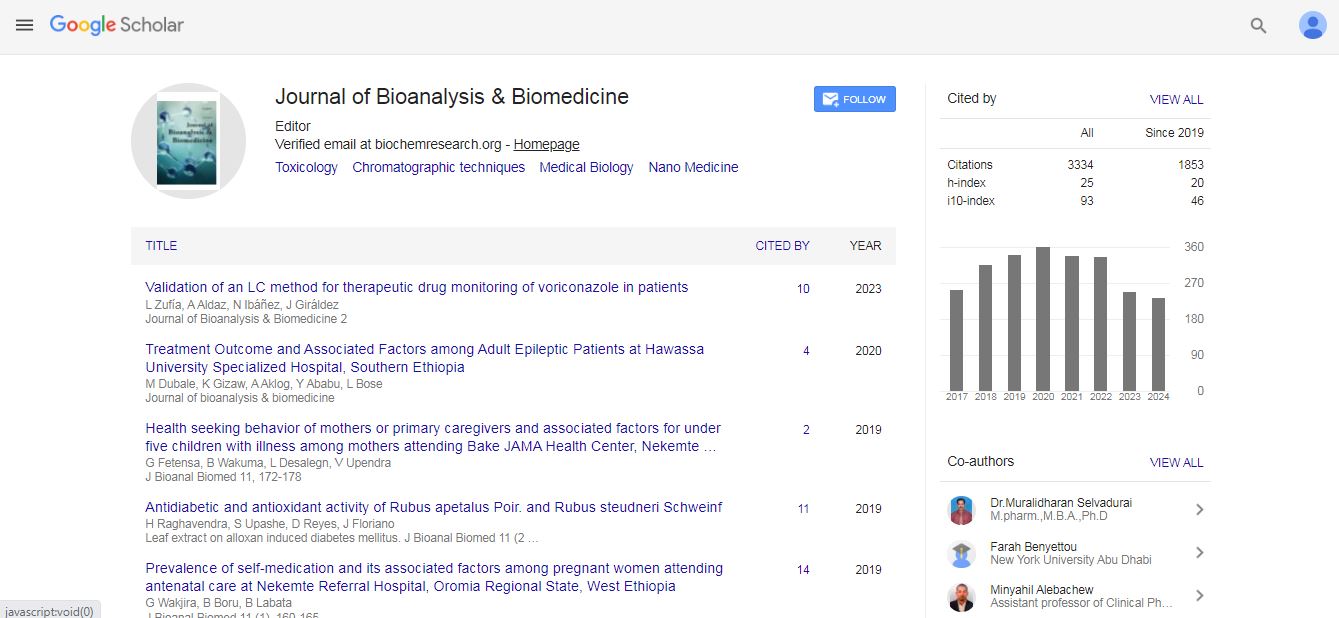
Journal of Bioanalysis & Biomedicine received 3099 citations as per Google Scholar report