Brief Report - (2025) Volume 15, Issue 4
Received: 01-Jul-2025, Manuscript No. jsmds-25-174509;
Editor assigned: 03-Jul-2025, Pre QC No. P-174509;
Reviewed: 17-Jul-2025, QC No. Q-174509;
Revised: 22-Jul-2025, Manuscript No. R-174509;
Published:
29-Jul-2025
, DOI: 10.37421/2161-0673.2025.15.437
Citation: O’Connell, Liam. ”Advancing Sports Science: Tech, Performance, Well-being.” J Sports Med Doping Stud 15 (2025):437.
Copyright: © 2025 O’Connell L. This is an open-access article distributed under the terms of the Creative Commons Attribution License, which permits unrestricted use,
distribution and reproduction in any medium, provided the original author and source are credited.
In the dynamic landscape of modern athletics, technological advancements and data-driven approaches are increasingly pivotal for optimizing performance and managing competition. This review highlights how wearable technology helps athletes improve performance and prevent injuries. It details various sensor types, data analysis methods, and practical applications in training, showing promising results while also pointing out challenges like data privacy and validation. The paper suggests future research should focus on integrating these technologies more effectively into athletic programs[1].
Further, the growing application of sports analytics provides data-driven insights that influence coaching strategies, player recruitment, injury risk management, and tactical planning. The authors highlight the potential of analytics to revolutionize sports, while also addressing challenges in data interpretation and integration[10].
Technology's reach extends to in-game decision-making, as exemplified by the Video Assistant Referee (VAR) in football, which impacts game flow and referee decision-making. This systematic review analyzes the effects on match duration, accuracy of decisions, and player behavior. While VAR generally improves decision accuracy, the review notes ongoing debates about its influence on the game's intrinsic rhythm and experience[7].
Beyond the technological front, a holistic understanding of athlete well-being is critical, encompassing mental, physical, and nutritional aspects. This article explores the current understanding and future directions for supporting the mental health and well-being of elite athletes. It emphasizes the unique stressors faced by this population and the need for tailored, comprehensive support systems, including early intervention and psychological skills training. The authors call for more research on effective interventions and preventative strategies[2].
Similarly, systematic approaches to injury prevention are fundamental, especially in youth sports, where neuromuscular training programs have been shown to significantly reduce overall injury rates, particularly for lower limb injuries. The paper stresses the importance of implementing these evidence-based programs consistently in youth athletic development[3].
Effective recovery strategies are equally vital for minimizing fatigue and enhancing subsequent performance. This systematic review and meta-analysis assesses the effectiveness of various recovery strategies in sport. It evaluates methods such as cold water immersion, compression garments, and active recovery, providing evidence-based insights into their efficacy for minimizing fatigue and enhancing subsequent performance. The review underscores the importance of individualizing recovery protocols[8].
Nutritional science offers specific strategies for improving athletic performance and aiding recovery, particularly in team sports. This article reviews key nutritional strategies for improving athletic performance and enhancing recovery, specifically within team sports. It covers various macronutrient and micronutrient approaches, hydration protocols, and ergogenic aids. The authors highlight the need for individualized nutrition plans, considering the unique demands of different sports and athlete needs[4].
The psychological and societal dimensions of sport also hold significant weight in understanding participation and leadership. This scoping review synthesizes recent research on motivation in sport, identifying key theories and practical applications. It examines various motivational factors, including intrinsic and extrinsic drivers, goal setting, and coach-athlete relationships. The paper emphasizes the dynamic nature of motivation and its critical role in sustained participation and performance[5].
On a broader scale, the profound role of exercise in promoting public health across the lifespan is well-established. This comprehensive review explores the profound role of exercise in promoting public health across the lifespan. It details the physiological and psychological benefits of regular physical activity, from reducing chronic disease risk to improving mental well-being. The authors advocate for broader public health initiatives to increase physical activity levels in populations[6].
Furthermore, issues of equity and representation in sport leadership require careful examination. This systematic review explores the persistent issue of gender equity in sport leadership, identifying key barriers and facilitators. It examines systemic issues, cultural norms, and individual factors influencing the representation of women in leadership roles. The paper calls for targeted interventions and policy changes to promote more inclusive leadership structures[9].
Wearable technology stands at the forefront of athletic development, offering powerful tools to enhance performance and mitigate injury risks. This technology meticulously details various sensor types and sophisticated data analysis methodologies that find practical application in training environments. While the results from these integrated systems are often promising, their widespread adoption encounters hurdles related to data privacy and ensuring validation. Future research efforts are geared towards seamlessly integrating these advanced technologies into daily athletic programs[1].
Complementing wearable tech, the field of sports analytics is increasingly critical for optimizing decision-making in elite performance settings. It leverages data-driven insights to inform crucial aspects like coaching strategies, player recruitment, injury risk management, and overall tactical planning. The potential for analytics to revolutionize how sports are approached is vast, yet challenges remain in interpreting complex data and integrating findings effectively into practical applications[10].
Athlete well-being extends significantly into mental health, especially for elite athletes who endure unique stressors. Current understanding emphasizes the urgent need for comprehensive, tailored support systems. These systems should prioritize early intervention alongside robust psychological skills training to foster resilience. Experts in the field advocate for increased research to identify and implement more effective interventions and preventative strategies, ensuring athletesâ?? psychological health is as robust as their physical conditioning[2].
Underpinning an athlete's sustained engagement and drive is motivation. Recent scoping reviews synthesize essential theories and practical applications in this domain. They highlight various motivational factors, including both intrinsic and extrinsic drivers, the strategic use of goal setting, and the profound influence of coach-athlete relationships. This research underscores motivation's dynamic nature and its indispensable role in continuous participation and peak performance[5].
Preventing injuries, particularly in youth sports, is a paramount concern addressed by evidence-based interventions. A systematic review and meta-analysis confirmed the significant effectiveness of neuromuscular training programs in reducing overall injury rates, with a notable impact on lower limb injuries. The consensus stresses the critical importance of consistently implementing these programs within youth athletic development frameworks[3].
Post-exertion recovery is equally vital for minimizing fatigue and ensuring optimal subsequent performance. A systematic review and meta-analysis comprehensively assesses various recovery strategies, such as cold water immersion, the use of compression garments, and active recovery protocols. The findings provide evidence-based insights into the efficacy of these methods, reinforcing the necessity of individualizing recovery plans to meet specific athlete needs[8].
Nutritional science offers a precise framework for enhancing athletic performance and accelerating recovery, particularly within the demanding context of team sports. Key strategies encompass detailed macronutrient and micronutrient approaches, specific hydration protocols, and the careful consideration of ergogenic aids. The core principle here is the development of individualized nutrition plans, meticulously crafted to align with the unique physiological demands of different sports and the personal requirements of each athlete[4].
Beyond competitive sports, the role of exercise in promoting public health across the lifespan is profound and widely acknowledged. A comprehensive review details the extensive physiological benefits, such as reduced risk of chronic diseases, alongside significant psychological improvements, including enhanced mental well-being. This body of work strongly advocates for broader public health initiatives aimed at increasing physical activity levels across entire populations to harness these far-reaching advantages[6].
The dynamics of competitive play are also evolving with technology. The Video Assistant Referee (VAR) system in football has been closely examined for its impact on game flow and the accuracy of referee decision-making. Analysis shows VAR generally improves decision accuracy and influences player behavior, yet discussions persist regarding its effect on the intrinsic pace and overall spectator experience of the game[7].
Moreover, broader societal issues like gender equity in sport leadership demand attention. A systematic review identifies significant barriers and facilitators influencing the representation of women in leadership roles. These include deeply rooted systemic issues, prevailing cultural norms, and various individual factors. The paper calls for decisive, targeted interventions and policy changes to foster more inclusive and equitable leadership structures throughout the sports industry[9].
The field of sports science is rapidly evolving, integrating technology and data-driven insights to enhance athletic performance and well-being. Wearable technology, for instance, provides crucial data through various sensors, aiding in performance improvement and injury prevention, despite challenges in data privacy and validation. Alongside physical advancements, the mental health of elite athletes is gaining critical attention, with calls for comprehensive, tailored support systems that include early intervention and psychological skills training. Injury prevention is also a significant focus, particularly in youth sports, where neuromuscular training programs have shown considerable success in reducing overall and lower limb injury rates. Beyond training methodologies, nutrition plays a pivotal role, with individualized strategies, hydration protocols, and ergogenic aids being essential for maximizing performance and recovery in team sports. Motivation, encompassing intrinsic and extrinsic factors, goal setting, and coach-athlete dynamics, is recognized as a key driver for sustained engagement and success. Broader societal benefits of physical activity are also highlighted, with exercise serving as a cornerstone for public health across all ages, promoting both physiological and psychological well-being. Technology also impacts the game itself; Video Assistant Referee (VAR) in football has improved decision accuracy, though its effect on game flow is still debated. Post-exertion recovery is addressed through evidence-based strategies like cold water immersion and compression garments, emphasizing tailored approaches for fatigue reduction. Finally, systemic issues like gender equity in sport leadership persist, requiring targeted interventions to overcome barriers and foster inclusive environments. The application of sports analytics further empowers decision-making in elite performance, from coaching to injury risk management, transforming how sports are managed and played.
None
None
Indexed at, Google Scholar, Crossref
Indexed at, Google Scholar, Crossref
Indexed at, Google Scholar, Crossref
Indexed at, Google Scholar, Crossref
Indexed at, Google Scholar, Crossref
Indexed at, Google Scholar, Crossref
Indexed at, Google Scholar, Crossref
Indexed at, Google Scholar, Crossref
Indexed at, Google Scholar, Crossref
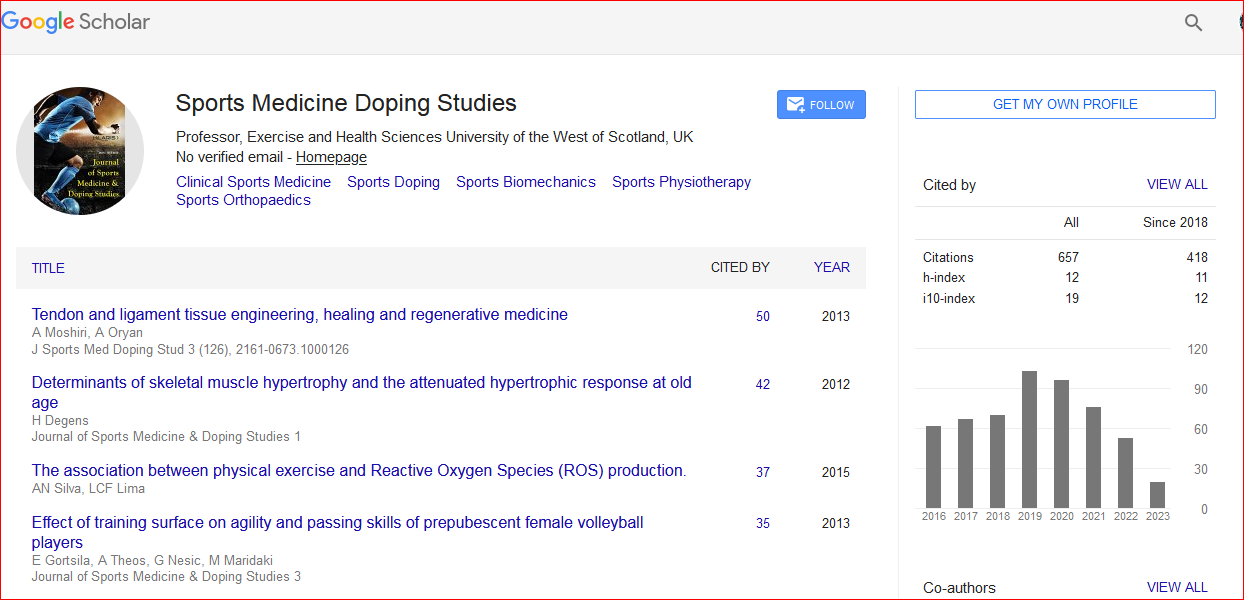
Journal of Sports Medicine & Doping Studies received 1022 citations as per Google Scholar report