Commentary - (2025) Volume 16, Issue 2
Received: 01-Mar-2025, Manuscript No. jnmrt-25-172725;
Editor assigned: 03-Mar-2025, Pre QC No. P-172725;
Reviewed: 17-Mar-2025, QC No. Q-172725;
Revised: 24-Mar-2025, Manuscript No. R-172725;
Published:
31-Mar-2025
, DOI: 10.37421/2155-9619.2025.16.634
Citation: Al-Harthi, Fatima A.. ”Advancing Radiation Protection Across All Exposures.” J Nucl Med Radiat Ther 16 (2025):634.
Copyright: © 2025 Al-Harthi A. Fatima This is an open-access article distributed under the terms of the Creative Commons Attribution License, which permits unrestricted use, distribution and reproduction in any medium, provided the original author and source are credited.
Radiation protection remains a paramount concern across diverse fields, from medical diagnostics to environmental safety and emergency preparedness. As technologies involving ionizing radiation continue to evolve and become more prevalent, the imperative to minimize risks for patients, medical personnel, and the general public grows. This collection of insights offers a nuanced perspective on current challenges, innovative solutions, and evolving practices, highlighting the dynamic landscape of radiation safety and the continuous efforts required to maintain high standards. A crucial area of focus is the crucial area of patient radiation protection in Computed Tomography (CT), where common challenges are thoroughly examined and practical solutions are proposed. These strategies aim to minimize the radiation dose received by patients without compromising the diagnostic quality of the images. Implementing smart approaches in this essential imaging modality is vital for patient well-being and effective healthcare delivery [1].
Occupational safety presents another significant challenge, particularly in high-exposure environments such as interventional cardiology. This paper provides an excellent overview, critically examining existing guidelines and current practices to protect medical staff, underscoring the serious importance of safeguarding healthcare professionals in such settings [2].
Public understanding and perception of radiation risks in medical imaging are explored, revealing significant gaps in knowledge. These insights call for the development of more effective communication strategies, emphasizing the clear need for better ways to inform the public about these important health topics and foster informed decision-making [3].
The continuous evolution of technology and protocols plays a pivotal role in improving patient safety. A comprehensive review offers a thorough look at cutting-edge techniques employed to reduce radiation dose in CT, demonstrating how these advancements are optimizing imaging procedures while effectively minimizing patient exposure [4].
Preparing for and responding to radiological and nuclear emergencies constitutes a critical aspect of public safety. This article lays out the critical elements involved, discussing both established concepts and the ongoing challenges faced by those involved in disaster management and public safety operations, making it a vital read for preparedness [5].
Radiation protection in nuclear medicine is a specialized field with unique considerations. A focused review outlines current practices and looks ahead to future developments, highlighting the distinct challenges and innovative solutions being pursued to enhance safety within this specific area of medical imaging [6].
Environmental radiation monitoring provides essential data for understanding the impact of both natural and artificial radiation sources. This paper offers a comprehensive overview, detailing various methods and technologies used to accurately assess radiation levels in our surroundings, which is crucial for public health and environmental stewardship [7].
From a European standpoint, the regulatory framework governing radiation protection in diagnostic and interventional radiology is meticulously explored. This perspective sheds light on how guidelines and legislation are structured and implemented to ensure the highest levels of safety across these critical medical practices within the region [8].
The long-term health of staff in interventional radiology necessitates vital attention to eye lens protection. This comprehensive review addresses this topic, detailing specific risks and various protective measures that are critical for ensuring the well-being of professionals in these high-exposure roles over their careers [9].
Safeguarding the youngest patients is of paramount importance, and this article thoroughly examines the unique challenges and effective solutions for radiation protection in pediatric Computed Tomography (CT) scans. It emphasizes the critical need for tailored protocols specifically designed for children, ensuring optimal care while minimizing their exposure [10].
In conclusion, the collective body of work presented here underscores the multifaceted nature of radiation protection. It highlights a continuous need for research, technological innovation, stringent regulatory oversight, and proactive public education. These elements are all indispensable in advancing the standards of safety, ensuring informed decision-making, and maintaining public confidence in the beneficial yet potentially hazardous applications of radiation across healthcare, environmental monitoring, and emergency response. The emphasis remains on minimizing exposure without compromising the essential diagnostic and therapeutic benefits provided by radiation technologies.
This compilation of research offers an extensive exploration into the critical domain of radiation protection, encompassing diverse applications and challenges within medical imaging, environmental monitoring, and emergency preparedness. The papers collectively emphasize the ongoing need for rigorous safety protocols, technological innovation, and improved public awareness to mitigate the risks associated with radiation exposure.
Patient safety in medical imaging, particularly in Computed Tomography (CT), is a recurring theme. One article meticulously examines the crucial area of patient radiation protection in CT, identifying common challenges and proposing practical solutions to minimize dose without compromising diagnostic quality [1]. This includes smart, optimized approaches for this essential imaging modality. Further refining these efforts, another review offers a thorough look at cutting-edge techniques designed to reduce radiation dose in CT, showcasing how evolving technology and protocols are continuously improving patient safety by optimizing imaging while minimizing exposure [4]. Special attention is also paid to vulnerable populations, with a dedicated article thoroughly examining the unique challenges and effective solutions for radiation protection in pediatric CT scans. This study emphasizes the critical need for tailored protocols specifically designed for children, ensuring the safeguarding of our youngest patients [10].
Occupational radiation safety forms another cornerstone of these discussions, with particular emphasis on high-exposure medical environments. An excellent overview delves into occupational radiation safety in interventional cardiology, critically examining existing guidelines and current practices. This work strongly underscores the importance of protecting medical staff in these demanding settings [2]. Complementing this, a comprehensive review addresses the vital topic of eye lens protection for staff working in interventional radiology, detailing the specific risks involved and outlining various protective measures. This is a critical discussion for ensuring the long-term health of professionals in these high-exposure roles [9]. Beyond interventional practices, radiation protection in nuclear medicine is also scrutinized, with a review outlining current practices and looking ahead to future developments. This article highlights the unique challenges and innovative solutions prevalent in this specialized field of medical imaging [6].
Beyond the clinical sphere, the broader societal implications of radiation are also addressed. A study delves into public understanding and perception of radiation risks in medical imaging, revealing significant gaps in knowledge. These findings clearly indicate a need for more effective communication strategies to inform the public about these important health topics [3]. Furthermore, environmental radiation monitoring is presented as a critical area, with a paper providing a comprehensive overview. It details various methods and technologies used to assess radiation levels in our surroundings, which is crucial for understanding the impact of both natural and artificial radiation sources [7].
The regulatory and emergency preparedness aspects complete this holistic view. From a European perspective, an article explores the regulatory framework governing radiation protection in diagnostic and interventional radiology. It sheds light on how guidelines and legislation are implemented to ensure safety across these critical medical practices [8]. Finally, the critical aspects of preparing for and responding to radiological and nuclear emergencies are laid out in an article discussing both established concepts and ongoing challenges. This makes it a vital read for anyone involved in disaster management and public safety, highlighting the necessity for robust planning and response mechanisms [5]. This diverse collection ultimately reinforces the multifaceted nature of radiation safety, advocating for a holistic and continuously evolving approach to protection across all exposure scenarios.
The provided data offers a comprehensive look at radiation protection, spanning various critical areas. One major theme involves safeguarding patients in medical imaging, particularly in Computed Tomography (CT), by addressing challenges and proposing practical solutions to minimize dose without compromising diagnostic quality. This extends to specialized protocols for pediatric CT, emphasizing the need for tailored approaches for younger patients. Occupational safety is another key focus. Articles delve into protecting medical staff in high-exposure environments like interventional cardiology, reviewing existing guidelines and current practices. Specific measures for eye lens protection in interventional radiology are also highlighted, underscoring risks and protective strategies for long-term staff health. Similarly, radiation protection in nuclear medicine is reviewed, outlining unique challenges and future developments in this specialized field. Beyond clinical settings, the data touches upon public understanding of radiation risks in medical imaging, identifying knowledge gaps and advocating for clearer communication. Environmental radiation monitoring is explored, detailing methods and technologies for assessing radiation levels from both natural and artificial sources. The regulatory landscape is examined from a European perspective, showing how legislation ensures safety in diagnostic and interventional radiology. Lastly, preparedness and response for radiological and nuclear emergencies are discussed, covering established concepts and ongoing challenges in disaster management and public safety. This body of work collectively advocates for continuous improvement in radiation safety across all exposures.
None
None
Indexed at, Google Scholar, Crossref
Indexed at, Google Scholar, Crossref
Indexed at, Google Scholar, Crossref
Indexed at, Google Scholar, Crossref
Indexed at, Google Scholar, Crossref
Indexed at, Google Scholar, Crossref
Indexed at, Google Scholar, Crossref
Indexed at, Google Scholar, Crossref
Indexed at, Google Scholar, Crossref
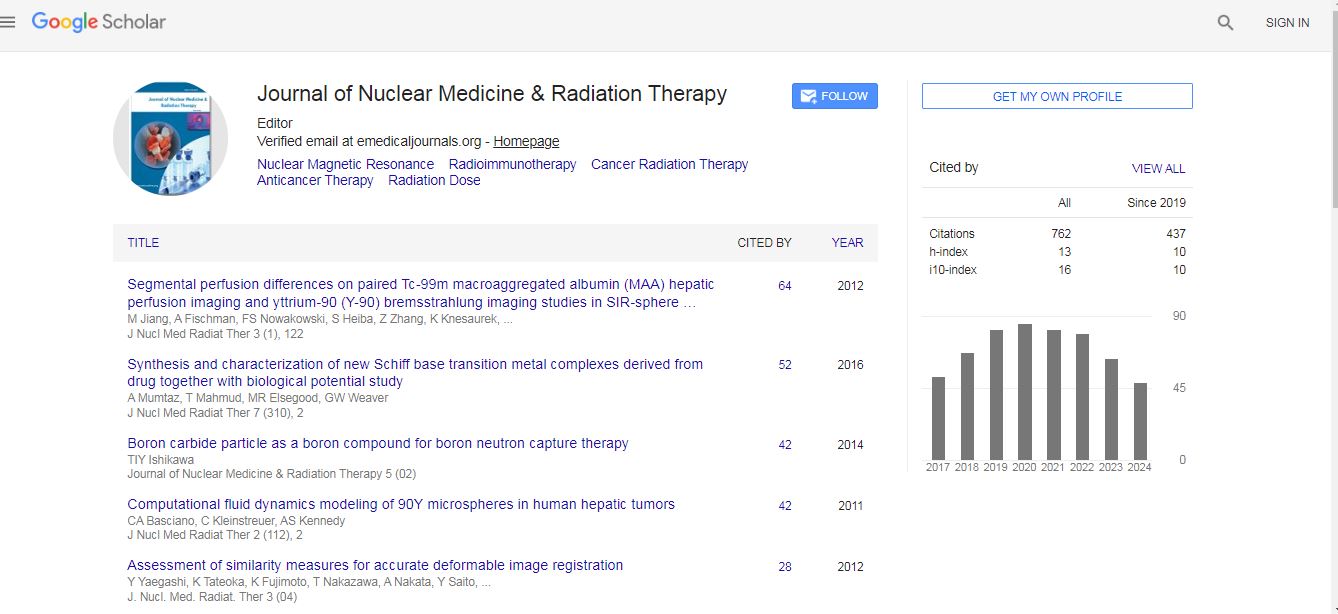
Nuclear Medicine & Radiation Therapy received 706 citations as per Google Scholar report