Perspective - (2025) Volume 15, Issue 2
Received: 02-Jun-2025, Manuscript No. jttr-25-175396;
Editor assigned: 04-Jun-2025, Pre QC No. P-175396;
Reviewed: 18-Jun-2025, QC No. Q-175396;
Revised: 23-Jun-2025, Manuscript No. R-175396;
Published:
30-Jun-2025
, DOI: 10.37421/2161-0991.2025.15.303
Citation: Smith, Angela K.. ”Advancing Organ Transplantation: Precision, Immunology, Survival.” J Transplant Technol Res 15 (2025):303.
Copyright: © 2025 Smith K. Angela This is an open-access article distributed under the terms of the Creative Commons Attribution License, which permits unrestricted use, distribution and reproduction in any medium, provided the original author and source are credited.
This paper highlights the increasing importance of donor-derived cell-free DNA dd-cfDNA as a non-invasive biomarker for monitoring allograft rejection in kidney transplant recipients. It explains how dd-cfDNA offers a promising tool for early detection of rejection, potentially reducing the need for biopsies and improving patient outcomes. The review covers the current understanding of dd-cfDNA biology, its clinical applications, limitations, and future directions in transplant surveillance [1].
This review delves into the complex role of T-cell exhaustion in solid organ transplantation, explaining how this state of T-cell dysfunction can impact both chronic rejection and the maintenance of immune tolerance. It discusses the molecular mechanisms underlying T-cell exhaustion and explores potential therapeutic strategies aimed at reversing this state to improve long-term graft survival [2].
This article provides a comprehensive overview of immunosuppressive regimens used in solid organ transplantation, detailing both established therapies and promising new agents. It discusses the delicate balance required to prevent rejection while minimizing adverse effects like infection, malignancy, and toxicity, and highlights the ongoing efforts to personalize immunosuppression for better patient outcomes [3].
This review explores various strategies aimed at inducing transplantation tolerance, a state where the recipients immune system accepts the allograft without continuous immunosuppression. It discusses the fundamental immunological mechanisms involved, including regulatory T cells and donor-specific hyporesponsiveness, and evaluates the clinical progress and challenges in achieving stable, drug-free graft survival [4].
This article discusses the significant progress in xenotransplantation, particularly using genetically modified porcine organs, as a potential solution to the critical shortage of human organs for transplantation. It highlights recent clinical trials and the challenges that remain, including immune rejection, zoonotic disease transmission, and ethical considerations, while emphasizing the revolutionary potential for patient care [5].
This review addresses the critical role of human leukocyte antigen HLA antibodies in transplant immunology, detailing their impact on sensitization, crossmatch testing, and both acute and chronic rejection. It explains the advanced methodologies for HLA antibody detection and characterization, and discusses strategies for managing antibody-mediated rejection, underscoring the personalized approach needed for successful transplantation [6].
This article examines the innovative application of organ-on-a-chip technology in transplant immunology research. It demonstrates how these microphysiological systems can mimic human organ function and immune responses, providing powerful platforms for studying mechanisms of rejection, testing novel immunosuppressants, and personalizing therapies in a more physiologically relevant manner than traditional in vitro models [7].
This review focuses on the increasingly recognized role of B cells in both humoral and cellular immune responses leading to allograft rejection in solid organ transplantation. It discusses the various subsets of B cells, their activation pathways, and their contribution to antibody production and antigen presentation, highlighting B cell-targeted therapies as promising strategies to prevent and treat rejection [8].
This article provides an update on the critical role of regulatory T cells Tregs in promoting immune tolerance and preventing allograft rejection in solid organ transplantation. It summarizes the current understanding of Treg biology, their suppressive mechanisms, and the clinical strategies being explored to harness their therapeutic potential, including ex vivo expansion and adoptive transfer [9].
This review explores the transformative impact of omics technologies genomics, proteomics, metabolomics and Artificial Intelligence on transplant immunology. It discusses how these advanced tools facilitate a deeper understanding of graft rejection mechanisms, enable the discovery of novel biomarkers, and pave the way for precision medicine approaches to personalize immunosuppression and improve long-term outcomes for transplant recipients [10].
This paper highlights the increasing importance of donor-derived cell-free DNA dd-cfDNA as a non-invasive biomarker for monitoring allograft rejection in kidney transplant recipients. It explains how dd-cfDNA offers a promising tool for early detection of rejection, potentially reducing the need for biopsies and improving patient outcomes. The review covers the current understanding of dd-cfDNA biology, its clinical applications, limitations, and future directions in transplant surveillance [1]. The critical role of Human Leukocyte Antigen HLA antibodies in transplant immunology, detailing their impact on sensitization, crossmatch testing, and both acute and chronic rejection, is explored [6]. Advanced methodologies for HLA antibody detection and characterization, along with strategies for managing antibody-mediated rejection, underscore the personalized approach vital for successful transplantation [6].
The complex role of T-cell exhaustion in solid organ transplantation impacts both chronic rejection and the maintenance of immune tolerance [2]. Understanding the molecular mechanisms underlying T-cell dysfunction can lead to therapeutic strategies for improving long-term graft survival [2]. Furthermore, B cells are increasingly recognized for their role in humoral and cellular immune responses that lead to allograft rejection [8]. Various subsets of B cells, their activation pathways, and their contribution to antibody production and antigen presentation are discussed, highlighting B cell-targeted therapies as promising strategies [8]. Regulatory T cells Tregs are also critical in promoting immune tolerance and preventing allograft rejection [9]. The current understanding of Treg biology, their suppressive mechanisms, and clinical strategies like ex vivo expansion and adoptive transfer are being explored for therapeutic potential [9].
A comprehensive overview of immunosuppressive regimens in solid organ transplantation details both established therapies and promising new agents [3]. The delicate balance needed to prevent rejection while minimizing adverse effects like infection, malignancy, and toxicity drives ongoing efforts to personalize immunosuppression for improved patient outcomes [3]. Complementing these efforts, various strategies aimed at inducing transplantation tolerance are explored [4]. This state allows the recipients immune system to accept the allograft without continuous immunosuppression, involving fundamental immunological mechanisms such as regulatory T cells and donor-specific hyporesponsiveness [4].
Significant progress in xenotransplantation, particularly with genetically modified porcine organs, offers a potential solution to the critical shortage of human organs [5]. Recent clinical trials and remaining challenges, including immune rejection, zoonotic disease transmission, and ethical considerations, are highlighted, emphasizing its revolutionary potential [5]. Moreover, organ-on-a-chip technology provides an innovative application in transplant immunology research [7]. These microphysiological systems mimic human organ function and immune responses, offering powerful platforms to study rejection mechanisms, test novel immunosuppressants, and personalize therapies in a more physiologically relevant manner [7].
The transformative impact of omics technologies, encompassing genomics, proteomics, and metabolomics, along with Artificial Intelligence, on transplant immunology is explored [10]. These advanced tools facilitate a deeper understanding of graft rejection mechanisms, enable the discovery of novel biomarkers, and pave the way for precision medicine approaches to personalize immunosuppression and improve long-term outcomes for transplant recipients [10].
Advancements in solid organ transplantation are improving graft survival and patient outcomes. Donor-derived cell-free DNA dd-cfDNA is a key non-invasive biomarker for early kidney allograft rejection detection, potentially reducing the need for biopsies. Understanding complex immune mechanisms, such as T-cell exhaustion, B cell roles, and regulatory T cells Tregs, is vital for developing targeted therapies and inducing immune tolerance. Current immunosuppressive regimens are evolving toward personalization to balance rejection prevention with minimizing adverse effects. Addressing the organ shortage, xenotransplantation, particularly with genetically modified porcine organs, shows promise despite challenges in immune rejection and ethics. Human Leukocyte Antigen HLA antibodies are crucial in transplant immunology; their advanced detection and characterization guide personalized management strategies for antibody-mediated rejection. Innovative research tools, like organ-on-a-chip technology, mimic human organ function and immune responses to study rejection mechanisms and test novel immunosuppressants. Additionally, omics technologies and Artificial Intelligence are transforming the field by uncovering novel biomarkers and enabling precision medicine, aiming to personalize treatment and enhance long-term graft function.
None
None
Wei W, Kai Y, Hongbin G. "Donor-derived cell-free DNA for rejection surveillance in kidney transplantation.".Nat Rev Nephrol 19 (2023):301-314.
Indexed at, Google Scholar, Crossref
Daniel JO, Anusha S, Nicole AG. "T-cell exhaustion in solid organ transplantation: current understanding and future therapeutic strategies.".Transplant Int 35 (2022):1000673.
Indexed at, Google Scholar, Crossref
Jennifer BC, Sarah LO, Amy L. "Immunosuppression in Solid Organ Transplantation: A Review of Current and Emerging Therapies.".Am J Transplant 20 (2020):2289-2300.
Indexed at, Google Scholar, Crossref
Laura GS, Mark JH, Stephen AM. "Strategies to Induce Transplantation Tolerance.".Front Immunol 12 (2021):688753.
Indexed at, Google Scholar, Crossref
Daniel PK, Jason LS, Lori JW. "Xenotransplantation: a paradigm shift in organ supply.".Lancet 401 (2023):588-601.
Indexed at, Google Scholar, Crossref
Michael SL, John ES, Nicole MJ. "The expanding role of HLA antibodies in transplantation.".Clin Kidney J 14 (2021):1310-1319.
Indexed at, Google Scholar, Crossref
Ann-Kathrin H, Michael KS, Jan-Hendrik B. "Organ-on-a-chip models to study immune responses in transplantation.".Curr Opin Organ Transplant 28 (2023):154-162.
Indexed at, Google Scholar, Crossref
Christian R, Peter R, Michael OMS. "B cells in solid organ transplantation: an emerging target for therapy.".J Clin Med 9 (2020):2044.
Indexed at, Google Scholar, Crossref
Kazunari T, Satoshi O, Masayuki N. "Regulatory T cells in solid organ transplantation: progress and challenges.".Int J Mol Sci 20 (2019):6197.
Indexed at, Google Scholar, Crossref
Laura BSMV, Maarten HJB, Maarten LGBLCK. "Omics technologies and artificial intelligence in transplant immunology.".Transplants 2 (2022):7.
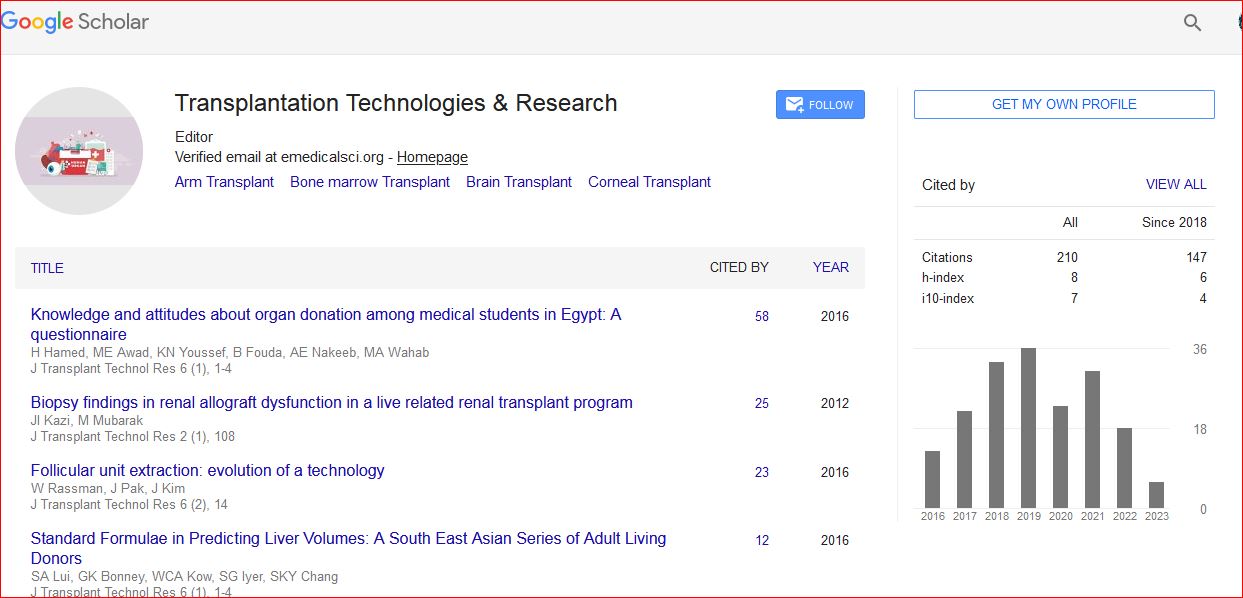
Transplantation Technologies & Research received 223 citations as per Google Scholar report