Brief Report - (2025) Volume 14, Issue 6
Received: 01-Dec-2025, Manuscript No. MBL-26-182628;
Editor assigned: 03-Dec-2025, Pre QC No. P-182628;
Reviewed: 17-Dec-2025, QC No. Q-182628;
Revised: 22-Dec-2025, Manuscript No. R-182628;
Published:
29-Dec-2025
, DOI: 10.37421/2168-9547.2025.14.521
Citation: Ignatova, Maria. "Advancing Molecular Visualization
and Understanding." Mol Biol 14 (2025):521.
Copyright: © 2025 Ignatova M. This is an open-access article distributed under the terms of the Creative Commons Attribution License, which permits unrestricted use,
distribution and reproduction in any medium, provided the original author and source are credited.
The visualization and understanding of molecular interactions have undergone a profound transformation, largely driven by advancements in imaging techniques and computational methodologies [1].
These innovations have enabled the observation of processes that were previously beyond the reach of direct perception, leading to significant progress in unraveling complex biological mechanisms [1].
The field of structural biology has been revolutionized by techniques such as cryo-electron microscopy (cryo-EM), which allows for the determination of three-dimensional structures of large biomolecular complexes with unprecedented detail [2].
This has provided crucial insights into protein function, drug binding, and the intricate assembly of cellular machinery [2].
Single-molecule fluorescence spectroscopy offers a unique perspective by enabling the real-time observation of the dynamic behavior of individual biomolecules [3].
This method is invaluable for revealing molecular kinetics and conformational changes that are often masked in ensemble measurements, thus deepening our understanding of biological processes [3].
Computational chemistry and molecular dynamics simulations play a vital role in predicting molecular behavior and interactions [4].
These in silico approaches serve as powerful complements to experimental studies, facilitating the exploration of reaction pathways and the design of novel molecular systems with tailored functions [4].
Advancements in nanoscale imaging, particularly super-resolution microscopy, have broken through the diffraction limit of light, allowing for the visualization of molecular structures and dynamics within living cells at resolutions previously unattainable [5].
This has been instrumental in furthering our comprehension of cell biology [5].
Biophysical techniques, such as atomic force microscopy (AFM), are essential for probing the mechanical properties of single molecules and cellular structures [6].
AFM not only visualizes topography at the nanoscale but also measures forces, offering critical insights into molecular recognition and cellular mechanics [6].
The development of molecular visualization tools has had a significant impact on drug discovery and development [7].
By enabling a detailed understanding of drug-target interactions at the molecular level, these techniques accelerate the design of more effective and safer therapeutics [7].
Multi-scale modeling provides a framework for understanding biological systems by integrating information across different levels of detail, from atomic interactions to cellular functions [8].
This holistic approach offers a comprehensive view of molecular processes within their biological context [8].
Advanced mass spectrometry techniques have become indispensable for characterizing protein complexes and their interactions [9].
These methods facilitate high-throughput analysis, providing critical data on the stoichiometry and dynamics of macromolecular assemblies [9].
The integration of artificial intelligence (AI) and machine learning (ML) with experimental data is accelerating molecular discovery and design [10].
AI/ML algorithms can rapidly identify novel molecular structures with specific properties, fostering innovation in diverse fields such as materials science and drug development [10].
The intricate world of molecular interactions is being illuminated by sophisticated imaging techniques and computational modeling, allowing researchers to visualize and comprehend processes previously hidden from direct observation [1].
This has led to significant progress in mapping the dynamic behavior of molecules, which is fundamental for understanding biological mechanisms and developing new therapeutic strategies [1].
Cryo-electron microscopy (cryo-EM) has emerged as a transformative tool in structural biology, enabling the high-resolution determination of three-dimensional structures of large biomolecular complexes [2].
This technique provides unparalleled insights into the functional roles of proteins, their interactions with drugs, and the complex assembly processes that underpin cellular machinery [2].
Single-molecule fluorescence spectroscopy offers a powerful method for observing the dynamic behavior of individual biomolecules in real-time [3].
By circumventing the averaging inherent in ensemble measurements, this technique reveals crucial details about molecular kinetics and conformational changes, thereby enhancing our understanding of dynamic biological processes [3].
Computational chemistry and molecular dynamics simulations are integral to predicting how molecules behave and interact [4].
These in silico approaches complement experimental data, allowing for the exploration of complex reaction pathways and the rational design of novel molecular systems with specific functionalities [4].
Super-resolution microscopy represents a significant leap in nanoscale imaging, overcoming the diffraction limit of light to visualize molecular structures and dynamics within living cells at resolutions previously unimaginable [5].
This has had a profound impact on advancements in cell biology research [5].
Biophysical techniques, notably atomic force microscopy (AFM), are crucial for investigating the mechanical properties of individual molecules and cellular components [6].
AFM enables nanoscale topography visualization and precise force measurements, offering unique insights into molecular recognition events and cellular mechanical behaviors [6].
Advanced molecular visualization tools are critically important in the field of drug discovery and development [7].
They facilitate a detailed understanding of drug-target interactions at the molecular level, thereby accelerating the design and optimization of more effective and safer therapeutic agents [7].
Multi-scale modeling approaches are essential for comprehending the complexities of biological systems, bridging the gap between atomic-level detail and macroscopic cellular functions [8].
By integrating various computational methods, these strategies provide a more holistic perspective on molecular processes within their broader biological context [8].
Mass spectrometry has seen significant advancements, with new techniques enabling the thorough characterization of protein complexes and their intricate interactions [9].
These methods are key to high-throughput proteomic analysis, shedding light on the stoichiometry and dynamic behavior of macromolecular assemblies [9].
The synergy between artificial intelligence (AI), machine learning (ML), and experimental data is revolutionizing molecular discovery and design [10].
AI/ML algorithms are adept at rapidly identifying novel molecular structures with desired properties, thus driving innovation in fields ranging from materials science to pharmaceutical development [10].
This compilation explores the cutting edge of molecular science, highlighting advancements in visualizing and understanding molecular interactions. Techniques like cryo-EM, single-molecule spectroscopy, and super-resolution microscopy are revealing the dynamic behavior of biomolecules and cellular structures with unprecedented detail. Computational methods, including molecular dynamics simulations and multi-scale modeling, complement experimental approaches, enabling predictions and the design of novel molecular systems. The integration of AI and machine learning is further accelerating the discovery and design of molecules with specific properties. These developments are crucial for unraveling fundamental biological mechanisms and driving innovation in drug discovery, materials science, and beyond.
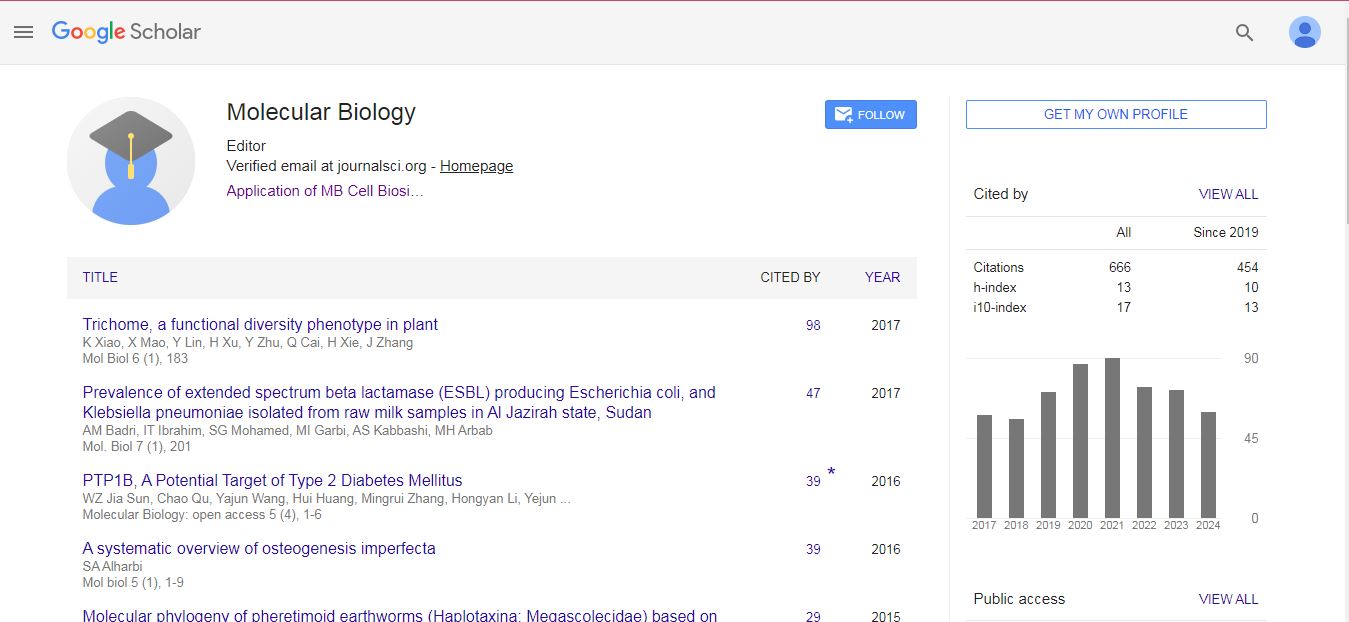
Molecular Biology: Open Access received 607 citations as per Google Scholar report