Commentary - (2025) Volume 15, Issue 3
Received: 02-Jun-2025, Manuscript No. jeat-26-188609;
Editor assigned: 04-Jun-2025, Pre QC No. P-188609;
Reviewed: 18-Jun-2025, QC No. Q-188609;
Revised: 23-Jun-2025, Manuscript No. R-188609;
Published:
30-Jun-2025
, DOI: 10.37421/2161-0525.2025.15.845
Citation: Anderson, James. ”Advancements in Environmental
Toxin Analysis and Monitoring.” J Environ Anal Toxicol 15 (2025):845.
Copyright: © 2025 Anderson J. This is an open-access article distributed under the terms of the Creative Commons Attribution License, which permits unrestricted use,
distribution and reproduction in any medium, provided the original author and source are credited.
The monitoring of toxic organic compounds in environmental matrices has seen significant advancements, particularly with the development of sensitive and selective analytical methods, including chromatography-mass spectrometry techniques, for detecting emerging contaminants. The importance of standardized sampling and sample preparation protocols is also discussed to ensure data reliability and comparability across different studies and regions, which is crucial for effective environmental health risk assessment [1].
Polycyclic aromatic hydrocarbons (PAHs) are a class of organic pollutants frequently found in urban air, especially in proximity to industrial zones. Studies utilizing gas chromatography-mass spectrometry (GC-MS) have identified specific PAH congeners and their concentrations, linking elevated levels to traffic emissions and industrial activities, underscoring the need for targeted emission control strategies to mitigate exposure risks [2].
The solid-phase extraction (SPE) of persistent organic pollutants (POPs) from water samples is a critical step for their accurate trace-level quantification in complex environmental matrices. Research into novel sorbent materials for SPE has focused on improving extraction efficiency and selectivity for a range of POPs, including pesticides and dioxins [3].
Phthalates are a group of chemicals commonly used in plastic products, and their bioaccumulation in freshwater fish from industrialized rivers is a growing concern. Studies employing liquid chromatography-tandem mass spectrometry (LC-MS/MS) have quantified phthalate levels in fish tissues, revealing significant contamination and calculating bioaccumulation factors that indicate potential risks to both aquatic ecosystems and human consumers of fish, highlighting the need for effective wastewater treatment [4].
Volatile organic compounds (VOCs) are prevalent in indoor air and can contribute to indoor air pollution. Novel methods, such as headspace solid-phase microextraction coupled with GC-MS, have been developed for the simultaneous determination of VOCs in indoor air, demonstrating high sensitivity and rapid analysis, enabling the identification of key VOC sources essential for improving indoor environmental quality and public health [5].
Bisphenols and their analogs are endocrine-disrupting compounds that have been detected in tap water samples from various locations. Studies using LC-MS/MS have found widespread contamination, with some analogs detected at higher concentrations than bisphenol A, highlighting the challenges of removing these compounds from drinking water sources [6].
Per- and polyfluoroalkyl substances (PFAS) are a group of man-made chemicals that are highly persistent in the environment. Their presence in soil samples collected near industrial manufacturing sites has been investigated using liquid chromatography coupled with high-resolution mass spectrometry (LC-HRMS), revealing significant contamination and potential risks of PFAS migration into groundwater [7].
Pharmaceutical residues in wastewater pose a threat to aquatic ecosystems and potentially human health. Advanced oxidation processes (AOPs), such as the combination of ozonation and UV irradiation, have shown significant degradation of common drug contaminants, demonstrating their potential in improving the quality of treated wastewater and reducing the environmental burden of pharmaceuticals [8].
Organophosphate flame retardants (OPFRs) are commonly found in indoor dust samples from residential buildings, posing potential human exposure pathways through inhalation and dermal contact. Studies using gas chromatography with an electron capture detector (GC-ECD) have quantified OPFRs, revealing widespread contamination and emphasizing the need for safer alternatives [9].
Biosensors offer a promising approach for the rapid detection of environmental toxins. Recent developments in biosensing platforms, including electrochemical, optical, and piezoelectric sensors, are being explored for monitoring toxic organic compounds in water and air, emphasizing the advantages of biosensors for on-site, real-time analysis [10].
The analysis of toxic organic compounds in environmental samples is a critical area of environmental science, with recent reviews highlighting advancements in sensitive and selective analytical methods, such as chromatography-mass spectrometry. These techniques are essential for detecting emerging contaminants, and the standardization of sampling and sample preparation protocols is emphasized for ensuring data reliability and comparability, which are vital for environmental health risk assessment [1].
Studies investigating polycyclic aromatic hydrocarbons (PAHs) in urban air have identified specific congeners and their concentrations using gas chromatography-mass spectrometry (GC-MS). These investigations often link elevated PAH levels to sources like traffic emissions and industrial activities, driving the need for targeted emission control strategies to mitigate public health risks [2].
The development of novel sorbent materials for solid-phase extraction (SPE) is crucial for the accurate quantification of persistent organic pollutants (POPs) in complex environmental matrices like water. Research efforts are focused on enhancing the extraction efficiency and selectivity of these sorbent materials for a diverse range of POPs, including pesticides and dioxins [3].
Bioaccumulation of phthalates in freshwater fish is a significant environmental concern, particularly in areas affected by industrial activity. Analytical techniques like liquid chromatography-tandem mass spectrometry (LC-MS/MS) are employed to quantify phthalate levels in fish tissues, providing data for bioaccumulation factors that inform risk assessments for aquatic ecosystems and human consumers of fish, thus emphasizing the importance of effective wastewater treatment [4].
For volatile organic compounds (VOCs) in indoor air, innovative methods like headspace solid-phase microextraction coupled with GC-MS have been developed. These techniques enable the simultaneous determination and identification of key VOCs contributing to indoor air pollution, which is essential for improving indoor environmental quality and safeguarding public health [5].
The widespread presence of bisphenols and their analogs in tap water is a notable finding, with studies using LC-MS/MS detecting these compounds and, in some cases, their analogs at higher concentrations than bisphenol A. This widespread contamination highlights the challenges associated with their removal from drinking water sources, raising public health concerns [6].
Per- and polyfluoroalkyl substances (PFAS) contamination in soils near industrial sites has been extensively studied using advanced analytical techniques such as liquid chromatography coupled with high-resolution mass spectrometry (LC-HRMS). These studies have detected significant concentrations of both legacy and emerging PFAS, indicating potential risks of migration into groundwater resources [7].
The removal of pharmaceutical residues from wastewater is a critical environmental challenge. Advanced oxidation processes (AOPs), including combinations of ozonation and UV irradiation, have demonstrated significant efficacy in degrading common drug contaminants, showcasing their potential to improve treated wastewater quality and reduce the environmental impact of pharmaceuticals [8].
Organophosphate flame retardants (OPFRs) are frequently found in indoor dust, leading to potential human exposure through inhalation and dermal contact. Analytical methods such as gas chromatography with an electron capture detector (GC-ECD) are used to quantify these compounds, prompting a focus on the development and adoption of safer alternatives in consumer products [9].
Biosensors are emerging as powerful tools for the rapid and on-site detection of environmental toxins. Advances in various biosensing platforms, including electrochemical and optical sensors, are being explored for their application in monitoring toxic organic compounds in water and air, offering advantages for real-time environmental surveillance [10].
This collection of research highlights significant progress in the analysis and monitoring of toxic organic compounds in various environmental matrices. Studies cover advancements in analytical techniques like chromatography-mass spectrometry for detecting emerging contaminants and persistent organic pollutants in air, water, soil, and indoor environments. Key areas of focus include polycyclic aromatic hydrocarbons (PAHs) in urban air, phthalates and bisphenols in water and fish, volatile organic compounds (VOCs) in indoor air, per- and polyfluoroalkyl substances (PFAS) in soil, and pharmaceutical residues in wastewater. The research also explores novel sorbent materials for improved sample extraction and the application of biosensors for rapid toxin detection. Overall, these studies underscore the importance of sensitive analytical methods, standardized protocols, and effective remediation strategies for mitigating the risks associated with widespread environmental contamination.
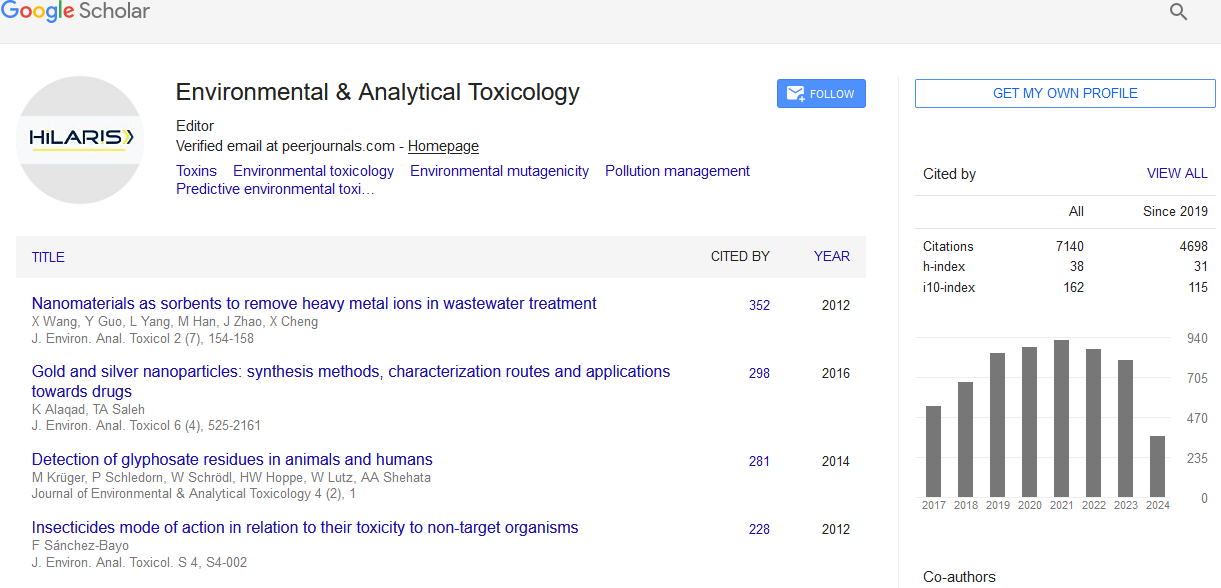
Environmental & Analytical Toxicology received 6818 citations as per Google Scholar report