Brief Report - (2025) Volume 11, Issue 2
Received: 01-Apr-2025, Manuscript No. jctt-26-188382;
Editor assigned: 03-Apr-2025, Pre QC No. P-188382;
Reviewed: 17-Apr-2025, QC No. Q-188382;
Revised: 22-Apr-2025, Manuscript No. R-188382;
Published:
29-Apr-2025
, DOI: 10.37421/2471-9323.2024.10.310
Citation: Tanaka, Hiroshi. ”Advanced Dermatology and Cosmetology: Novel Ingredients and Therapies.” J Cosmo Tricho 11 (2025):310.
Copyright: © 2025 Tanaka H. This is an open-access article distributed under the terms of the Creative Commons Attribution License, which permits unrestricted use, distribution and reproduction in any medium, provided the original author and source are credited.
The field of cosmeceuticals has witnessed remarkable advancements, driven by a deeper understanding of biochemical pathways and the development of novel ingredient technologies aimed at improving skin and hair health. These innovations focus on scientifically validated approaches to achieve healthier, more vibrant skin and hair through the interaction of specific active compounds with cellular mechanisms [1].
The intricate relationship between the scalp microbiome and hair growth cycles is emerging as a critical area of research. Disruptions in the microbial balance of the scalp can lead to various conditions, including dandruff and alopecia, prompting the exploration of probiotic and prebiotic interventions as promising trichological treatments [2].
Peptide-based formulations represent a significant breakthrough in dermal rejuvenation, demonstrating efficacy in stimulating collagen synthesis and improving skin elasticity. The specific mechanisms by which these signaling peptides penetrate the epidermis and interact with fibroblasts to enhance extracellular matrix production are central to their visible anti-aging effects [3].
Botanical extracts are gaining prominence for their photoprotective and antioxidant properties, offering advanced skincare solutions. The isolation and characterization of potent compounds from resilient plants are being assessed for their ability to neutralize free radicals and shield skin cells from UV-induced damage [4].
Current research into the molecular mechanisms governing hair follicle cycling is paving the way for innovative treatments for alopecia. Understanding the signaling pathways involved in different phases of hair growth and exploring regenerative medicine approaches, such as stem cell therapy and growth factor delivery, are crucial [5].
Ceramides and hyaluronic acid play fundamental roles in maintaining skin barrier function and hydration. Their contribution to skin resilience against environmental aggressors and their importance in formulations designed for dry and sensitive skin conditions are well-established [6].
Exosome-based therapies are showing considerable potential for hair regeneration. Exosomes derived from mesenchymal stem cells can deliver bioactive molecules that promote hair follicle stem cell proliferation and survival, offering a novel approach to treating hair loss [7].
The application of nanocarriers in cosmetic formulations is a key strategy for enhancing the delivery of active ingredients. Nanoparticles, liposomes, and microemulsions can improve the penetration, stability, and efficacy of cosmetic compounds, leading to improved outcomes for both skin and hair [8].
Topical retinoids continue to be a cornerstone in the management of acne vulgaris and photoaging. Their dermatological benefits, including accelerated skin cell turnover, reduced inflammation, and stimulated collagen production, are well-documented, with ongoing focus on formulation and patient compliance [9].
Microneedling, particularly when combined with topical agents, offers promising results for scar revision and skin texture improvement. The micro-injury induced by microneedles enhances the penetration and efficacy of therapeutic serums, promoting better collagen remodeling and aesthetic outcomes [10].
The exploration of cosmeceuticals is deeply rooted in understanding the complex biochemical pathways and novel ingredient technologies that drive effective skin and hair transformations. These advancements are meticulously examining how specific active compounds, sourced from both natural origins and sophisticated synthesis, engage with cellular mechanisms to foster regeneration, repair, and aesthetic enhancement. The overarching goal is to employ scientifically validated methods to cultivate healthier, more radiant skin and hair [1].
A significant paradigm shift in hair health research involves the role of the scalp microbiome. The journal highlights how imbalances within this microbial ecosystem can directly impact hair growth cycles, leading to conditions such as dandruff and alopecia. Consequently, probiotic and prebiotic interventions are being investigated as a novel and promising avenue for advanced trichological treatments [2].
The efficacy of peptide-based formulations in stimulating critical processes like collagen synthesis and enhancing skin elasticity is a subject of intensive research. Investigations are delving into the precise mechanisms by which these signaling peptides traverse the epidermal layers and interact with dermal fibroblasts, thereby boosting the production of the extracellular matrix and yielding observable anti-aging benefits [3].
Novel botanical extracts are being evaluated for their inherent photoprotective and antioxidant capabilities, positioning them as advanced agents for skincare. The research focuses on the isolation and detailed characterization of potent phytochemicals from plants known for their resilience to environmental stressors, assessing their capacity to neutralize harmful free radicals and safeguard skin cells from detrimental UV radiation [4].
An in-depth review of the molecular mechanisms governing hair follicle cycling is crucial for the development of next-generation treatments for alopecia. This research synthesizes current knowledge on the intricate signaling pathways that regulate the anagen, catagen, and telogen phases, while also exploring the vast potential of regenerative medicine strategies, including stem cell therapy and growth factor delivery [5].
The fundamental importance of ceramides and hyaluronic acid in maintaining the integrity of the skin barrier and ensuring optimal hydration is well-recognized. These essential lipids and humectants are vital for bolstering skin resilience against environmental insults and are indispensable components in formulations designed to address dryness and sensitivity [6].
Exosome-based therapies are emerging as a groundbreaking approach for hair regeneration. The study explores how exosomes, particularly those derived from mesenchymal stem cells, can effectively deliver a cargo of bioactive molecules that stimulate the proliferation and survival of hair follicle stem cells, presenting a novel therapeutic strategy for diverse forms of hair loss [7].
The integration of nanocarriers into cosmetic formulations represents a sophisticated strategy to amplify the delivery efficiency of active ingredients. The article elucidates how various nanocarrier systems, including nanoparticles, liposomes, and microemulsions, can significantly enhance the penetration, stability, and overall efficacy of key cosmetic compounds, ultimately leading to superior skin and hair outcomes [8].
Topical retinoids remain a critical element in the dermatological treatment of acne vulgaris and photoaging. Their well-documented benefits include accelerating epidermal turnover, mitigating inflammatory responses, and promoting collagen production, with a consistent emphasis on optimizing formulation parameters and ensuring high patient compliance [9].
Microneedling, when strategically combined with complementary topical agents, demonstrates considerable potential for scar revision and enhancing overall skin texture. The micro-injury induced by microneedling creates enhanced pathways for therapeutic serums, thereby augmenting their penetration and efficacy, which translates into improved collagen remodeling and more desirable aesthetic results [10].
This collection of research explores advanced strategies in dermatology and cosmetology. It covers novel cosmeceutical ingredients and biochemical pathways for skin and hair rejuvenation, including peptide therapies and botanical extracts. The role of the scalp microbiome and emerging treatments like exosomes and nanocarriers for hair loss are discussed. Additionally, the benefits of established ingredients such as ceramides, hyaluronic acid, and retinoids for skin barrier function, hydration, and treating conditions like acne and photoaging are reviewed. Finally, the efficacy of microneedling in combination with topical agents for scar revision and skin texture improvement is highlighted.
None
None
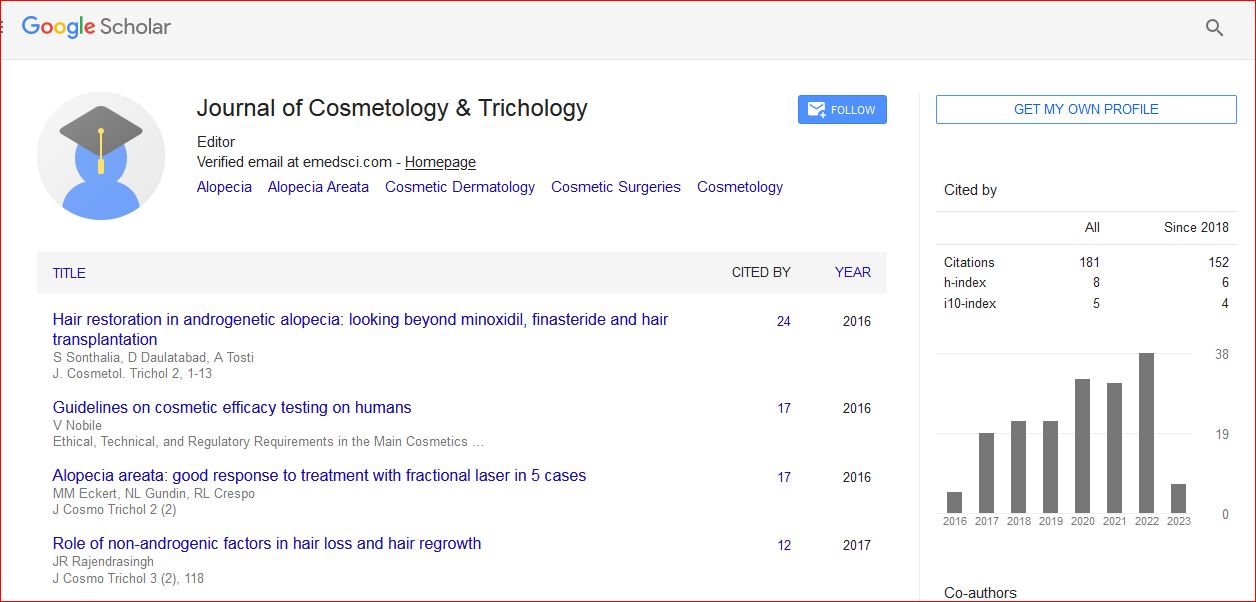
Journal of Cosmetology & Trichology received 180 citations as per Google Scholar report