Commentary - (2025) Volume 17, Issue 5
Received: 02-Oct-2025, Manuscript No. jbabm-26-182353;
Editor assigned: 05-Oct-2025, Pre QC No. P-182353;
Reviewed: 19-Oct-2025, QC No. Q-182353;
Revised: 23-Oct-2025, Manuscript No. R-182353;
Published:
30-Oct-2025
, DOI: 10.37421/1948-593X.2025.17.511
Citation: Iyer, Meera V.. ”Advanced Bioanalytics: Unraveling Host-Pathogen Interactions.” J Bioanal Biomed 17 (2025):511.
Copyright: © 2025 Iyer V .Meera This is an open-access article distributed under the terms of the Creative Commons Attribution License, which permits unrestricted use, distribution and reproduction in any medium, provided the original author and source are credited.
The study of host-pathogen interactions is a cornerstone of infectious disease research, demanding sophisticated analytical tools to unravel complex biological processes. Modern bioanalytical techniques are at the forefront of this endeavor, providing unprecedented insights into the molecular dialogues that occur during infection. These methods enable researchers to dissect the intricate interplay between hosts and pathogens, illuminating the mechanisms of disease pathogenesis and host defense [1].
The precise characterization of host cell responses at the metabolic level is crucial for understanding how viruses hijack cellular machinery. Liquid chromatography-mass spectrometry (LC-MS) has emerged as a powerful technique for profiling these metabolic changes during viral infections. By revealing dysregulated metabolic pathways, LC-MS offers insights into viral replication strategies and potential targets for intervention [2].
Bacterial pathogens often manipulate host cellular functions to establish infection. Quantitative proteomics offers a means to systematically identify host proteins that are altered in response to bacterial invasion. This approach, utilizing methods like label-free quantification, is instrumental in pinpointing proteins involved in critical processes such as immune signaling and pathogen entry, thereby deepening our understanding of early infection dynamics [3].
Fungal infections present unique challenges to host immunity, and understanding the host's transcriptional response is key to developing effective treatments. RNA sequencing provides a comprehensive view of gene expression changes in host cells during fungal infections, identifying key genes and pathways involved in host defense and offering potential targets for antifungal therapies [4].
Identifying host factors that pathogens rely on for their survival and replication is a critical step in developing novel anti-infective strategies. High-throughput screening assays, coupled with advanced imaging techniques, are revolutionizing this discovery process by enabling the rapid evaluation of numerous host factors in miniaturized formats [5].
Host immune responses to pathogens are often heterogeneous, with different cell populations exhibiting distinct behaviors. Single-cell technologies, including single-cell RNA sequencing and single-cell proteomics, are essential for dissecting this cellular heterogeneity. These technologies reveal distinct cell states and subpopulations that contribute differently to infection outcomes, providing a finer resolution of immune responses [6].
Visualizing the dynamic and intricate molecular events that occur at the interface of host and pathogen is paramount for understanding infection mechanisms. Advanced microscopy techniques, such as super-resolution microscopy and live-cell imaging, provide unparalleled spatial and temporal resolution, allowing researchers to observe host-pathogen interactions at the nanoscale [7].
Genome-wide approaches are invaluable for identifying host genes that confer susceptibility or resistance to infectious diseases. CRISPR-based screening technologies have emerged as powerful tools for functional genomics, enabling the rapid discovery of host factors that can be therapeutically targeted to combat infectious agents [8].
A comprehensive understanding of host-pathogen interactions necessitates the integration of diverse biological data. By combining information from genomics, transcriptomics, proteomics, and metabolomics (multi-omics), researchers can construct detailed models of infection pathways and identify crucial regulatory points that govern the host-pathogen relationship [9].
Flow cytometry and cell sorting are indispensable techniques for analyzing the complex landscape of host immune cells during infection. These methods allow for the quantitative assessment of cellular phenotypes and functional states, providing critical insights into how immune cells orchestrate defense responses against a variety of pathogens [10].
Advances in bioanalytical techniques have significantly expanded our capacity to dissect the intricate molecular interactions between hosts and pathogens. Mass spectrometry, in its various forms, alongside high-resolution imaging and omics technologies like genomics, transcriptomics, proteomics, and metabolomics, are collectively revolutionizing our understanding of host immune responses, pathogen virulence, and the molecular underpinnings of infection. These powerful methodologies enable the identification of crucial biomarkers, drug targets, and therapeutic strategies by offering a holistic, systems-level perspective on host-pathogen dynamics [1].
Liquid chromatography-mass spectrometry (LC-MS) plays a pivotal role in investigating the metabolic consequences of viral infections within host cells. This technique allows for detailed profiling of host cell metabolites, thereby revealing how viral replication disrupts essential metabolic pathways and impacts host defense mechanisms. Such insights are invaluable for the development of novel therapeutic interventions that target host metabolism to combat viral infections [2].
In the context of bacterial pathogenesis, quantitative proteomics offers a systematic approach to identify host proteins that are significantly modulated by the presence of the pathogen. The application of techniques such as label-free quantification enables the precise identification of proteins involved in immune signaling pathways and pathogen entry mechanisms, providing a deeper understanding of the early molecular events that characterize the host's response to bacterial invasion [3].
Understanding the host's genetic and transcriptional landscape during fungal infections is critical for designing effective antifungal therapies. RNA sequencing technology has proven instrumental in this regard, allowing researchers to identify key differentially expressed genes in immune cells. This data sheds light on the host defense pathways activated against fungi and highlights potential targets for novel therapeutic strategies [4].
The discovery of host factors that are essential for pathogen survival and replication is a key objective in the development of anti-infective agents. High-throughput screening assays, often integrated with advanced imaging technologies and miniaturized formats, are accelerating this discovery process. These assays facilitate the rapid identification of critical host factors that can be targeted to disrupt pathogen life cycles [5].
Host immune responses to pathogens are characterized by significant cellular heterogeneity. Single-cell technologies, including single-cell RNA sequencing (scRNA-seq) and single-cell proteomics, are indispensable for unraveling this complexity. By analyzing individual cells, researchers can identify distinct cell states and subpopulations that exhibit varying roles in infection outcomes, leading to a more nuanced understanding of immune defense [6].
Visualizing the dynamic and spatially resolved interactions between hosts and pathogens at the molecular level is a major frontier in infection biology. Advanced microscopy techniques, such as super-resolution microscopy and live-cell imaging, offer unprecedented opportunities to observe these interactions with high precision. These methods provide critical insights into the spatiotemporal dynamics of cellular processes during infection [7].
Functional genomics approaches, particularly those leveraging CRISPR-based screening, are revolutionizing the identification of host genes that influence susceptibility or resistance to infectious diseases. This genome-wide methodology allows for the rapid and systematic discovery of host factors that can be exploited as therapeutic targets for developing new anti-infective strategies [8].
A truly comprehensive understanding of host-pathogen interactions requires the integration of data from multiple biological levels. The combined analysis of genomics, transcriptomics, proteomics, and metabolomics data (multi-omics) allows for the construction of sophisticated models of infection pathways. This integrated approach facilitates the identification of key regulatory nodes that govern the complex interplay between host and pathogen [9].
Flow cytometry and cell sorting are essential tools for dissecting the cellular composition and functional states of host immune responses during infection. These techniques enable the quantitative assessment of immune cell populations, providing critical data on how different immune cells respond to and combat various pathogens, thereby contributing to a deeper understanding of host defense mechanisms [10].
This collection of research highlights the critical role of advanced bioanalytical techniques in understanding host-pathogen interactions. Studies explore mass spectrometry, omics technologies (genomics, transcriptomics, proteomics, metabolomics), and high-resolution imaging to dissect immune responses and pathogen virulence mechanisms. Specific applications include metabolomic profiling of host cells during viral infection using LC-MS, quantitative proteomics for identifying host proteins modulated by bacterial pathogens, and RNA sequencing to analyze host transcriptional responses to fungal infections. High-throughput screening assays are employed to discover host factors essential for pathogen survival, while single-cell technologies unravel immune heterogeneity. Advanced microscopy visualizes interactions at the nanoscale, and CRISPR-based screening identifies host genes involved in susceptibility or resistance. The integration of multi-omics data provides a holistic view, and flow cytometry analyzes immune cell populations. Collectively, these methods offer comprehensive insights into infection processes and pave the way for novel therapeutic strategies.
None
None
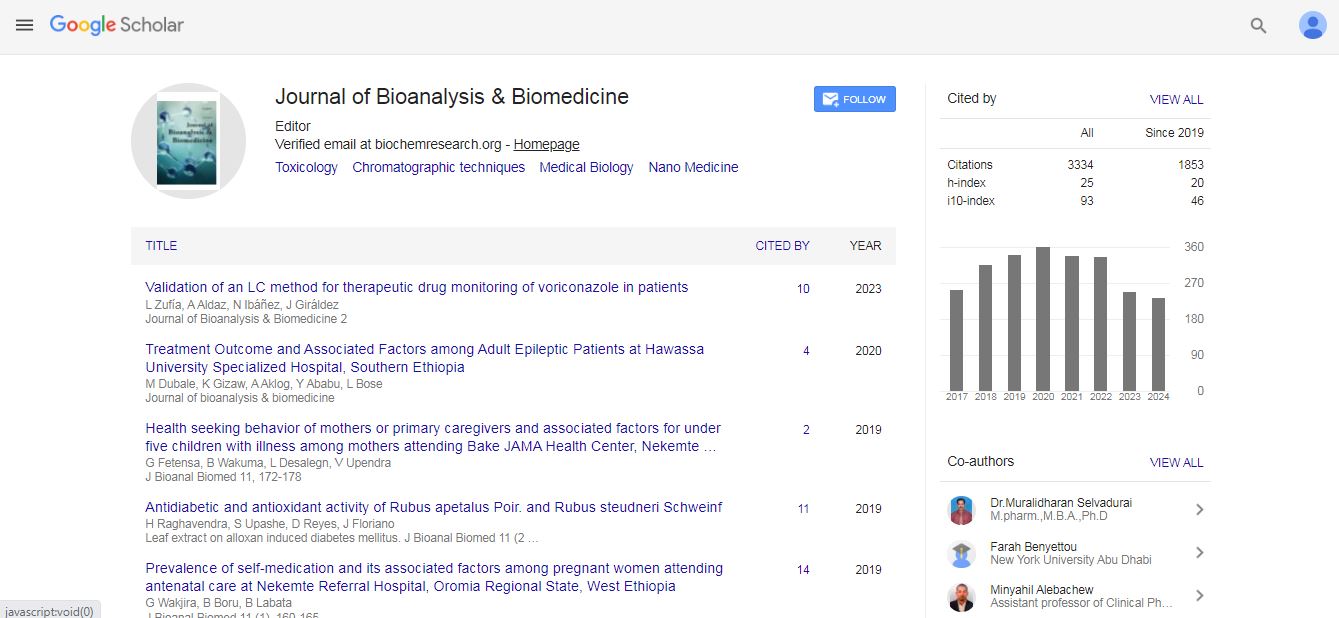
Journal of Bioanalysis & Biomedicine received 3099 citations as per Google Scholar report