Opinion - (2025) Volume 15, Issue 5
Received: 02-Oct-2025, Manuscript No. jeat-26-188652;
Editor assigned: 06-Oct-2025, Pre QC No. P-188652;
Reviewed: 20-Oct-2025, QC No. Q-188652;
Revised: 23-Oct-2025, Manuscript No. R-188652;
Published:
30-Oct-2025
, DOI: 10.37421/2161-0525.2025.15.872
Citation: Hansen, Erik. ”Advanced Analytical Techniques for
Environmental Pollutant Detection.” J Environ Anal Toxicol 15 (2025):872.
Copyright: © 2025 Hansen E. This is an open-access article distributed under the terms of the Creative Commons Attribution License, which permits unrestricted use,
distribution and reproduction in any medium, provided the original author and source are credited.
The imperative for precise and sensitive analytical methodologies in environmental science has never been more pronounced, driven by the escalating concerns surrounding toxic organic pollutants and their pervasive presence across diverse environmental matrices. Advanced analytical techniques, particularly those leveraging mass spectrometry, have become indispensable tools for identifying and quantifying these substances at trace levels, thereby safeguarding public health and ecological integrity. These sophisticated methods are instrumental in detecting a wide array of contaminants, from established threats like persistent organic pollutants (POPs) to emerging concerns such as pharmaceuticals and personal care products (PPCPs), underscoring the critical role of analytical chemistry in environmental monitoring and risk assessment [1].
Polycyclic aromatic hydrocarbons (PAHs), widely recognized for their carcinogenic properties and association with combustion processes, represent another significant class of environmental pollutants. Their detection and quantification in environmental samples like air and water necessitate highly sensitive analytical approaches capable of overcoming matrix interferences. Hyphenated techniques, such as gas chromatography-mass spectrometry/mass spectrometry (GC-MS/MS) and liquid chromatography-mass spectrometry/mass spectrometry (LC-MS/MS), have proven exceptionally effective in achieving the low limits of detection required for comprehensive PAH monitoring and long-term environmental assessment [2].
Agricultural practices, while essential for food production, can introduce pesticides and their transformation products into the environment, posing potential risks to soil and water quality. The comprehensive analysis of these contaminants requires advanced extraction techniques coupled with highly selective detection methods. Liquid chromatography-tandem mass spectrometry (LC-MS/MS) has emerged as a powerful tool for generating detailed analytical profiles of both parent pesticide compounds and their metabolites, enabling a thorough understanding of their environmental fate and potential ecological impacts [3].
Endocrine-disrupting chemicals (EDCs) represent a growing environmental concern due to their potential to interfere with hormonal systems in wildlife and humans. Their presence in wastewater, a significant pathway for environmental dissemination, necessitates the development of efficient analytical methods for their monitoring. Solid-phase extraction (SPE) combined with gas chromatography-mass spectrometry (GC-MS) offers an effective approach for the isolation and detection of various EDCs in complex matrices, aiding in the assessment of wastewater treatment efficacy [4].
The pervasive issue of microplastic pollution in marine environments is further complicated by the ability of these particles to adsorb and transport organic pollutants. A comprehensive understanding of this phenomenon requires analytical strategies that can simultaneously identify and quantify both microplastic particles and the associated contaminants. Advanced spectroscopic techniques, such as Fourier-transform infrared (FTIR) and Raman spectroscopy, when integrated with chromatographic methods like GC-MS and LC-MS/MS, provide a powerful means to unravel the complex interactions between microplastics and adsorbed organic pollutants in aquatic ecosystems [5].
Per- and polyfluoroalkyl substances (PFAS), a class of chemicals characterized by their persistence in the environment and potential health effects, are increasingly found in drinking water sources. The analytical determination of these compounds poses significant challenges due to their diverse chemical structures and low concentrations. Evaluating various SPE methods and LC-MS/MS configurations is crucial for developing robust analytical protocols that ensure high sensitivity and specificity in detecting the wide range of PFAS present in water resources, addressing a growing global concern [6].
Indoor environments can serve as significant reservoirs for various pollutants, including flame retardants, which are often incorporated into consumer products. Brominated flame retardants (BFRs), in particular, have garnered attention due to their persistence and potential health risks. Gas chromatography-tandem mass spectrometry (GC-MS/MS) offers an efficient and sensitive method for analyzing these compounds in complex matrices such as indoor dust, highlighting its importance as a pathway for human exposure to persistent pollutants [7].
The simultaneous analysis of a broad spectrum of airborne pollutants, including volatile organic compounds (VOCs) and semi-volatile organic compounds (SVOCs), presents a significant analytical challenge. Innovative methods that combine techniques like headspace solid-phase microextraction (HS-SPME) with GC-MS/MS have been developed to address this need. Such approaches provide a robust and efficient means for comprehensive environmental monitoring of air quality, capturing a wide range of atmospheric contaminants [8].
Ensuring the safety of the global food supply necessitates vigilant monitoring for mycotoxins, toxic secondary metabolites produced by fungi, which can contaminate food and feed. While enzyme-linked immunosorbent assay (ELISA) offers rapid screening capabilities, definitive identification and quantification often require more advanced techniques. The integration of ELISA with LC-MS/MS provides a powerful, complementary approach, enabling both rapid screening and accurate confirmation of trace mycotoxin levels, thereby enhancing food safety protocols [9].
Pharmaceutical residues in wastewater and surface waters represent an emerging environmental concern due to their potential ecotoxicological effects. The accurate and sensitive determination of these compounds in complex water matrices requires sophisticated analytical tools. Advancements in sample preparation techniques, such as advanced SPE, combined with high-resolution mass spectrometry (HRMS), are critical for accurately quantifying a wide array of drug contaminants, informing strategies for their effective environmental management [10].
The field of environmental analytical chemistry is continually advancing to meet the challenge of detecting and quantifying a diverse array of organic pollutants present in various environmental matrices. This progress is largely driven by the development and refinement of sophisticated instrumental techniques. Specifically, advanced analytical strategies involving gas chromatography-mass spectrometry (GC-MS) and liquid chromatography-mass spectrometry/mass spectrometry (LC-MS/MS) have demonstrated remarkable advancements in sensitivity and selectivity. These methods are crucial for identifying and quantifying trace levels of contaminants such as persistent organic pollutants (POPs), as well as emerging contaminants like pharmaceuticals and personal care products (PPCPs) in environmental samples. The emphasis on rigorous sample preparation and method validation further ensures the reliability of data obtained, which is essential for effective environmental monitoring and for safeguarding public health and ecological systems [1].
Polycyclic aromatic hydrocarbons (PAHs) are ubiquitous environmental pollutants originating from incomplete combustion processes, and their carcinogenic nature makes their monitoring a priority. The analysis of PAHs in air and water samples demands highly sensitive analytical methods capable of distinguishing target analytes from complex matrix components. Hyphenated techniques, particularly GC-MS/MS and LC-MS/MS, offer significant advantages by providing enhanced selectivity and reduced detection limits. These powerful tools are instrumental in overcoming matrix interferences and are vital for the long-term monitoring of PAHs, which are widely distributed environmental contaminants with known health risks [2].
Pesticides and their associated transformation products are a significant concern in agricultural environments, potentially impacting soil and water quality. The comprehensive assessment of these contaminants requires sophisticated analytical approaches that can capture a wide range of target compounds. Advanced extraction techniques, when coupled with LC-MS/MS, provide a detailed analytical profile of pesticides and their metabolites in agricultural soils and water bodies. This approach is essential for understanding the environmental fate of these chemicals and for accurately evaluating their potential risks to ecosystems and human health [3].
Endocrine-disrupting chemicals (EDCs) are a class of environmental contaminants that can interfere with hormonal systems, posing risks to both wildlife and human health. Wastewater is a primary pathway for the dissemination of EDCs into the environment. The development of innovative analytical methods for their simultaneous determination in wastewater is therefore critical. A common strategy involves the application of solid-phase extraction (SPE) for sample enrichment, followed by GC-MS analysis, enabling the efficient isolation and detection of various EDCs and facilitating the assessment of wastewater treatment plant performance in removing these harmful substances [4].
The presence of microplastics in marine environments poses a significant threat to aquatic ecosystems, and these particles can also act as vectors for organic pollutants. Analyzing both microplastics and adsorbed contaminants requires a multimodal approach. Spectroscopic techniques like FTIR and Raman spectroscopy are valuable for identifying plastic particles, while GC-MS and LC-MS/MS are employed for the identification and quantification of adsorbed organic pollutants. This combined approach is essential for a comprehensive understanding of the complex interactions between microplastics and pollutants in marine sediments and other aquatic environments [5].
Per- and polyfluoroalkyl substances (PFAS) are a group of synthetic chemicals that are persistent in the environment and have raised considerable concern regarding their potential health effects. Their presence in drinking water sources necessitates the development of sensitive and specific analytical methods. Evaluating the performance of different SPE techniques in conjunction with various LC-MS/MS configurations is crucial for achieving high sensitivity and specificity in the detection of a broad spectrum of PFAS. This research is vital for establishing robust analytical protocols to address the growing problem of PFAS contamination in water resources [6].
Indoor dust can accumulate various persistent pollutants, including flame retardants, which may pose risks to human health through inhalation and ingestion. Brominated flame retardants (BFRs) are a particular focus due to their widespread use and persistence. Gas chromatography-tandem mass spectrometry (GC-MS/MS) is a highly effective technique for the sensitive and efficient analysis of BFRs in complex matrices like indoor dust. This method is crucial for understanding the pathways of human exposure to these persistent pollutants within indoor environments [7].
The accurate analysis of volatile organic compounds (VOCs) and semi-volatile organic compounds (SVOCs) in ambient air is essential for air quality monitoring. Capturing and analyzing these diverse compounds can be challenging. A novel approach involving headspace solid-phase microextraction (HS-SPME) coupled with GC-MS/MS has been developed to achieve simultaneous analysis of both VOCs and SVOCs. This method offers a robust and efficient strategy for comprehensively assessing the composition of airborne pollutants in environmental samples [8].
Mycotoxins, toxic metabolites produced by fungi, can contaminate food and feed products, posing significant risks to public health. While enzyme-linked immunosorbent assay (ELISA) is useful for rapid screening, definitive confirmation and quantification of mycotoxins at trace levels require more advanced techniques. An integrated approach combining ELISA for initial screening with LC-MS/MS for confirmation and quantification provides a powerful solution. This dual-technique strategy is crucial for ensuring food safety against a wide range of toxic fungal metabolites [9].
Pharmaceutical residues in wastewater and surface waters are a growing environmental concern due to their potential adverse effects on aquatic ecosystems. The analytical determination of these compounds in complex water matrices requires high sensitivity and specificity. Advancements in sample preparation, including various SPE techniques, coupled with high-resolution mass spectrometry (HRMS), are crucial for accurately identifying and quantifying a broad range of pharmaceutical contaminants. This research is vital for understanding the environmental impact of pharmaceuticals and for developing effective management strategies [10].
This collection of research highlights the critical role of advanced analytical techniques in environmental science. Studies focus on the sensitive detection and quantification of various organic pollutants, including persistent organic pollutants (POPs), polycyclic aromatic hydrocarbons (PAHs), pesticides, endocrine-disrupting chemicals (EDCs), microplastics with adsorbed pollutants, per- and polyfluoroalkyl substances (PFAS), brominated flame retardants (BFRs), volatile and semi-volatile organic compounds (VOCs/SVOCs), and pharmaceutical residues. Techniques such as gas chromatography-mass spectrometry (GC-MS) and liquid chromatography-mass spectrometry/mass spectrometry (LC-MS/MS) are frequently employed due to their high sensitivity and selectivity. The research emphasizes the importance of robust sample preparation methods, method validation, and the application of these techniques to real-world environmental matrices like water, air, soil, and indoor dust to ensure public health and ecological safety. Integrated approaches, combining screening methods with definitive analytical techniques, are also showcased for efficient contaminant assessment.
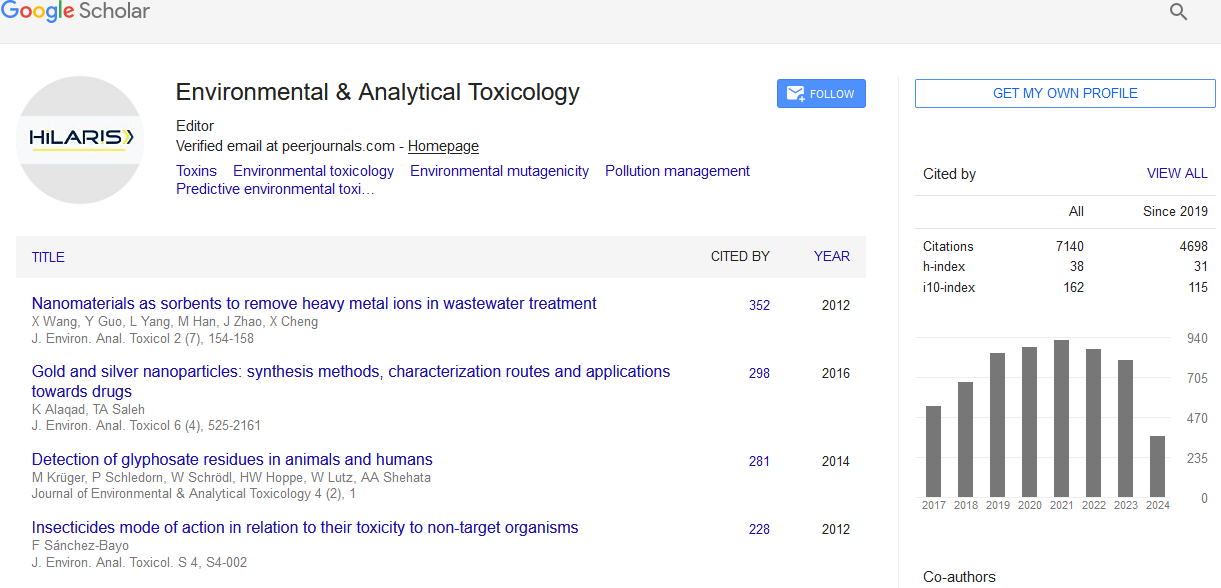
Environmental & Analytical Toxicology received 6818 citations as per Google Scholar report