Opinion - (2025) Volume 15, Issue 3
Received: 02-Jun-2025, Manuscript No. jeat-26-188630;
Editor assigned: 04-Jun-2025, Pre QC No. P-188630;
Reviewed: 18-Jun-2025, QC No. Q-188630;
Revised: 23-Jun-2025, Manuscript No. R-188630;
Published:
30-Jun-2025
, DOI: 10.37421/2161-0525.2025.15.851
Citation: Brown, Olivia. ”Advanced Analytical Methods for Harmful
Algal Toxin Detection.” J Environ Anal Toxicol 15 (2025):851.
Copyright: © 2025 Brown O. This is an open-access article distributed under the terms of the Creative Commons Attribution License, which permits unrestricted use, distribution
and reproduction in any medium, provided the original author and source are credited.
The detection of toxins produced by harmful algal blooms (HABs) is a matter of significant importance for both environmental preservation and public health. Advanced analytical techniques are being developed and refined to meet this challenge, offering improved sensitivity and specificity. Among these, mass spectrometry-based methods, such as liquid chromatography coupled with tandem mass spectrometry (LC-MS/MS) and gas chromatography-mass spectrometry (GC-MS), have emerged as powerful tools for identifying and quantifying potent algal metabolites like microcystins and saxitoxins. The ongoing development of these methods aims to address the complexities of real-time monitoring of HAB events and the identification of novel toxin variants [1].
Liquid chromatography coupled with high-resolution mass spectrometry (LC-HRMS) has shown particular promise for the simultaneous determination of a wide array of cyanotoxins, including microcystins and nodularins. The capabilities of HRMS are crucial for accurate toxin identification and structural elucidation, which is vital for understanding the diversity of existing and emerging toxin structures. Method validation is a critical component of this work, ensuring reliability and compliance with regulatory standards [2].
For rapid and cost-effective screening, the development of field-deployable methods is essential. Enzyme-linked immunosorbent assays (ELISA) for microcystin detection offer such a solution, providing an early warning system for HABs. These assays are designed to be sensitive and specific, making them suitable for widespread use in environmental monitoring programs and complementing more sophisticated laboratory analyses [3].
Saxitoxins, a group of potent neurotoxins responsible for paralytic shellfish poisoning, present their own set of analytical challenges. Reviewing various chromatographic (HPLC) and mass spectrometric (LC-MS/MS) approaches highlights their utility in identifying and quantifying these complex molecules in diverse matrices, including shellfish and water. Ensuring comparability between methods and conducting inter-laboratory studies are key to advancing saxitoxin analysis [4].
Gas chromatography-mass spectrometry (GC-MS) is another valuable technique for the detection of specific algal toxins, such as anatoxin-a, particularly in freshwater samples. Validated GC-MS methods can offer good sensitivity and selectivity for these neurotoxins, contributing to the robust risk management strategies needed for cyanobacterial blooms impacting drinking water sources [5].
Routine monitoring of microcystins in water bodies necessitates a critical evaluation of various analytical techniques. Comparing the performance of ELISA, HPLC with UV detection, and LC-MS/MS based on sensitivity, specificity, cost, and ease of implementation provides valuable guidance for selecting the most appropriate methods based on specific monitoring objectives and available resources [6].
Innovative biosensor approaches are emerging as rapid detection tools. Electrochemical biosensors, for instance, utilizing specific antibodies for microcystin-LR detection, demonstrate high sensitivity and swift response times. These technologies hold significant potential for in-situ environmental monitoring and can serve as a valuable complement to traditional analytical methods for early HAB warning systems [7].
Analyzing emerging algal toxins, such as cylindrospermopsin and domoic acid, poses distinct challenges. The evolution of analytical methodologies, with a strong emphasis on LC-MS/MS, is critical for detecting and quantifying these less commonly monitored toxins. Comprehensive toxin profiling is essential for accurate risk assessment in aquatic ecosystems [8].
Efficient sample preparation is paramount for accurate quantification of algal toxins. Methods like solid-phase extraction (SPE) coupled with LC-MS/MS have been developed to enhance sample cleanup and analyte enrichment, leading to improved detection limits for the simultaneous analysis of multiple cyanotoxins in complex water matrices [9].
Phycotoxin detection in marine environments, particularly in shellfish, requires a range of analytical techniques. Both targeted and non-targeted approaches, including advanced LC-MS/MS methods, are employed for identifying known and unknown toxin congeners. A multi-toxin approach is crucial for a comprehensive risk assessment strategy [10].
The detection of toxins produced by harmful algal blooms (HABs) is a critical concern for environmental health and public safety. Modern analytical chemistry offers a suite of advanced techniques to address this challenge, with mass spectrometry-based methods leading the way. Specifically, LC-MS/MS and GC-MS provide high sensitivity and specificity for identifying and quantifying a range of potent algal toxins, including microcystins and saxitoxins. The continuous evolution of these analytical platforms aims to improve real-time monitoring capabilities for HAB events and the characterization of novel algal metabolites [1].
Liquid chromatography coupled with high-resolution mass spectrometry (LC-HRMS) stands out for its ability to simultaneously determine a broad spectrum of cyanotoxins, such as microcystins and nodularins. The high resolution offered by HRMS is indispensable for precise toxin identification and detailed structural analysis, which aids in the discovery and understanding of new toxin variants. Rigorous method validation is a cornerstone of this research, ensuring the reliability and regulatory acceptance of the analytical data generated [2].
To facilitate early detection and rapid response to HABs, the development of field-deployable analytical tools is crucial. Enzyme-linked immunosorbent assays (ELISA) for microcystin detection offer a cost-effective and efficient screening solution. These assays are designed for high sensitivity and specificity, making them well-suited for integration into broad environmental monitoring programs and as a complementary tool to laboratory-based analyses [3].
Saxitoxins, a class of potent neurotoxins linked to paralytic shellfish poisoning, present unique analytical hurdles. The review of various chromatographic techniques, such as HPLC, and mass spectrometric methods, like LC-MS/MS, underscores their effectiveness in identifying and quantifying these complex molecules in diverse sample types, including shellfish and water. The comparability of analytical methods and the execution of inter-laboratory studies are vital for advancing the field of saxitoxin analysis [4].
Gas chromatography-mass spectrometry (GC-MS) is a significant technique for the targeted detection of specific algal toxins, such as anatoxin-a, in aquatic environments. The implementation of validated GC-MS protocols ensures good sensitivity and selectivity for these neurotoxins, which is essential for developing robust risk management strategies concerning cyanobacterial blooms affecting drinking water supplies [5].
The routine surveillance of microcystins in water bodies necessitates a thorough evaluation of available analytical methodologies. A comparative analysis of ELISA, HPLC with UV detection, and LC-MS/MS examines their respective strengths and weaknesses in terms of sensitivity, specificity, economic feasibility, and ease of use. This comparison provides practical guidance for selecting the most appropriate analytical approach based on specific monitoring goals and resource constraints [6].
Emerging technologies such as biosensors are revolutionizing rapid toxin detection. Electrochemical biosensors, employing specific antibodies for the detection of microcystin-LR, exhibit remarkable sensitivity and rapid response times, making them ideal for on-site environmental monitoring. These biosensing technologies complement traditional analytical methods by offering an immediate alert system for potential HAB events [7].
The analysis of emerging algal toxins, including cylindrospermopsin and domoic acid, introduces additional complexities. Analytical methods are continuously evolving, with LC-MS/MS being a key platform for detecting and quantifying these less frequently monitored toxins. Comprehensive toxin profiling is increasingly recognized as essential for effective risk assessment in aquatic ecosystems [8].
To ensure the accurate quantification of algal toxins in complex environmental matrices, efficient sample preparation techniques are indispensable. The integration of solid-phase extraction (SPE) with LC-MS/MS has proven effective for simultaneous analysis of multiple cyanotoxins, enhancing sample cleanup and analyte enrichment, thereby improving detection limits. This highlights the importance of optimized sample preparation protocols in toxin analysis [9].
Assessing phycotoxins in marine ecosystems, particularly within shellfish, requires a multifaceted analytical approach. This includes both targeted methods for known toxins and non-targeted strategies for identifying unknown compounds. Advanced LC-MS/MS techniques play a crucial role in the identification of a wide range of toxin congeners, emphasizing the need for a comprehensive, multi-toxin strategy for robust risk assessment [10].
This compilation of research addresses the critical need for accurate and efficient detection of harmful algal bloom (HAB) toxins. Advanced analytical techniques, primarily mass spectrometry-based methods like LC-MS/MS and GC-MS, are highlighted for their sensitivity and specificity in identifying and quantifying microcystins, saxitoxins, and other potent algal metabolites. The studies also explore emerging technologies such as LC-HRMS for simultaneous determination of diverse cyanotoxins, rapid ELISA kits for cost-effective screening, and electrochemical biosensors for in-situ monitoring. Challenges in analyzing emerging toxins and the importance of robust sample preparation methods like SPE are discussed. Overall, the research emphasizes the ongoing advancements and the necessity of selecting appropriate analytical strategies for comprehensive toxin profiling and effective risk assessment in aquatic environments.
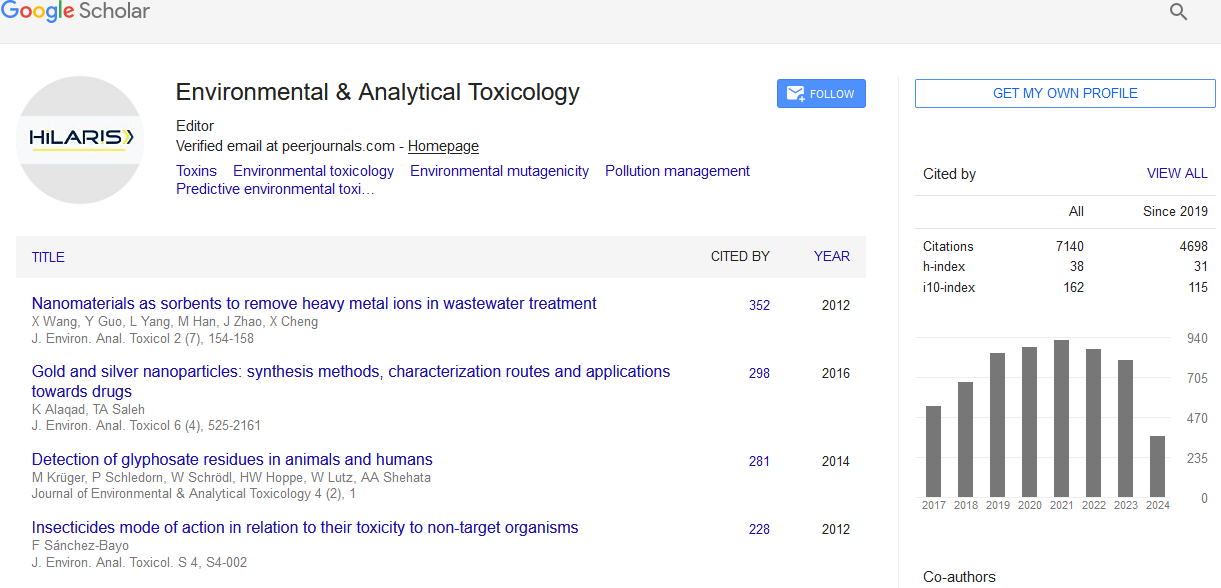
Environmental & Analytical Toxicology received 6818 citations as per Google Scholar report