Research Article - (2021) Volume 11, Issue 6
Received: 15-Apr-2021
Published:
06-May-2021
Citation: Egata, Desta Fikadu. "Morphological and
Biochemical Variability of Ethiopian Lippia adoensis Genotypes." Med Chem 11(2021):534.
Copyright: © 2021 Egata DF, et al. This is an open-access article distributed under the terms of the Creative Commons Attribution License, which permits unrestricted use, distribution, and reproduction in any medium, provided the
original author and source are credited.
Lippia adoensis Hochst is an herbaceous plant of the genus Lippia belongs to the family Verbenaceae, which is an erect woody shrub that grows up to 1 m-3 m tall. It is an indigenous plant, endemic medicinal plant, and cultivated commonly in home gardens in different regions of Ethiopia with an altitudinal range of 1600 m-3000 m. The experiment was aimed to determine the morphological and bio-chemical performance and variability of Ethiopian Lippia adoensis. The experiment was conducted at Wondo Genet in 2020 using twenty-four selected genotypes. Seedlings were raised in a nursery using top cutting and transplanted to the experimental site after three months of age. Transplanted seedlings were managed properly as required and data were collected from; morphological, biochemical and economical traits at blooming stage. Essential oil was extracted from leaf and inflorescence using hydro distillation in a Clevenger-type apparatus. All measured parameters were showed a very highly significant difference at a tested location. Plant height varies from 1.25 m to 2.15 m, branch number/plant varies from 140-345, leaf color is light and deep green, an essential oil is very variable, leaf yield/hectare varies from 2.89 tons-13.53 tons and total essential oil yield/hectare varies from 12.16 liter-95.02 liter. Generally, this experiment revealed that Ethiopian Lippia adoensis is variable in morphology, economic, and biochemical traits and the obtained result is comparable with different international reports. In the next research, all potential growing areas should be covered during collection, the experiment should be repeated using representative agroecology and essential oil composition should be tested.
Koseret • Variability • Leaf yield • Inflorescence • Essential oil yield
Lippia adoensis Hochst is an herbaceous plant of the genus Lippia belongs to the family Verbanaceae, it is an erect woody shrub grow up to 1 m-3 m tall [1]. Lippia adoensis mainly distributed throughout tropical Africa, South and Central American countries [2] and commonly known as lippia tea and commercially known as “Gambian Tea Bush” and “Healer Herb” [3]. It is the most commonly used herbal drugs in Ethiopian traditional medicine used in different forms either as powder, infusion or in the form of ointment for the treatment of various skin diseases including eczema, acne, scabies and superficial microbial infections [4]. The extracted essential oil or crude of this plant is known for its antimicrobial activities [5].
In Ethiopia Lippia adoensis is an indigenous plant and endemic medicinal plant and cultivated commonly in home gardens in different regions of Ethiopia with altitudinal range of 1600 m-3000 m altitude above sea level [6]. There are two recognized varieties in Ethiopia, the wild variety (Lippia adoensis var. adoensis) and the cultivated variety Lippia adoensis var. Koseret sebsebe, locally known as ‘koseret’ in Amharic, ‘Urgo or Kusaye’ in Afan Oromo [7]. This experiment was focused on the cultivated crop that grown on famers garden for its popular spice throughout the country and widely grown in the central and southern highlands of the country [1]. Traditionally, the dried leaves are used for preparation of spiced butter, used as food flavoring agent and food preservative [8]. In traditional medicine, leaves of Lippia adoensis are used for the treatment of various skin diseases including eczema and superficial fungal infections [4]. The crude or essential oil extracts of this plant are also shown to have antimicrobial activities that can be used for different treatment of different human and animal ailments [5]. Despite, Lippia adoensis is an indigenous plant with an enormous advantage for local farmers as well as for the country economy as import substitution and export promotion, there is limitation of information due to lack of research activities and absence of known variety. The benefit of this crop is negligible and not considered as prioritized spice or aromatic plant due to lack of knowledge and experience. However, our country can be benefited from this crop of its multipurpose use; there is no enough information on the crop. This experiment was aimed to determine a morphological and bio-chemical performance or variability of Ethiopian Lippia adoensis that could help to reduce the information gap for cultivation and utilization of the crop in the country.
The experiment was conducted at Wondo Genet, southern Ethiopia in 2020 G.C. Wondo Genet is located at 7°192’ N latitude and 38°382’ E longitudes with an altitude of 1780 m.a.s.l. The site receives mean annual rainfall of 1000 mm with the respective minimum and maximum temperature of 10 and 30°C. The textural class of the soil is sandy clay loam with an average pH of 6.4 [9]. Lippia adoensis accessions were collected from southern and central part of Ethiopia where plant potentially grown by Ethiopian farmers and maintained in Wondo Genet Agricultural Research Center Botanical Garden for three years. Twenty-four accessions were selected based on their performance prior to the experiment and used for this particular experiment from the collection. Seedlings were raised in nursery using top cutting from selected matured and healthy mother plants and planted in plastic polyethylene bag. The raised seedlings well managed in seedling nursery for three months and transplanted to main experimental field at age of three months after planted in polyethylene bag for evaluation of the Ethiopian Lippia adoensis genotypes. 1 m spacing was used between plants and rows and treatments were arranged in Randomized Complete Block Design (RCBD) with three replications. Twenty-four treatments were arranged and assigned randomly within the block. A single plot area was 80 m2 having 8 m length and 10 m width. A spacing of 1.5 m and 2 m was maintained between plots and replications respectively. Each and every transplanted seedling of genotypes on the main experimental field, were managed properly and all necessary practices such as, weeding, hoeing and supplementary irrigations were undertaken as required for proper growth of the transplanted plant. Supplemental irrigation was applied when the rain was not enough as necessary and continues irrigation was given once per a week when rain fall was not existed at all. Data were collected from different traits such as; plant height, branch number, leaf length, leaf width, Fresh leaf weight/plant, fresh leaf yield/hectare, essential oil content and essential oil yield at blooming stage. The whole plant part had been cut using sharp cutter at 20 cm-25 cm height above the ground during harvesting. The harvested herb was distilled for the production of essential oil using hydro distillation in a Clevenger type apparatus according to Gunter [10]. The collected data were subjected to Analysis of Variance (ANOVA) using SAS version 9.4 [11] statistical software packages. Means were separated using the Least Significant Difference (LSD) procedure at the 5% and 1% level of significant.
The experiment revealed that all measured parameters such as; plant height, leaf length, leaf width, branch number, inflorescence yield, leaf yield, inflorescence and leaf essential oil content and leaf and inflorescence essential oil yield/hectare, total essential oil yield were showed very highly significant difference at tested Wondo genet location (Table 1). Where: -PH (Plant Height), LL (Leaf Length), LW (Leaf Width), BNP (Branch Number Plant), FLWP (Fresh Leaf Weight/Plant), FIWP (Fresh Inflorescence Weight/Plant) FLYH (Fresh Leaf Yield/Hectare), FIYH (Fresh Inflorescence Yield/Hectare), LEOC (Leaf Essential Oil Content), IEOC (Inflorescence Essential Oil Content).
| SV | DF | PH | LL | LW | BNP | FLWP | FIWP | FLYH | FIYH | LEOC | IEOC | LEOYH | IEOYH | |
|---|---|---|---|---|---|---|---|---|---|---|---|---|---|---|
| TRT | 23 | 1591.43 | 4.01 | 0.7 | 9162.22 | 191527.9 | 44678.1 | 19152888 | 4467786.3 | 0.08 | 0.09 | 737.7 | 84.3 | |
| REP | 2 | 11.24 | 0.3 | 0.03 | 10389.4 | 8793.05 | 22381.1 | 879313.8 | 2238199.3 | 0.00 | 0.00 | 0.00 | 0.00 | |
| ERROR | 181.98 | 0.2 | 0.05 | 1383.68 | 20234.27 | 3373.53 | 2023437.2 | 337352.1 | 0.00 | 0.00 | 0.02 | 0.00 | ||
| R2 | 81 | 90.94 | 88 | 78 | 83 | 87 | 75 | 87 | 100 | 100 | 100 | 100 | ||
| CV | 7.72 | 5.95 | 8.38 | 16.52 | 20.21 | 20.04 | 20.21 | 20.04 | 2.83 | 4.03 | 0.08 | 0.14 | ||
| Mean | 174.63 | 7.53 | 2.61 | 225.18 | 703.83 | 289.89 | 7038.28 | 2898.92 | 0.33 | 0.26 | 22.86 | 7.01 |
Table 1: Analysis of variance of ethiopian Lippia adoensis morphological and biochemical variability tested at Wondo Genet in 2020.
Morphological measured traits of Ethiopian Lippia adoensis genotypes
Plant height : Tested genotypes plant height difference ranged from 1.25 m to 2.15 m (Table 2). The maximum or the longest plant height obtained from genotype GESK-2 and the minimum plant height or the shortest genotype is AAKK-40. This result comparable and in the range of different research reports but relatively the plant height is shorter when compared with result reported by Gemechu and his colleagues, 2015 this is may be the crop did not get the suitable environment.
| Genotype | PH | LL | LW | BNP |
|---|---|---|---|---|
| GESK-1 | 125.00 | 7.53 | 2.60 | 296.67 |
| GEKK-2 | 215.45 | 7.67 | 2.30 | 157.78 |
| GCSK-3 | 191.56 | 8.54 | 3.14 | 216.45 |
| GCGK-4 | 186.56 | 8.84 | 2.78 | 143.56 |
| GGJK-5 | 198.22 | 7.76 | 3.27 | 230.67 |
| GGYK-6 | 212.78 | 9.18 | 3.35 | 226.89 |
| GGFK-8 | 166.22 | 7.76 | 3.25 | 181.56 |
| GGIK-9 | 141.50 | 7.92 | 2.77 | 154.78 |
| HLTK-16 | 169.67 | 5.90 | 2.41 | 139.67 |
| SWAK-17 | 172.11 | 8.06 | 3.42 | 236.00 |
| SSGK-18 | 180.11 | 6.96 | 2.29 | 222.11 |
| KDTK-19 | 183.22 | 7.03 | 2.17 | 247.00 |
| KDGK-20 | 166.95 | 6.30 | 2.35 | 188.08 |
| KABK-22 | 167.22 | 5.62 | 1.67 | 206.22 |
| KDAK-24 | 137.11 | 7.48 | 2.32 | 345.33 |
| WHSK-25 | 157.22 | 8.92 | 2.93 | 276.4 |
| WSKK-26 | 165.22 | 8.87 | 3.10 | 232.89 |
| HMBK-28 | 184.78 | 6.99 | 1.98 | 271.67 |
| SSMK-29 | 191.00 | 7.12 | 2.34 | 285.33 |
| STCK-31 | 176.67 | 7.98 | 2.75 | 292.56 |
| SWAK-32 | 211.89 | 8.82 | 2.67 | 188.89 |
| SAHK-33 | 175.78 | 8.58 | 2.66 | 293.67 |
| AKGK-37 | 153.11 | 5.86 | 2.01 | 283.22 |
| AAKK-40 | 162.22 | 5.01 | 2.07 | 167.00 |
| LSD | 22.17 | 0.74 | 0.36 | 61.14 |
Table 2: Mean comparison of Lippia adoensis genotypes measured morphological traits tested at Wondo Genet in 2020 .
Branch number: Ethiopian Lippia adoensis have numerous branches and have erect runner or softy stem branching character. The maximum branch number/plant obtained from genotype KDAK-24 (345) and minimum branch number/plant was obtained from genotype HLTK-16 (140) (Table 2).
Leaf length and leaf width: This experiment result revealed that Ethiopian Lippia adoensis leaf size such as leaf length and leaf width is variable. The longest leaf length including leaf petiole obtained from genotype GGFK5 (9.18 cm) and the shortest leaf length obtained from genotype AAKK-40 (5.01 cm) long and leaf width also vary from 3.42 cm to 1.67 cm obtained from genotype SWAK-17 and KABT22 respectively (Table 2).
Where: -PH (Plant Height), LL (Leaf Length), LW (Leaf Width), BNP (Branch Number/Plant).
Leaf color: Leaf color was observed as deep and light green during the experimentation and flower color is pink and some other has white color flower (Figure 1).
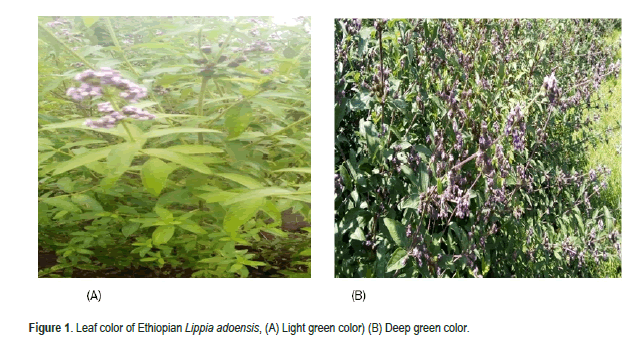
Figure 1: Leaf color of Ethiopian Lippia adoensis, (A) Light green color) (B) Deep green color.
Essential oil color: In this experimented, tested genotype showed variable essential oil color with different color such as most identified oil color are light golden, deep golden, deep yellow, light yellow, colorless or watery, light gray, deep gray and (Figure 2).
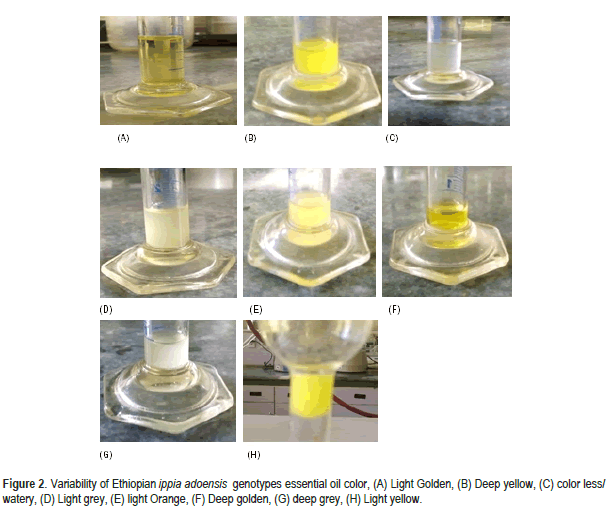
Figure 2: Variability of Ethiopian lippia adoensis genotypes essential oil color, (A) Light Golden, (B) Deep yellow, (C) color less/ watery, (D) Light grey, (E) light Orange, (F) Deep golden, (G) deep grey, (H) Light yellow.
Economical measured traits of Ethiopia Lippia adoensis genotypes
L. adoensis is medicinal and Aromatic plant mainly used for medicinal value and as a spice plant in Ethiopia. The main economical parts are leaf and inflorescence from which essential oil could extract. Economically, leaf, inflorescence and essential oil yield is very important product in the production of Lippia adoensis.
Fresh leaf weight/plant and fresh leaf yield/ hectare
This plant part is the most important part of Lippia aodoensis that utilized for different purposed and manly used for essential oil extraction. Maximum leaf weight/plant and yield/hectare was obtained from KDAK-24 (1.35 kg) and (13.53 tons) respectively and minimum leaf weight/plant and leaf yield/hectare obtained from genotype AAKK-40 (2.89 kg) and (2.89 tons) respectively (Table 3). The obtained difference could come from genotype difference and location difference where the planted collected. These genotypes collected from different location with different altitude range from 1793 m to 2895 m above sea level.
| Genotype | FLWP | FIWP | FLYH | FIYH | LEOYH | IEOYH | TEOYH |
|---|---|---|---|---|---|---|---|
| GESK-1 | 840.05 | 329.08 | 8400.48 | 3290.85 | 36.08 | 4.98 | |
| GEKK-2 | 622.05 | 231.59 | 6220.51 | 2315.89 | 9.41 | 3.32 | 12.73 |
| GCSK-3 | 869.25 | 390.63 | 8692.55 | 3906.31 | 3.63 | 5.82 | 19.45 |
| GCGK-4 | 551.90 | 465.96 | 5519.00 | 4659.61 | 9.58 | 6.55 | 16.14 |
| GGJK-5 | 809.89 | 354.44 | 8098.94 | 3544.39 | 12.47 | 4.98 | 17.46 |
| GGYK-6 | 851.91 | 321.42 | 8519.15 | 2214.22 | 35.74 | 4.78 | 40.58 |
| GGFK-8 | 834.16 | 223.46 | 834.60 | 2234.55 | 36.24 | 3.48 | 39.72 |
| GGIK-9 | 766.95 | 126.56 | 7669.55 | 1255.63 | 32.43 | 1.91 | 34.33 |
| HLTK-16 | 384.77 | 249.58 | 3847.68 | 2495.76 | 16.16 | 9.83 | 25.99 |
| SWAk-17 | 672.28 | 250.58 | 6722.77 | 2505.79 | 35.74 | 3.67 | 39.43 |
| SSGK-18 | 609.52 | 231.32 | 695.18 | 2313.19 | 24.48 | 9.76 | 30.24 |
| KDTK-19 | 714.16 | 275.31 | 7141.64 | 2753.12 | 24.00 | 4.11 | 28.10 |
| KDGK-20 | 695.26 | 621.78 | 6952.58 | 6217.80 | 10.50 | 8.08 | 18.59 |
| KABK-22 | 369.56 | 419.19 | 3695.58 | 4191.91 | 5.59 | 8.26 | 13.84 |
| KDAK-24 | 1352.90 | 269.27 | 13529.00 | 2692.71 | 81.05 | 13.98 | 95.12 |
| WHSK-25 | 1234.82 | 164.28 | 12348.00 | 1642.81 | 19.02 | 2.50 | 21.51 |
| WSKK-26 | 855.71 | 238.33 | 8557.08 | 2383.30 | 29.26 | 6.71 | 36.65 |
| HMBK-28 | 490.01 | 400.25 | 4900.09 | 4002.49 | 15.09 | 26.48 | 45.55 |
| SSMK-29 | 881.51 | 305.70 | 6815.08 | 3057.03 | 20.09 | 12.04 | 33.03 |
| STCK-31 | 614.35 | 314.01 | 6143.48 | 3140.06 | 7.74 | 4.42 | 21.16 |
| SWAK-32 | 853.37 | 304.50 | 8533.73 | 3039.99 | 19.12 | 3.85 | 22.96 |
| SAHK-33 | 676.26 | 51.47 | 5762.60 | 514.71 | 22.11 | 1.22 | |
| AKGK-37 | 352.59 | 320.85 | 3525.85 | 3208.60 | 15.11 | 11.28 | 26.39 |
| AAKK-40 | 288.64 | 99.34 | 2886.37 | 993.38 | 20.29 | 6.31 | 26.60 |
| LSD ≥ 0.05 | 233.79 | 95.46 | 2337.90 | 954.59 | 0.03 | 0.02 | 0.01 |
Table 3: Mean comparison of Ethiopian Lippia adoensis genotypes measured economical traits tested at Wondo Genet in 2020.
Inflorescence leaf weight/plant and fresh inflorescence yield/hectare
Inflorescence is also another economical part of Lippia adoensis used for different purpose mixed with leaf and essential oil can be extracted from it. This experiment revealed that Ethiopian Lippia adoensis tested genotypes showed high value different which is very significant. Maximum inflorescence weigh/plant and yield/hectare value was obtained from Genotype KDGK-20 which was (621.78 kg) and (6.22 tons) respectively and the minimum inflorescence weight/plant and inflorescence yield/hectare value was obtained from genotype SAHK-33 which was 51.47 g and 0.52 ton respectively (Table 3).
Leaf essential oil yield/hectare
Leaf essential oil is essential oil that extracted from leaf part of Lippia adoensis. The experiment revealed that an essential oil of Ethiopian Lippia adoensis genotypes is highly variable and the value was varied from 5.59 liter-81.05 liter. The maximum leaf essential oil was obtained from genotype KDAK-24 and minimum leaf essential oil genotype KABK-22 (Table 3). The maximum leaf essential oil was obtained from KDAK-24 due to its; high branch number, high leaf yield and higher essential oil content directly or indirectly affect essential oil yield.
Inflorescence essential oil yield/hectare
Inflorescence essential oil is essential oil that extracted from inflorescence part of Lippia adoensis. The experiment revealed that an essential oil of Ethiopian Lippia adoensis genotypes is highly variable and the value was varied from 1.22-26.46 liter. The maximum leaf essential oil was obtained from genotype HMBK-28 and minimum leaf essential oil genotype SHAK-33 (Table 3). The maximum inflorescence essential oil was obtained from HMBK-28 due to its; medium inflorescence yield and higher inflorescence essential oil content.
Total essential oil yield/hectare
Total essential oil of Lippia adoensis is sum of lessential oil extracted from leaf and inflorescence. Total essential oil yield is essential oil yield that extracted from both leaf and inflorescence part of Lippia adoensis. The experiment revealed that an essential oil of Ethiopian Lippia adoensis genotypes is highly variable and the value was varied from 12.16 liter-95.02 liter. The maximum Total essential oil yield was obtained from genotype KDAK-24 and minimum leaf essential oil genotype STCK-31 (Table 3). All economical traits are significantly different; this is due to genotypes different because the y collected from different agroecology of the country. The range is too wide for different genotypes this is may be all collected accessions grown at the same location that may be not suitable for other. To know the real potential of the collected genotype it should be grown in suitable agroecology.
Biochemical traits
Traits considered as biochemical traits are leaf essential oil content and inflorescence content.
Leaf essential oil content
Ethiopian Lippia adoensis leaf essential oil content varied from 0.13%- 0.71%. Maximum and minimum leaf essential oil content obtained from genotype AAKK-40 and STCK-31 respectively.
Inflorescence essential oil content
Ethiopian Lippia adoensis inflorescence essential oil content similar to leaf essential oil content varied from 0.13%-0.71%. Maximum and minimum leaf essential oil content obtained from genotype AAKK-40 and SWAK-31 respectively (Table 4).
| Genotype | LEOC (%) | IEOC (%) |
|---|---|---|
| GESK-1 | 0.43 | 0.15 |
| GEKK-2 | 0.60 | 0.14 |
| GCSK-3 | 0.16 | 0.14 |
| GCGK-4 | 0.18 | 0.14 |
| GGJK-5 | 0.16 | 0.14 |
| GGYK-6 | 0.43 | 0.15 |
| GGFK-8 | 0.45 | 0.16 |
| GGIK-9 | 0.43 | 0.15 |
| HLTK-16 | 0.43 | 0.39 |
| SWAk-17 | 0.54 | 0.15 |
| SSGK-18 | 0.35 | 0.42 |
| KDTK-19 | 0.35 | 0.15 |
| KDGK-20 | 0.16 | 0.14 |
| KABK-22 | 0.16 | 0.20 |
| KDAK-24 | 0.60 | |
| WHSK-25 | 0.16 | 0.16 |
| WSKK-26 | 0.36 | 0.28 |
| HMBK-28 | 0.31 | 0.66 |
| SSMK-29 | 0.31 | 0.39 |
| STCK-31 | 0.13 | 0.14 |
| SWAK-32 | 0.23 | 0.13 |
| SAHK-33 | 0.39 | 0.22 |
| AKGK-37 | 0.44 | 0.35 |
| AAKK-40 | 0.71 | 0.71 |
| LSD ≥ 0.05 | 0.02 | 0.02 |
Table 4: Mean comparison of Ethiopian Lippia adoensis genotypes measured biochemical traits tested at Wondo Genet in 2020.
Where: FLWP (Fresh Leaf Weight/Plant), FIWP (Fresh Inflorescence Wight/Plant), FLYH (Fresh Leaf Yield/Hectare), FIYH (Fresh Inflorescence Yield/Hectare), LEOYH (Leaf Essential Oil Yield/Hectare), IEOYH (Inflorescence Essential Oil Yield/Hectare), TEOYH (Total Essential Oil Yield/Hectare).
Where: LEOC (Leaf Essential Oil Content), IEOC (Inflorescence Essential Oil Content).
In this experiment, I conclude that Ethiopian Lippia adoensis collected from different parts of the country is highly variable in their morphological, economical and biochemical measured traits. Depending on the finding, my conclusion is that Ethiopian Lippia adoensis genotype distributed throughout the country is different because of agroecological and genotypes difference. This experiment can give initial clues for breeders to work on the genotype improvement in breeding program. My experiment, even though tried all my bests have short coming such as; the collection of the genotypes was not covered all potential growing, the experiment done using one location that is unable to express the potential of genotype and essential oil quality was not tested. Because of aforementioned truth, in the next experiments all potential growing area should be covered, all collected genotypes should be tested using representative agroecology and essential oil composition or essential oil quality should be tested.
I like to acknowledge Wondo Genet Agricultural Research Center for the different field and laboratory facilities support during implementation of the activity. We are also grateful to Medicinal and Aromatic, Plants Research Program for providing all the necessary funds for executing the entire experimentation. Our acknowledgement also goes to Mr. Abera Waritu, Ms. Jemanes Elias, Mr. Abdela Befa and Mrs. Selamawit Derese for their unreserved support in planting, managing the experimental field and data collection during field experimentation
Medicinal Chemistry received 6627 citations as per Google Scholar report