Short Communication - (2025) Volume 16, Issue 5
Received: 01-Oct-2025, Manuscript No. jbsbe-26-183324;
Editor assigned: 03-Oct-2025, Pre QC No. P-183324;
Reviewed: 17-Oct-2025, QC No. Q-183324;
Revised: 22-Oct-2025, Manuscript No. R-183324;
Published:
29-Oct-2025
, DOI: 10.37421/2165-6210.2025.16.530
Citation: Mendez, Carlos. ”3D Printing’s Revolution: Bioelectronic Devices and Biosensors.” J Biosens Bioelectron 16 (2025):530.
Copyright: © 2025 Mendez C. This is an open-access article distributed under the terms of the Creative Commons Attribution License, which permits unrestricted use, distribution and reproduction in any medium, provided the original author and source are credited.
The field of bioelectronics is undergoing a significant transformation driven by advancements in additive manufacturing technologies, particularly 3D printing. This innovative approach is revolutionizing the creation of biosensors and bioelectronic devices, offering unprecedented capabilities for rapid prototyping and the generation of highly customized designs. The ability to precisely control material deposition and construct intricate geometries allows for the development of biosensors with enhanced sensitivity, selectivity, and diverse functionalities, paving the way for a new era of point-of-care diagnostics and sophisticated wearable health monitors [1].
Furthermore, the development of flexible and stretchable bioelectronic devices through 3D printing is opening up novel avenues for continuous health monitoring. These adaptable devices can seamlessly conform to the contours of the human body, providing comfortable and unobtrusive means to track a wide array of physiological signals. The successful fabrication of these advanced interfaces relies heavily on the utilization of specialized materials such as conductive inks and biocompatible polymers, which are instrumental in achieving the desired mechanical and electrical properties [2].
Multi-material 3D printing represents another significant leap forward, enabling the fabrication of complex biosensors that integrate multiple functionalities. This advanced technique allows for the seamless incorporation of microfluidic channels and integrated electrodes directly within the sensor architecture. Such a high degree of integration simplifies device design, enhances the efficiency of sample handling, and improves the overall signal transduction process, making these devices crucial for developing sophisticated analytical systems capable of performing complex biological assays [3].
The application of 3D bioprinting, which involves the use of bioinks containing living cells, is ushering in the creation of advanced models that mimic biological systems. This includes the fabrication of organ-on-a-chip models and various tissue-engineered devices. These bio-hybrid systems possess the remarkable ability to replicate the native microenvironment of tissues, thereby providing powerful and physiologically relevant tools for essential applications such as drug screening and the detailed modeling of diseases, accelerating research and development in these critical areas [4].
To achieve the high precision required for advanced bioelectronic applications, sophisticated printing techniques are being employed. Technologies such as stereolithography and inkjet printing are proving instrumental in the fabrication of micro- and nano-scale bioelectronic components. This level of precision is absolutely essential for the development of high-density sensor arrays and intricately designed neural interfaces, pushing the boundaries of what is possible in neural engineering and biomedical device design [5].
The synergy between 3D printing and nanomaterials is unlocking new possibilities for the development of biosensors with exceptionally high sensitivity. By incorporating nanoparticles and nanowires into the printed structures, researchers can significantly enhance the electrical conductivity of the biosensors. Moreover, these nanomaterials provide substantially larger surface areas available for the binding of target analytes, leading to a dramatic improvement in detection capabilities and overall sensor performance [6].
In the realm of electrochemical biosensing, 3D printing offers remarkable advantages by enabling the fabrication of customized electrode geometries and electrode arrays. This tailored approach leads to significant improvements in sensor performance, including enhanced sensitivity and reduced non-specific binding of interfering substances. This capability is particularly invaluable for the development of multiplexed detection systems, allowing for the simultaneous detection of multiple analytes from a single sample [7].
Wearable bioelectronic devices, fabricated using 3D printing, are emerging as a critical tool for the non-invasive monitoring of various biomarkers present in biological fluids such as sweat and interstitial fluid. This rapidly growing area of research holds immense promise for providing continuous and real-time physiological data, which is fundamental for the advancement of personalized health management strategies and proactive healthcare interventions [8].
3D printing plays a pivotal role in the creation of intricate microfluidic structures that are essential for the development of integrated biosensing platforms. These precisely fabricated microfluidic channels allow for meticulous control over sample flow dynamics and reaction conditions within the device. This level of control is paramount for the successful development of compact, efficient, and highly functional diagnostic devices that can be deployed in diverse settings [9].
Finally, the application of 3D printing in the fabrication of bioelectronic devices for neural interfaces is opening up exciting prospects for enhanced biocompatibility and the precise placement of electrodes within delicate neural tissues. This technology is poised to be a driving force in the advancement of critical fields such as neuroprosthetics and the development of sophisticated brain-computer interfaces, offering new hope for individuals with neurological conditions [10].
3D printing is fundamentally reshaping the landscape of biosensor and bioelectronic device development by facilitating rapid prototyping and enabling highly customized designs. This advanced manufacturing technique allows for precise control over material deposition and the creation of complex geometries, leading to biosensors with superior sensitivity, selectivity, and multifaceted functionalities. These advancements are crucial for the progression of point-of-care diagnostics and the creation of advanced wearable health monitors [1].
The fabrication of flexible and stretchable bioelectronic devices through 3D printing presents transformative opportunities for continuous health monitoring. These conformable devices can adapt to the body's natural contours, offering unobtrusive and comfortable solutions for tracking vital physiological signals. The successful realization of these interfaces depends on the strategic use of conductive inks and biocompatible polymers, which are integral to achieving the desired performance characteristics [2].
Multi-material 3D printing empowers the creation of intricate biosensors that feature embedded microfluidic channels and seamlessly integrated electrodes. This high level of integration streamlines device architecture, optimizes sample handling efficiency, and enhances signal transduction, making such devices indispensable for building sophisticated analytical systems for various biological applications [3].
3D bioprinting, which utilizes bioinks loaded with living cells, is opening up new frontiers in the creation of organ-on-a-chip models and tissue-engineered constructs. These bio-hybrid systems are capable of accurately mimicking the microenvironments found in native tissues, thus providing powerful tools for crucial research areas such as drug screening and the complex modeling of diseases [4].
Cutting-edge printing technologies, including stereolithography and inkjet printing, are being instrumental in the precise fabrication of micro- and nano-scale bioelectronic components. This meticulous level of precision is a prerequisite for the development of high-density sensor arrays and complex neural interfaces, which are vital for the advancement of neurological research and therapeutic interventions [5].
The integration of 3D printing with advanced nanomaterials is leading to the development of biosensors with remarkably enhanced sensitivity. The incorporation of nanoparticles and nanowires into printed structures boosts electrical conductivity and significantly increases the surface area available for analyte binding, thereby improving the overall detection capabilities of the sensors [6].
For electrochemical biosensors, 3D printing allows for the fabrication of custom-designed electrode geometries and electrode arrays. This customization results in improved sensor performance, including greater sensitivity and a reduction in non-specific binding. These advancements are particularly beneficial for the development of multiplexed detection systems that can analyze multiple targets simultaneously [7].
Wearable 3D-printed bioelectronic devices are advancing the field of non-invasive biomarker monitoring in biological fluids like sweat and interstitial fluid. This burgeoning area provides continuous, real-time physiological data essential for the sophisticated personalization of health management strategies and proactive health monitoring [8].
3D printing is instrumental in constructing complex microfluidic architectures required for integrated biosensing platforms. These structures enable precise control over fluid flow and reaction conditions, which is critical for developing compact, efficient, and highly functional diagnostic devices suitable for a wide range of applications [9].
In the domain of neural interfaces, 3D printing offers the potential to enhance biocompatibility and enable precise electrode placement within neural tissues. This technology is critical for progress in neuroprosthetics and brain-computer interfaces, holding significant promise for restorative medicine and human augmentation [10].
3D printing is revolutionizing bioelectronic devices and biosensors by enabling rapid prototyping, customized designs, and enhanced functionality. The technology facilitates the integration of sensing and electronic components, leading to point-of-care diagnostics and wearable health monitors. Flexible and stretchable bioelectronics for continuous monitoring are being developed using conductive inks and biocompatible polymers. Multi-material printing allows for complex integrated biosensors with microfluidics and electrodes. Bioprinting with living cells is advancing tissue engineering and organ-on-a-chip models. Advanced printing techniques are crucial for micro- and nano-scale bioelectronics, while nanomaterial integration boosts biosensor sensitivity. Customized 3D-printed electrodes improve electrochemical biosensing, and wearable devices offer non-invasive biomarker monitoring. Microfluidic structures fabricated by 3D printing enhance biosensing platforms, and 3D printing is key to developing advanced bioelectronic neural interfaces with improved biocompatibility.
None
None
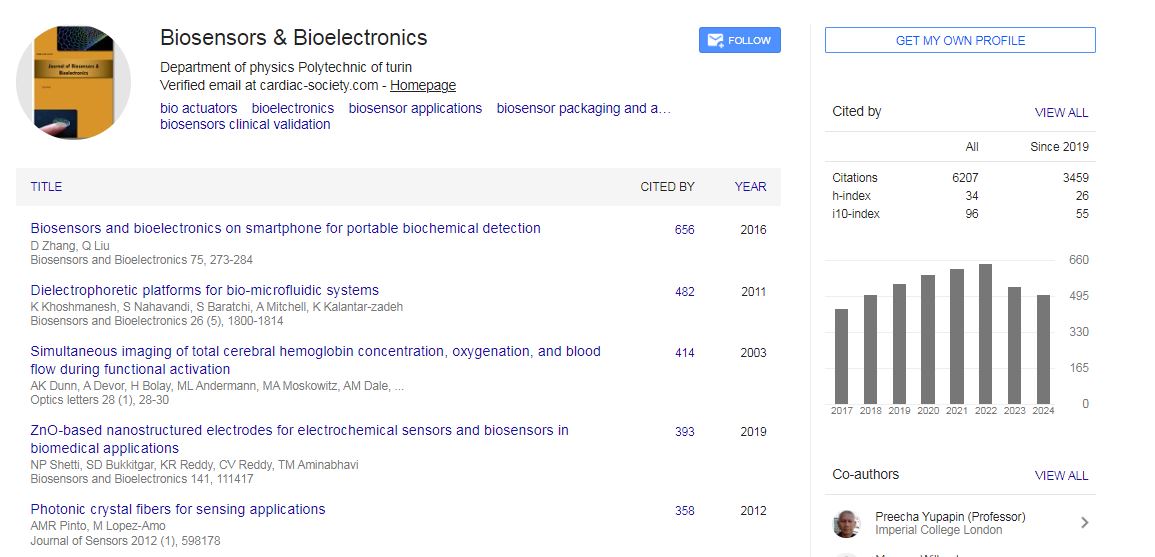
Biosensors & Bioelectronics received 6207 citations as per Google Scholar report