Amod Kulkarni and Girish Kotwal*
DOI: 10.37421/2165-7920.2025.15.1669
Background: The incidence and prevalence of prostate cancer is very high in aged individuals above 65 in the USA and across the globe,
establishing it as a prominent aging-related disorder in men. Leuprolide acetate stands as a standard treatment for aging-related metastatic
prostate cancer, aiming to lower testosterone levels to castrate levels.
Methods: This research report presents data from a patient with metastatic prostate cancer treated with leuprolide acetate to elucidate the agent's
effectiveness and limitations in managing the metastatic prostate cancer. Additionally, curcumin, yellow spice gold from turmeric that works as an
anticancer agent via multiple mechanisms including reduction in the androgen receptors and known to reduce PSA levels, was also taken as a
supplement.
Results: Following the initial dose of Leuprolide acetate, significant reductions in testosterone and PSA levels were observed. However, castrationresistant
prostate cancer developed after the second dose. Furthermore androgen depletion due to leuprolide acetate led to a substantial decline
in hemoglobin levels, resulting in anemia.
Conclusion: Lowering testosterone levels below the normal range with leuprolide acetate for aging-related metastatic prostate cancer should
not be viewed as an optimal long-term standard of care. Curcumin therapy is reported in some studies to reduce PSA levels, but did not seem to
reduce PSA levels in the patient. Earlier surgical intervention and/or procedures like arterial embolization may offer superior protection, particularly
in castration-resistant patients, compared to androgen suppression therapy.
Shubham Sharma, Abbas Mehdi*, Umang Narayan, Parul Prasad and Aditi Jain
DOI: 10.37421/2165-7920.2025.15.1670
Introduction: Mental disorders constitute a wide spectrum ranging from sub-clinical states to very severe forms of disorders. Many patients are
exposed to numerous types of magico-religious therapy. Superstition and religious beliefs continue to hinder individuals with behavioural issues
and mental illness from obtaining psychiatric care. Religious priests and traditional faith healers are often the very first point of contact for many
people in India; however, these beliefs may hinder their ability to heal.
Objective: This study aims to determine the role of cultural and faith healing practices in the treatment of psychiatric illnesses.
Methods: A cross-sectional study was conducted at a tertiary care hospital, involving 205 caregivers of mentally ill patients, who had sought prior
help from faith-healers. A semi- structured questionnaire was administered to the caregivers to determine the cultural beliefs regarding the cause
of mental illnesses, reasons for not using psychiatric care and the reason for following faith healing practices. Statistical analysis was performed
to determine the role of cultural and faith healing practices in the treatment of psychiatric illnesses.
Results: The study showed that the most commonly cited belief (82.4%) regarding the cause of mental illness was destiny. The most prevalent
reason (89.8%) for not using psychiatric care was fear of side effects. This study noted that the most common reason (81%) for resorting to the
faith healing practices were religious beliefs, customs and norms. The prevalence of faith healing practices by caregivers of mentally ill patients
is 64.94%.
Conclusion: The study found that many age-old beliefs influence the health- seeking behaviours of people suffering from mental illnesses.
The findings of the current study should draw the attention of policymakers, planners and higher authorities, at the state and municipal levels,
to numerous concerns that might come from these activities, as they might delay obtaining medical attention and so adversely affect the illness
prognosis.
DOI: 10.37421-2165-7920.2025.15.1671
DOI: 10.37421-2165-7920.2025.15.1672
DOI: 10.37421-2165-7920.2025.15.1673
DOI: 10.37421-2165-7920.2025.15.1674
DOI: 10.37421-2165-7920.2025.15.1675
DOI: 10.37421-2165-7920.2025.15.1676
DOI: 10.37421-2165-7920.2025.15.1678
DOI: 10.37421-2165-7920.2025.15.1677
DOI: 10.37421/2165-7920.2025.15.1669
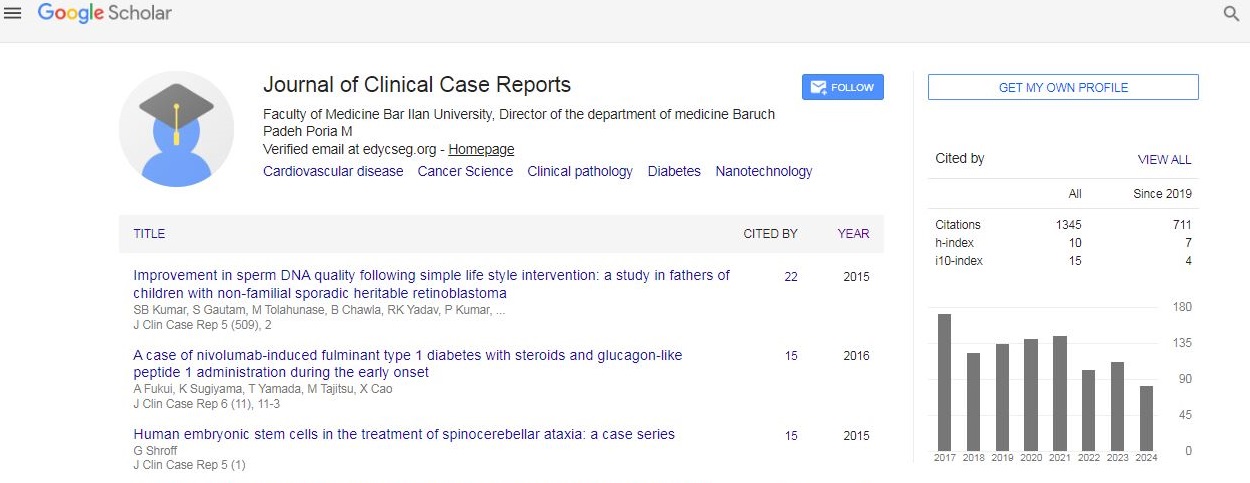
Journal of Clinical Case Reports received 1345 citations as per Google Scholar report


 Spanish
  Chinese
  Russian
  German
  French
  Japanese
  Portuguese
  Hindi
Hindi 