Brief Report - (2025) Volume 15, Issue 4
Received: 01-Jul-2025, Manuscript No. jccr-25-171241;
Editor assigned: 03-Jul-2025, Pre QC No. P-171241;
Reviewed: 15-Jan-2025, QC No. R-171241;
Revised: 22-Jul-2025, Manuscript No. Q-171241;
Published:
29-Jul-2025
, DOI: 10.37421-2165-7920.2025.15.1671
Citation: Oliva, Clarissa. “Case-based Applications of Molecular Genetics in Precision Medicine: From Bench to Bedside.” J Clin Case Rep 15 (2025): 1671.
Copyright: © 2025 Oliva C. This is an open-access article distributed under the terms of the Creative Commons Attribution License, which permits unrestricted use, distribution and reproduction in any medium, provided the original author and source are credited.
The integration of molecular genetics into precision medicine represents a pivotal advancement in modern healthcare. By decoding the genetic underpinnings of disease, clinicians and researchers can identify unique biomarkers, genetic variants and molecular pathways that influence patient health. These insights not only enhance diagnostic accuracy but also allow for individualized therapeutic interventions, shifting medical practice away from traditional generalized approaches. This evolution underscores the critical role of molecular genetics in bridging basic science with real-world clinical care. Case-based applications provide a powerful framework to illustrate how molecular discoveries translate into practice. Real patient cases demonstrate how genomic sequencing, pharmacogenomics and molecular profiling directly impact clinical decisions. From tailoring drug regimens based on genetic variations to predicting disease susceptibility, these case studies highlight the tangible benefits of precision medicine in diverse medical specialties, including oncology, cardiology, neurology and rare genetic disorders. Such examples showcase the transformative potential of genetics-driven care in improving outcomes and reducing treatment-related risks [2].
Furthermore, the case-based approach emphasizes the dynamic interplay between research innovation and clinical implementation. Advances in next-generation sequencing, bioinformatics and molecular diagnostics have accelerated the speed at which laboratory findings can be applied to patient care. However, these breakthroughs also raise challenges related to data interpretation, ethical considerations and equitable access to genomic medicine. By discussing case studies within this context, the field acknowledges both the opportunities and complexities of translating cutting-edge science into routine practice. Ultimately, the application of molecular genetics in precision medicine demonstrates how personalized healthcare can be both practical and impactful. Case-based narratives provide clinicians with valuable insights into integrating genetic information into diagnostic, preventive and therapeutic strategies. This not only empowers healthcare providers to make more informed decisions but also paves the way for a future where patient management is increasingly guided by genetic individuality. The bench-to-bedside journey exemplified through these cases reaffirms the promise of precision medicine as a cornerstone of next-generation healthcare [3].
Another key perspective lies in expanding the scope of precision medicine beyond oncology, where it is currently most established, to encompass cardiovascular disorders, autoimmune diseases, infectious diseases and neurodegenerative conditions. As case-based evidence grows across specialties, clinicians will gain stronger frameworks for incorporating genetic insights into routine practice. The development of comprehensive genomic databases, coupled with advances in global data sharing, will further accelerate this process by offering clinicians access to a broader pool of genetic knowledge. Ethical and societal considerations will remain central to the future of case-based applications. Issues such as genetic privacy, informed consent, data security and disparities in access to genomic medicine must be addressed to ensure equitable adoption. Efforts to develop cost-effective sequencing platforms and simplified diagnostic workflows will be critical in making precision medicine accessible not only in advanced healthcare settings but also in resource-limited regions [4].
Looking ahead, case-based applications will continue to serve as a vital bridge between bench research and bedside practice. By showcasing real-world examples of successful genetic interventions, they will inspire confidence in clinicians, patients and policymakers alike. Ultimately, the integration of molecular genetics into precision medicine is poised to transform healthcare into a more predictive, preventive, personalized and participatory system one where patient care is guided not just by symptoms, but by the unique genetic blueprint of each individual. The future of molecular genetics in precision medicine holds immense promise as research continues to advance and technologies become more accessible. Emerging tools such as single-cell sequencing, multi-omics integration and artificial intelligence driven analytics are expected to provide deeper insights into disease mechanisms and patient-specific variations. These innovations will enable more precise stratification of patients, allowing for earlier detection, optimized therapeutic targeting and better prediction of treatment responses [5].
Google Scholar Cross Ref Indexed at
Google Scholar Cross Ref Indexed at
Google Scholar Cross Ref Indexed at
Google Scholar Cross Ref Indexed at
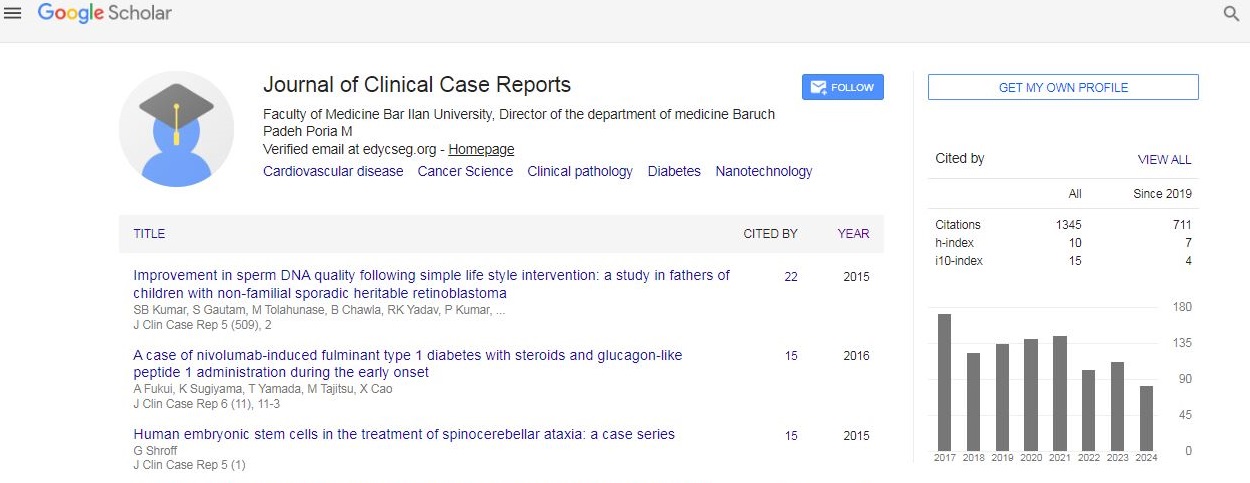
Journal of Clinical Case Reports received 1345 citations as per Google Scholar report