Short Communication - (2025) Volume 15, Issue 4
Received: 01-Jul-2025, Manuscript No. jccr-25-171248;
Editor assigned: 03-Jul-2025, Pre QC No. P-171248;
Reviewed: 15-Jul-2025, QC No. Q-171248;
Revised: 22-Jul-2025, Manuscript No. R-171248;
Published:
29-Jul-2025
, DOI: 10.37421-2165-7920.2025.15.1678
Citation: Zhao, Yulan. “Complexities in Glaucoma: Diagnostic and Management Challenges.” J Clin Case Rep 15 (2025): 1678.
Copyright: © 2025 Zhao Y. This is an open-access article distributed under the terms of the Creative Commons Attribution License, which permits unrestricted use, distribution and reproduction in any medium, provided the original author and source are credited.
Glaucoma encompasses a diverse group of optic neuropathies that share the hallmark feature of progressive retinal ganglion cell loss leading to characteristic optic nerve damage and visual field defects. It is one of the most common causes of irreversible blindness worldwide, disproportionately affecting elderly populations but also manifesting in younger individuals due to congenital or secondary causes. Traditionally, intraocular pressure (IOP) has been viewed as the primary driver of glaucomatous damage; however, research has shown that many patients with normal IOP still develop optic nerve injury, while others with elevated IOP never experience vision loss. This underscores the multifactorial nature of the disease, with vascular dysregulation, oxidative stress, mitochondrial dysfunction and genetic susceptibility playing important roles. The complexity is further highlighted by the existence of different subtypes, including primary open-angle glaucoma (POAG), primary angle-closure glaucoma (PACG), normal-tension glaucoma (NTG) and secondary glaucomas arising from trauma, inflammation, or systemic diseases. Each subtype carries distinct risk factors, pathophysiology and treatment responses, complicating universal diagnostic and therapeutic strategies. As a result, clinicians are often confronted with overlapping presentations that demand careful evaluation using both structural and functional assessment tools [2].
The diagnostic challenges of glaucoma stem from its insidious onset and highly variable progression. Many patients remain asymptomatic until late in the disease, when significant vision loss has already occurred, emphasizing the importance of early detection. Standard clinical tools such as tonometry, gonioscopy, visual field testing and optic disc evaluation remain essential but are often insufficient for capturing early or atypical cases. Structural imaging, including Optical Coherence Tomography (OCT), has greatly improved the ability to detect early nerve fiber layer thinning and subtle optic disc changes, yet interindividual variability in optic disc anatomy limits specificity. Similarly, visual field testing is prone to learning effects and variability, which can mask progression in borderline cases. Normal-tension glaucoma exemplifies these diagnostic difficulties, as patients present with optic nerve damage in the absence of elevated IOP, challenging the reliance on pressure-based diagnostic thresholds. Furthermore, coexisting ocular or systemic conditions such as diabetic retinopathy, myopia, or ischemic optic neuropathy may mimic or obscure glaucomatous changes, leading to misdiagnosis. Case reports frequently highlight these complexities by documenting unusual presentations, secondary glaucomas, or overlapping pathologies, underscoring the need for multimodal diagnostic approaches [3].
Management of glaucoma is equally challenging due to the diseaseâ??s heterogeneity, chronicity and the need for lifelong adherence to therapy. Lowering IOP remains the cornerstone of treatment, achieved through topical medications, laser therapy, or surgical interventions. However, patient responses to therapy vary considerably, with some achieving stability on a single agent while others require multiple modalities to slow progression. Polypharmacy introduces issues of ocular surface toxicity, systemic side effects and poor adherence, especially in elderly patients who often have multiple comorbidities. Laser trabeculoplasty and Minimally Invasive Glaucoma Surgeries (MIGS) have expanded the therapeutic arsenal, offering safer alternatives to traditional trabeculectomy or tube shunt procedures, but long-term outcomes remain inconsistent. Moreover, disease progression despite apparently adequate IOP control points to the involvement of non-IOP-dependent mechanisms such as vascular dysregulation and neurodegeneration. These factors highlight the need for adjunctive strategies targeting neuroprotection and optic nerve resilience. Insights from clinical case reports demonstrate that unusual treatment responses, surgical complications and unexpected disease trajectories provide valuable lessons for refining individualized care [4].
Emerging research is reshaping the understanding and management of glaucoma, highlighting the importance of personalized and multidisciplinary approaches. Genetic studies have identified susceptibility loci and molecular pathways that may serve as biomarkers for risk stratification and therapeutic targeting. Advances in neuroimaging and artificial intelligenceâ??based algorithms are improving diagnostic accuracy, progression monitoring and predictive modeling of disease outcomes. Novel therapeutics, including neuroprotective agents, sustained-release drug delivery systems and regenerative strategies aimed at retinal ganglion cell survival, are under active investigation. The integration of vascular health, systemic disease control and ocular management is increasingly recognized as essential in comprehensive glaucoma care, given the diseaseâ??s systemic associations. Case-based evidence remains pivotal in bridging the gap between research and practice by documenting rare presentations, innovative therapies and complex management decisions. Ultimately, addressing the complexities of glaucoma requires harmonizing technological advances with individualized patient care, promoting earlier diagnosis, safer interventions and long-term preservation of vision. By combining mechanistic insights, clinical experience and research innovation, the medical community can better meet the global challenge posed by this multifaceted disease [5].
Google Scholar Cross Ref Indexed at
Google Scholar Cross Ref Indexed at
Google Scholar Cross Ref Indexed at
Google Scholar Cross Ref Indexed at
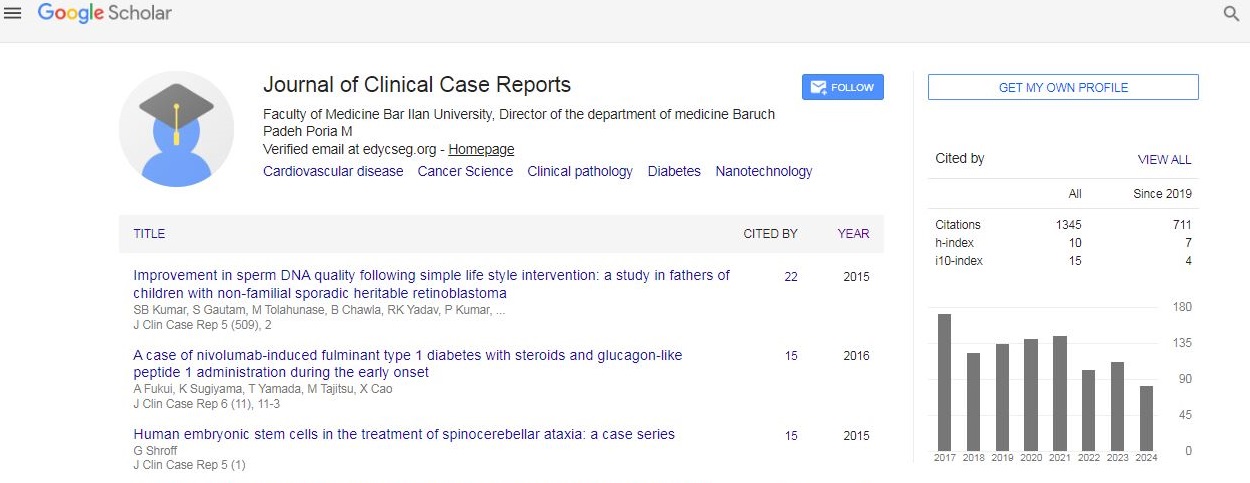
Journal of Clinical Case Reports received 1345 citations as per Google Scholar report