Commentary - (2025) Volume 15, Issue 4
Received: 01-Jul-2025, Manuscript No. jccr-25-171247;
Editor assigned: 03-Jul-2025, Pre QC No. P-171247;
Reviewed: 15-Jul-2025, QC No. Q-171247;
Revised: 22-Jul-2025, Manuscript No. R-171247;
Published:
29-Jul-2025
, DOI: 10.37421-2165-7920.2025.15.1677
Citation: Dejan, Maria. “Rare and Complex Spinal Disorders: Diagnostic and Therapeutic Insights.” J Clin Case Rep 15 (2025): 1677.
Copyright: © 2025 Dejan M. This is an open-access article distributed under the terms of the Creative Commons Attribution License, which permits unrestricted use, distribution and reproduction in any medium, provided the original author and source are credited.
Rare and complex spinal disorders encompass a wide range of pathologies, including congenital malformations, metabolic bone diseases, infections, inflammatory conditions, neoplasms and post-traumatic deformities. Many of these disorders present atypically, making them difficult to distinguish from common spinal pathologies such as degenerative disc disease or osteoarthritis. For instance, congenital abnormalities like Chiari malformations or tethered cord syndrome may remain silent until adulthood, when progressive neurological deficits emerge. Similarly, metabolic disorders such as osteogenesis imperfecta or Pagetâ??s disease can lead to fragility fractures, deformity and chronic pain that may be mistaken for age-related changes. Infectious spinal conditions, such as vertebral osteomyelitis or spinal tuberculosis, are particularly challenging because of their insidious onset and nonspecific systemic symptoms. Autoimmune or inflammatory spinal disorders, including ankylosing spondylitis and other spondyloarthropathies, may initially manifest with vague back pain, delaying diagnosis for years. Such heterogeneity complicates early recognition and delays in accurate diagnosis often result in irreversible neurological damage or worsening structural deformities. This diagnostic uncertainty underscores the importance of maintaining a high index of suspicion and utilizing advanced imaging modalities and laboratory testing in evaluating unexplained spinal symptoms [2].
The diagnostic process in rare spinal disorders is further complicated by overlapping clinical features and the limitations of conventional diagnostic tools. Standard radiographs, while useful for detecting gross deformities, may fail to reveal subtle spinal cord abnormalities or early infectious or neoplastic lesions. Magnetic Resonance Imaging (MRI) and Computed Tomography (CT) have greatly improved the ability to detect complex pathologies, including intradural lesions, spinal cord compression and inflammatory changes. However, even advanced imaging is not always definitive, as certain disorders can mimic others radiologically. For example, spinal tumors may resemble infectious granulomas and inflammatory conditions may be misinterpreted as degenerative changes. Biomarker testing, genetic studies and histopathological evaluation are often required to achieve diagnostic precision, particularly in cases involving rare neoplasms or hereditary spinal conditions. Case reports play a crucial role in expanding awareness of unusual presentations, as they document variations that may not be captured in broader clinical studies. By integrating imaging, laboratory and clinical data, physicians can navigate these diagnostic challenges more effectively, though the process remains time-intensive and often requires multidisciplinary collaboration [3].
Therapeutic management of rare and complex spinal disorders requires highly individualized strategies, balancing the risks and benefits of medical, surgical and rehabilitative interventions. Pharmacological treatments, such as antibiotics for spinal infections or biologics for autoimmune conditions, can provide substantial benefits but require careful monitoring to prevent complications. Surgical approaches, ranging from decompression and stabilization procedures to tumor resection and corrective osteotomies, are often necessary for structural deformities or progressive neurological compromise. Advances in minimally invasive and image-guided spinal surgery have improved safety and recovery, but outcomes remain highly variable depending on disease severity and patient comorbidities. Rehabilitation plays a central role in maximizing functional outcomes, with physical therapy, occupational therapy and assistive devices helping to restore mobility and independence. Yet, treatment is complicated by the scarcity of standardized guidelines, given the rarity of these disorders and the lack of large-scale clinical trials. Case-based evidence remains critical, as it highlights innovative approaches, complications and long-term outcomes that inform best practices in the absence of randomized controlled data. Multidisciplinary teams including neurosurgeons, orthopedic surgeons, rheumatologists, neurologists and rehabilitation specialists are essential to ensure comprehensive, patient-centered care [4].
The clinical and research implications of rare spinal disorders extend beyond individual patient management. On a broader scale, these conditions underscore the need for registries, collaborative research networks and the integration of precision medicine into spinal care. Molecular and genetic studies may reveal underlying mechanisms, identify biomarkers for early detection and pave the way for targeted therapies. For example, advances in genomics could elucidate the role of specific gene mutations in congenital spinal deformities, while immunological profiling may improve the management of inflammatory spinal disorders. Emerging technologies such as artificial intelligenceâ??assisted imaging interpretation and 3D printing for surgical planning are poised to enhance diagnostic accuracy and therapeutic precision. Case reports and case series remain indispensable in this context, as they not only enrich clinical knowledge but also provide the foundation for hypothesis generation and future research. Ultimately, addressing rare and complex spinal disorders requires bridging gaps in awareness, diagnosis and management through collaboration between clinicians, researchers and healthcare systems. By combining mechanistic insights with practical lessons from clinical practice, the medical community can improve outcomes, reduce diagnostic delays and advance treatment strategies for patients with these challenging conditions [5].
Google Scholar Cross Ref Indexed at
Google Scholar Cross Ref Indexed at
Google Scholar Cross Ref Indexed at
Google Scholar Cross Ref Indexed at
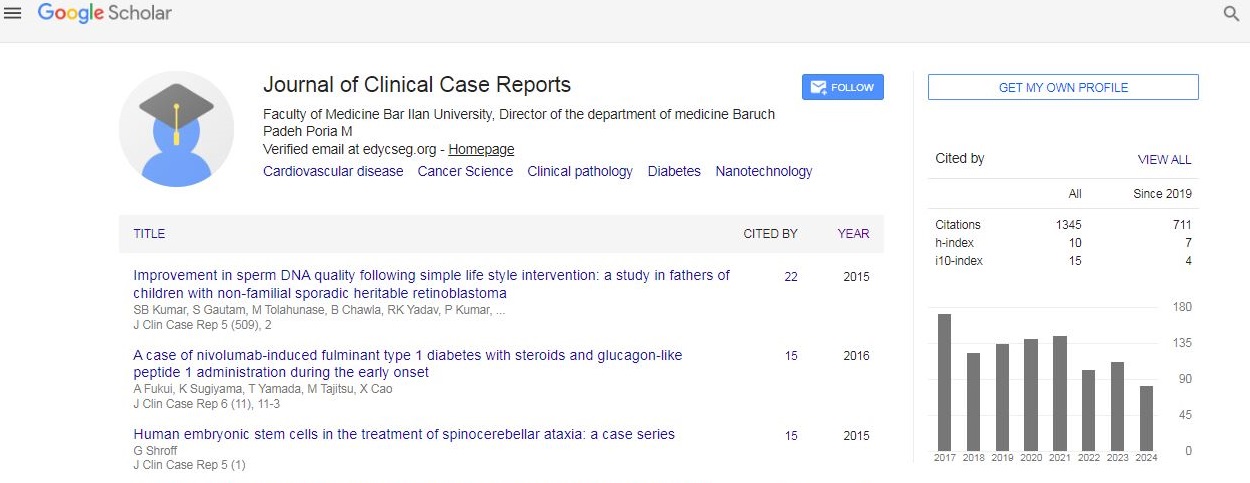
Journal of Clinical Case Reports received 1345 citations as per Google Scholar report