Opinion - (2025) Volume 15, Issue 4
Received: 01-Jul-2025, Manuscript No. jccr-25-171243;
Editor assigned: 03-Jul-2025, Pre QC No. P-171243Q;
Reviewed: 15-Jul-2025, QC No. jccr-25-171243;
Revised: 22-Jul-2025, Manuscript No. R-171243;
Published:
29-Jul-2025
, DOI: 10.37421-2165-7920.2025.15.1673
Citation: Joseph, Shelini. “Unusual Presentations in Neurodisorders: Diagnostic and Therapeutic Challenges.” J Clin Case Rep 15 (2025): 1673.
Copyright: © 2025 Joseph S. This is an open-access article distributed under the terms of the Creative Commons Attribution License, which permits unrestricted use, distribution and reproduction in any medium, provided the original author and source are credited.
Neurological disorders are among the most complex medical conditions due to the intricate structure and function of the nervous system and their presentations are often diverse and multifaceted. While certain conditions such as Parkinsonâ??s disease, Alzheimerâ??s disease, epilepsy and multiple sclerosis follow well-documented clinical pathways, many patients exhibit atypical or unusual manifestations that challenge conventional diagnostic frameworks. These presentations may arise from subtle early symptoms, overlapping features with psychiatric or systemic illnesses, or uncommon variants of classical diseases. For instance, an individual with Parkinsonâ??s disease might present initially with cognitive decline or mood disturbances rather than tremors, leading to misdiagnosis as depression or dementia. Similarly, epilepsy may manifest through non-convulsive symptoms such as episodic confusion, sensory distortions, or unexplained behavioral changes, which are often mistaken for psychiatric disorders. Stroke can also present in unusual ways, such as isolated cognitive impairment, visual disturbances, or even mood alterations, rather than the classic motor or speech deficits. Such atypical clinical profiles pose a significant risk for delayed recognition, misdiagnosis and inappropriate treatment, which in turn can worsen long-term outcomes. Moreover, the variability in disease expression is influenced by genetic predispositions, age at onset, environmental factors and comorbid medical conditions. These variables highlight the need for clinicians to maintain a broad differential diagnosis when encountering atypical neurological presentations. Without such vigilance, patients may undergo unnecessary investigations or ineffective treatments, further complicating the course of care [2].
One of the most striking features of unusual presentations in neurodisorders is the overlap between neurological, psychiatric and systemic manifestations. Many neurological conditions are accompanied by psychiatric symptoms such as anxiety, depression, psychosis, or cognitive impairment, which can obscure the primary disease process. For example, autoimmune encephalitis often presents with psychiatric disturbances before neurological deficits become apparent, leading patients to be treated initially for primary psychiatric illness. Similarly, neurodegenerative disorders like Huntingtonâ??s disease may first manifest as mood instability or personality changes years before motor symptoms develop. Multiple sclerosis, commonly associated with motor and sensory deficits, may present atypically with isolated visual loss, chronic fatigue, or vague cognitive complaints. These atypical features can confound diagnosis, especially in primary care settings where neurological expertise may be limited. Another diagnostic challenge arises from systemic diseases that mimic neurological disorders, such as metabolic imbalances, endocrine dysfunctions, or autoimmune conditions affecting the central nervous system. The clinical overlap emphasizes the importance of multidisciplinary collaboration between neurologists, psychiatrists and internists to achieve accurate diagnosis. Advanced neuroimaging, cerebrospinal fluid analysis and emerging biomarkers are becoming indispensable tools in distinguishing unusual presentations from mimicking conditions. However, even with advanced technology, diagnostic uncertainty persists in many cases, making clinical judgment and awareness of atypical disease variants crucial for patient care [3].
Therapeutic challenges in unusual neurodisorder presentations are equally significant, as standard treatment protocols are often developed based on typical disease phenotypes. Atypical presentations may not respond adequately to conventional therapies or may require earlier introduction of advanced treatments. For instance, patients with atypical forms of epilepsy resistant to standard anti-seizure medications may benefit from ketogenic diets, vagus nerve stimulation, or newer antiepileptic drugs, but identifying candidates for such interventions is difficult when diagnosis is delayed. Similarly, rare forms of Parkinsonism such as progressive supranuclear palsy or multiple system atrophy may initially respond to dopaminergic therapy but eventually require tailored multidisciplinary care. Autoimmune neurodisorders, particularly those presenting with psychiatric features, may benefit from early immunotherapy, but treatment initiation is often postponed due to misdiagnosis. Precision medicine approaches, including genetic testing and targeted therapies, hold promise for managing these atypical presentations, yet their application remains limited in clinical practice due to cost, availability and lack of robust evidence in rare scenarios. Rehabilitation strategies also need customization, as unusual symptom patterns may not align with conventional physical or cognitive therapy models. Moreover, patient compliance and psychological adaptation can be more challenging when diseases deviate from expected clinical patterns, as uncertainty about prognosis and treatment outcomes may cause distress. Thus, therapeutic planning for atypical neurodisorders requires flexibility, individualized care and often the integration of novel approaches beyond standard guidelines [4].
Case reports and clinical observations of unusual neurodisorder presentations play a critical role in bridging the gap between standard medical knowledge and real-world complexity. They provide valuable documentation of rare phenotypes, unexpected complications, or novel therapeutic responses that may not emerge in large-scale clinical trials. For example, unusual presentations of multiple sclerosis with predominant psychiatric or ocular features, or rare cases of epilepsy manifesting only as autonomic disturbances, have been primarily understood through case-based literature. Such reports not only enhance diagnostic awareness but also encourage clinicians to remain vigilant for non-classical signs. In addition, they often inspire further research into pathophysiology, biomarkers and potential therapeutic targets, thereby contributing to the evolution of neurology as a field. By highlighting clinical heterogeneity, case reports underscore the importance of personalized medicine, where treatment is adapted to the unique characteristics of each patient rather than following a one-size-fits-all model. They also remind practitioners of the value of detailed clinical observation and comprehensive patient histories in achieving accurate diagnosis. As precision medicine and neurogenetics continue to advance, unusual presentations are increasingly recognized as part of the broader disease spectrum rather than anomalies. Ultimately, integrating these insights into clinical practice improves diagnostic accuracy, optimizes therapeutic strategies and enhances patient quality of life, despite the inherent complexity of neurological disorders [5].
Google Scholar Cross Ref Indexed at
Google Scholar Cross Ref Indexed at
Google Scholar Cross Ref Indexed at
Google Scholar Cross Ref Indexed at
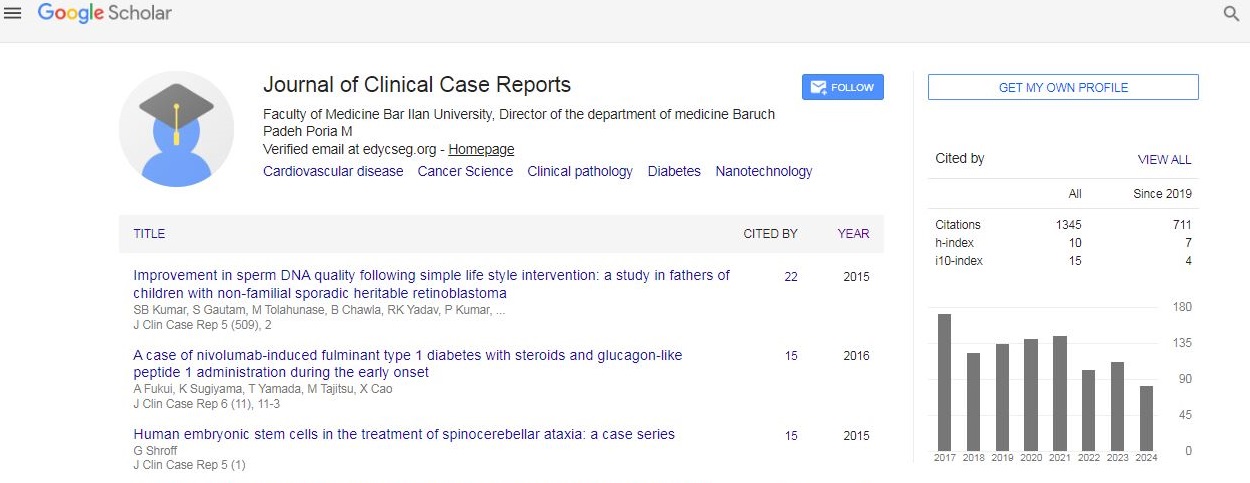
Journal of Clinical Case Reports received 1345 citations as per Google Scholar report