Perspective - (2025) Volume 15, Issue 4
Received: 01-Jul-2025, Manuscript No. jccr-25-171246;
Editor assigned: 03-Jul-2025, Pre QC No. P-171246;
Reviewed: 15-Jul-2025, QC No. Q-171246;
Revised: 22-Jul-2025, Manuscript No. R-171246;
Published:
29-Jul-2025
, DOI: 10.37421-2165-7920.2025.15.1676
Citation: Caban, Pearl. "Clinical Case Perspectives on Autoimmune Disorders and Aging: Mechanisms and Challenges." J Clin Case Rep 15 (2025): 1676.
Copyright: © 2025 Caban P. This is an open-access article distributed under the terms of the Creative Commons Attribution License, which permits unrestricted use, distribution and reproduction in any medium, provided the original author and source are credited.
Autoimmune disorders occur when the immune system loses tolerance to self-antigens, leading to chronic inflammation, progressive tissue damage and dysfunction across diverse organ systems. These disorders include systemic conditions such as systemic lupus erythematosus, rheumatoid arthritis and vasculitis, as well as organ-specific diseases like autoimmune thyroiditis, type 1 diabetes and autoimmune hepatitis. While traditionally thought to affect younger populations, the burden of autoimmune diseases in older adults is increasingly recognized, driven by demographic aging and improved diagnostic awareness. Aging profoundly alters the immune system, creating an environment in which both immune deficiency and dysregulated autoimmunity can coexist. The process of immunosenescence, marked by reduced naïve T-cell production, impaired B-cell diversity and diminished adaptive immunity, decreases the bodyâ??s ability to mount effective responses to infections and vaccines. At the same time, inflammaging, characterized by chronic low-grade systemic inflammation, fosters an environment conducive to autoimmunity. Together, these processes form a paradoxical framework in which immunity is weakened against external threats yet hyper-reactive against self, amplifying the risk of autoimmune manifestations in elderly individuals [2].
Mechanistically, the link between aging and autoimmunity is influenced by genetic predisposition, epigenetic changes and cumulative environmental exposures. Over time, repeated antigenic stimulation, oxidative stress and mitochondrial dysfunction reshape immune cell function and regulation. Dysregulation of T-regulatory cells, alterations in cytokine signaling and loss of central and peripheral tolerance all contribute to increased self-reactivity. Autoantibody production, a hallmark of many autoimmune diseases, often increases with age, even in clinically healthy individuals, complicating diagnostic specificity. This immunological remodeling results in atypical presentations of classic autoimmune conditions in older adults. For instance, systemic lupus erythematosus may manifest with fewer cutaneous symptoms but more pronounced serositis and renal involvement, while rheumatoid arthritis may present with polymyalgia-like features rather than classic joint deformities. These variations highlight the complexity of diagnosing autoimmune disorders in the elderly, where clinical features often overlap with age-related degenerative and metabolic conditions. Furthermore, the presence of multiple comorbidities such as cardiovascular disease, diabetes and chronic kidney disease further obscures the clinical picture, delaying timely diagnosis and intervention [3].
The management of autoimmune diseases in aging populations poses unique clinical challenges due to physiological changes, comorbid conditions and treatment-related risks. Standard therapies, including corticosteroids, conventional immunosuppressants and biologic agents, must be used with caution in elderly patients because of increased susceptibility to infections, malignancy, osteoporosis and drug toxicity. Polypharmacy further complicates treatment, as interactions between immunomodulatory drugs and medications for hypertension, diabetes, or cardiovascular disease are common. In addition, age-related decline in organ function particularly renal and hepatic impairment requires careful dose adjustments and vigilant monitoring. Frailty, cognitive decline and limited social support systems also influence adherence to therapy and overall treatment outcomes. Newer biologics and targeted therapies hold promise for improving disease control while minimizing systemic toxicity, but their use in older adults remains underexplored in clinical trials. Personalized treatment strategies that integrate geriatric assessment, comorbidity management and careful selection of immunotherapies are essential to balancing efficacy with safety in this vulnerable population [4].
Case reports and observational studies provide critical insights into the intersection of autoimmunity and aging, particularly in highlighting atypical presentations, diagnostic pitfalls and therapeutic dilemmas. These cases underscore the need for heightened clinical suspicion when evaluating elderly patients with nonspecific symptoms such as fatigue, weight loss, or chronic pain, which may mask underlying autoimmune processes. They also reveal the importance of multidisciplinary approaches that integrate rheumatology, geriatrics, immunology and primary care to optimize patient outcomes. Beyond immediate clinical care, the study of autoimmune disorders in aging populations offers important research opportunities. Investigating the molecular drivers of immunosenescence and inflammaging may uncover novel therapeutic targets, while exploring biomarkers of autoimmunity in the elderly can improve diagnostic accuracy. Furthermore, precision medicine approaches, including genomics, proteomics and advanced imaging, hold promise for tailoring treatments to individual patient profiles. Ultimately, addressing autoimmune disorders in aging is not only a clinical imperative but also a public health priority, as the global burden of chronic immune-mediated disease is expected to rise alongside aging populations. By learning from both mechanistic studies and case-based experiences, clinicians and researchers can develop strategies to enhance early detection, refine therapeutic approaches and improve quality of life for older adults living with autoimmune diseases [5].
Google Scholar Cross Ref Indexed at
Google Scholar Cross Ref Indexed at
Google Scholar Cross Ref Indexed at
Google Scholar Cross Ref Indexed at
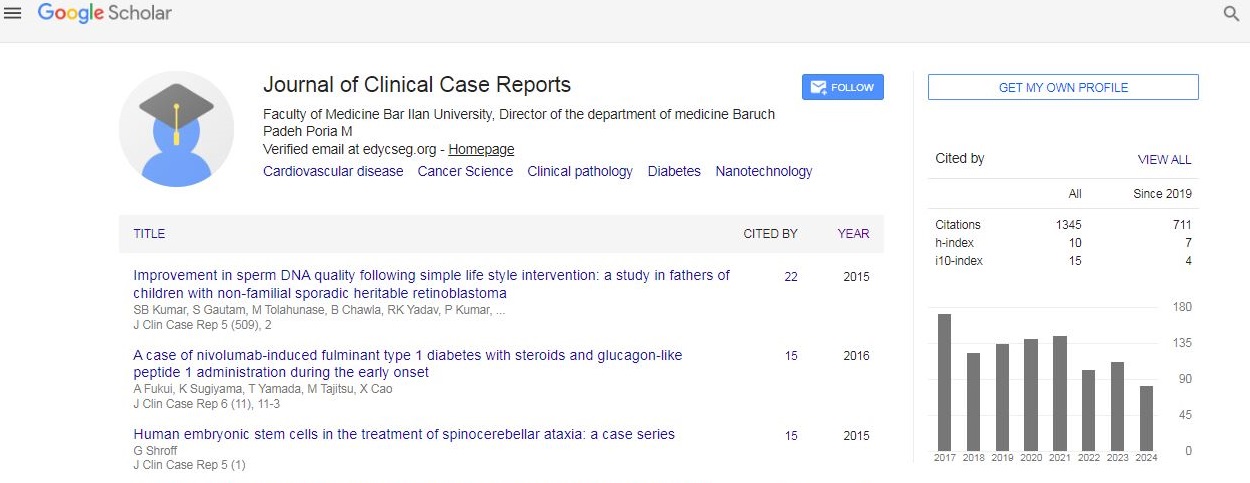
Journal of Clinical Case Reports received 1345 citations as per Google Scholar report