Opinion - (2025) Volume 15, Issue 4
Received: 01-Jul-2025, Manuscript No. jccr-25-171244;
Editor assigned: 03-Jul-2025, Pre QC No. P-171244;
Reviewed: 15-Jul-2025, QC No. q-171244;
Revised: 22-Jul-2025, Manuscript No. R-171244;
Published:
29-Jul-2025
, DOI: 10.37421-2165-7920.2025.15.1674
Citation: Barbara, Dylan. “Atypical Presentations of Cardiomyopathy: Lessons from Case Reports.” J Clin Case Rep 15 (2025): 1674.
Copyright: © 2025 Barbara D. This is an open-access article distributed under the terms of the Creative Commons Attribution License, which permits unrestricted use, distribution and reproduction in any medium, provided the original author and source are credited.
Cardiomyopathies constitute a diverse group of myocardial disorders that disrupt the structural and functional integrity of the heart, often culminating in heart failure, arrhythmias and sudden cardiac death. They are broadly categorized into dilated, hypertrophic, restrictive, arrhythmogenic right ventricular and unclassified subtypes, each with characteristic features and clinical trajectories. However, real-world clinical encounters reveal that not all patients present with the expected constellation of symptoms such as exertional dyspnea, palpitations, or syncope. Instead, many individuals exhibit atypical or misleading signs that obscure the underlying diagnosis and complicate clinical decision-making. For example, cardiomyopathy may initially manifest as gastrointestinal complaints, peripheral edema, thromboembolic phenomena, or even neurological disturbances that mimic other systemic diseases. Hypertrophic cardiomyopathy has been reported to present with unexplained fatigue or chest pain misattributed to coronary artery disease, while restrictive cardiomyopathy may masquerade as chronic liver disease or pulmonary hypertension. Such presentations challenge traditional diagnostic frameworks and often delay recognition, leading to inappropriate treatment and disease progression. The variability in phenotype underscores the importance of maintaining a broad differential diagnosis when evaluating patients with unexplained systemic or cardiovascular symptoms. These challenges highlight the central need for heightened clinical suspicion and reliance on multimodal diagnostic approaches, including advanced imaging, genetic testing and biomarker analysis [2].
The pathophysiology underlying atypical presentations of cardiomyopathy is influenced by genetic, molecular and environmental factors that shape disease expression. Variability in gene mutations, epigenetic regulation and modifier genes contributes to heterogeneous phenotypes even within the same family. Penetrance and expression may differ across age groups, leading to silent disease in some individuals and fulminant cardiomyopathy in others. For instance, arrhythmogenic right ventricular cardiomyopathy may initially present as isolated ventricular arrhythmias rather than overt structural abnormalities, complicating early diagnosis. Similarly, infiltrative forms of cardiomyopathy such as amyloidosis or sarcoidosis may first manifest as systemic complaints neuropathy, renal dysfunction, or dermatological findings before overt cardiac involvement is recognized. Diagnostic overlap with conditions such as myocarditis, pulmonary hypertension, or ischemic cardiomyopathy further adds to the complexity. Advanced cardiac imaging techniques, including cardiac magnetic resonance imaging with late gadolinium enhancement, have become invaluable for identifying subtle myocardial fibrosis and differentiating cardiomyopathies from mimicking conditions. Genetic testing also provides critical insights, not only confirming the diagnosis but also aiding in family screening and risk stratification. Nonetheless, in atypical cases, even advanced tools may yield inconclusive results, leaving clinicians reliant on clinical judgment and accumulated case-based experiences to guide diagnosis and management [3].
Management of atypical cardiomyopathy presentations poses additional therapeutic challenges, as standard treatment guidelines are largely based on typical clinical scenarios. Patients with unusual manifestations may not respond predictably to conventional pharmacologic regimens such as beta-blockers, ACE inhibitors, or diuretics. In hypertrophic cardiomyopathy, those presenting primarily with arrhythmias may require early consideration of implantable cardioverter-defibrillators (ICDs), while patients with restrictive cardiomyopathy misdiagnosed as hepatic or pulmonary disease may not benefit until the cardiac etiology is identified. Precision medicine approaches, including genotype-directed therapy, hold significant promise but remain underutilized due to limited access and lack of robust evidence in rare clinical variants. Additionally, advanced therapies such as left ventricular assist devices (LVADs) or transplantation may be delayed in atypical cases due to diagnostic uncertainty or misclassification. Non-cardiac symptoms may also hinder adherence to therapy, as patients may not appreciate the cardiac origin of their illness. Rehabilitation and lifestyle recommendations must also be tailored, since conventional exercise prescriptions or dietary advice may be inappropriate in certain rare cardiomyopathies. Ultimately, individualized treatment strategies informed by case-based evidence are essential to improving outcomes in this complex patient population [4].
Case reports play a pivotal role in expanding understanding of atypical cardiomyopathy presentations, offering valuable insights beyond what clinical trials and cohort studies typically capture. They provide detailed documentation of unusual phenotypes, unexpected complications and therapeutic responses that enrich clinical practice and research. For example, reports of cardiomyopathy presenting with stroke as the initial manifestation, or cases of arrhythmogenic cardiomyopathy misdiagnosed as idiopathic epilepsy due to seizure-like episodes, have broadened awareness of diagnostic pitfalls. Such case-based evidence reinforces the importance of comprehensive evaluation, multidisciplinary collaboration and incorporation of novel diagnostic modalities when faced with puzzling clinical scenarios. By emphasizing variability in presentation and response, case reports highlight the need for a flexible and personalized approach to patient care. Furthermore, they contribute to the development of new hypotheses regarding disease mechanisms and treatment strategies, laying the groundwork for future clinical research. As precision medicine and genetic therapies advance, lessons from case reports will remain indispensable in guiding early recognition, tailoring therapy and ultimately improving survival and quality of life in patients with cardiomyopathy [5].
Google Scholar Cross Ref Indexed at
Google Scholar Cross Ref Indexed at
Google Scholar Cross Ref Indexed at
Google Scholar Cross Ref Indexed at
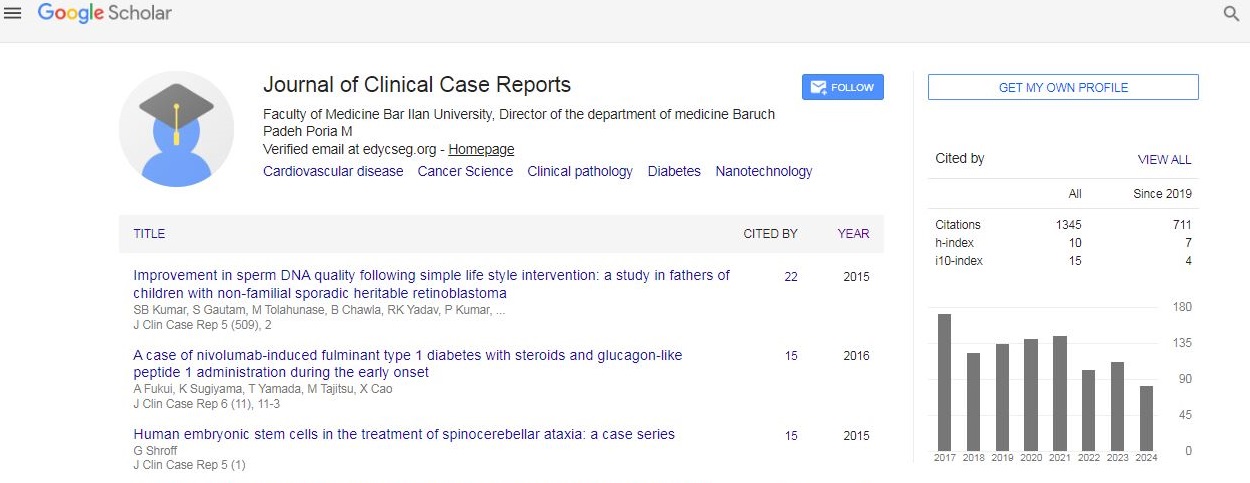
Journal of Clinical Case Reports received 1345 citations as per Google Scholar report