Mohamed Nafzi
Facial & Video Analytics, IDEMIA Identity & Security Germany AG / University Bochum
The main focus of this paper is to enhance the productivity and the efficiency of vehicle re-identification module based on shape and color classification. We show the ability of this module to help with the automation of several procedures like the Automated Vehicular Surveillance (AVS) or the fast analysis of video data. We present the steps leading to the improvement of the vehicle re-identification of our previous work. Data augmentation had to be done because our previous training data did not contain many vehicles with older model years and different perspectives. We show the development and the execution of clustering on our training data, which was required since the labels ‘model year’ and ‘view’ are not available. Both steps allow our module to classify more classes and increase its robustness and its accuracy. Our trained model contains Apriori probability because our training data does not have an equal class distribution. Elimination of Apriori probability improved the classification results of our testing data. We demonstrate with the help of our application the re-identification of vehicles on video data based on make/ model and color classification. This work was partially funded under the grant.
Mohamed Nafzi (male) received his degree in Electrical and Computer Engineering from the Ruhr- University Bochum, Institute of Electrical and Computer Engineering. In 2009 he worked for Faiz & Siegeln in the field of software development and customer consultation (TIBCO customers). Since 2010 he has been working for Idemia Identity & Security Germany AG in the field of biometrics and video analysis. He is a member of the “Research and Development for facial & video analytics” team. He has participated in different research projects (MisPel, GES-3D, APFEL, Florida, Victoria) funded by the German Ministry of Education and Research (BMBF) or by the European Commission. He is at the same time postgraduate at the university Bochum.
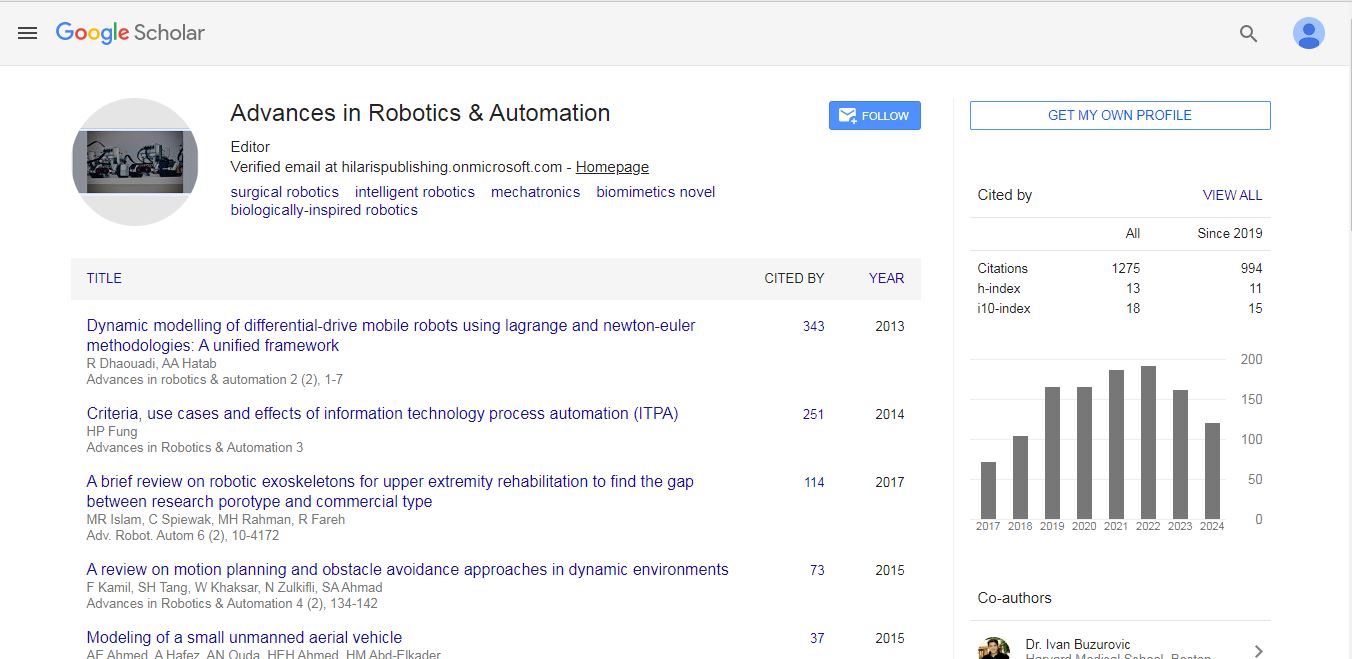
Advances in Robotics & Automation received 1275 citations as per Google Scholar report
 Spanish
  Chinese
  Russian
  German
  French
  Japanese
  Portuguese
  Hindi
Hindi 