Necar Merah
King Fahd University of Petroleum and Minerals, Saudi Arabia
Keynote: J Material Sci Eng
Statement of the problem: Epoxy resins have an attractive combination of stiffness, strength, high heat distortion temperature, creep resistance, thermal and environmental stability. This makes them one of the most applied thermoset polymers for fiber reinforced structures and anticorrosion coatings. However, epoxies’ affinity to water results in moisture uptake that degrades the functional, structural and mechanical properties of epoxy-based composites and coatings. Absorbed liquid molecules act as efficient plasticizers for cured epoxy systems thereby reducing strength, stiffness and glass transition temperatures. Several researchers have shown that proper mixing of clay nanocomposites with epoxy reduces its water uptake and helps improve its mechanical, thermal and physical properties. The purpose of this work is to show what optimum parameters can lead to proper clay dispersion and distribution of nanoclays in epoxy matrix. Methodology: Two mixing techniques, High Shear Mixing (HSM) and Ultra-Sonication, were used, at different mixing speeds and times, to disperse different clay loadings (1-10 wt%) in Di-Glycidyl Ether of Bisphenol A (DGEBA) epoxy matrix. Four types of organically-modified montmorillonite clays are investigated, namely; monomers: I.30E, I.28E and Cloisites C10A and C15A. Findings: The results showed that optimal clay dispersion was obtained with 1.0 wt% to 2.0 wt% of I.30E and C10A clays, using HSM at the optimum speed and mixing time of 6000 rpm and 60 min, respectively. These, with a degassing temperature, around 100Ë?C lead to the synthesis of nanocomposites with a disorder-intercalated and exfoliated morphologies that reduced the diffusion constant of epoxy by more than 50% and maximum water uptake by more than 20% [Figure 1]. Conclusion: The reduction in water uptake improved the glass transition temperature and the mechanical properties of the pristine polymer. These improvements are mainly due to the tortuosity effect, where water molecules have to move around clay layers during diffusion in nanocomposites.
Necar Merah is a professor in the Mechanical Engineering Department at King Fahd University of Petroleum and Minerals. He obtained his PhD in Mechanical Engineering from Ecole Polytechnique of Montreal and his M.Sc. and B.Sc. from the University of Tulsa, OK, USA. His research work in multidisciplinary design, fracture mechanics and materials synthesis and characterization has been largely funded by industry and national and international research organizations and institutions. He has contributed more than 170 scholarly publications and 15 US patents. His research outcome and excellence in teaching have been recognized by a number of national and international awards.
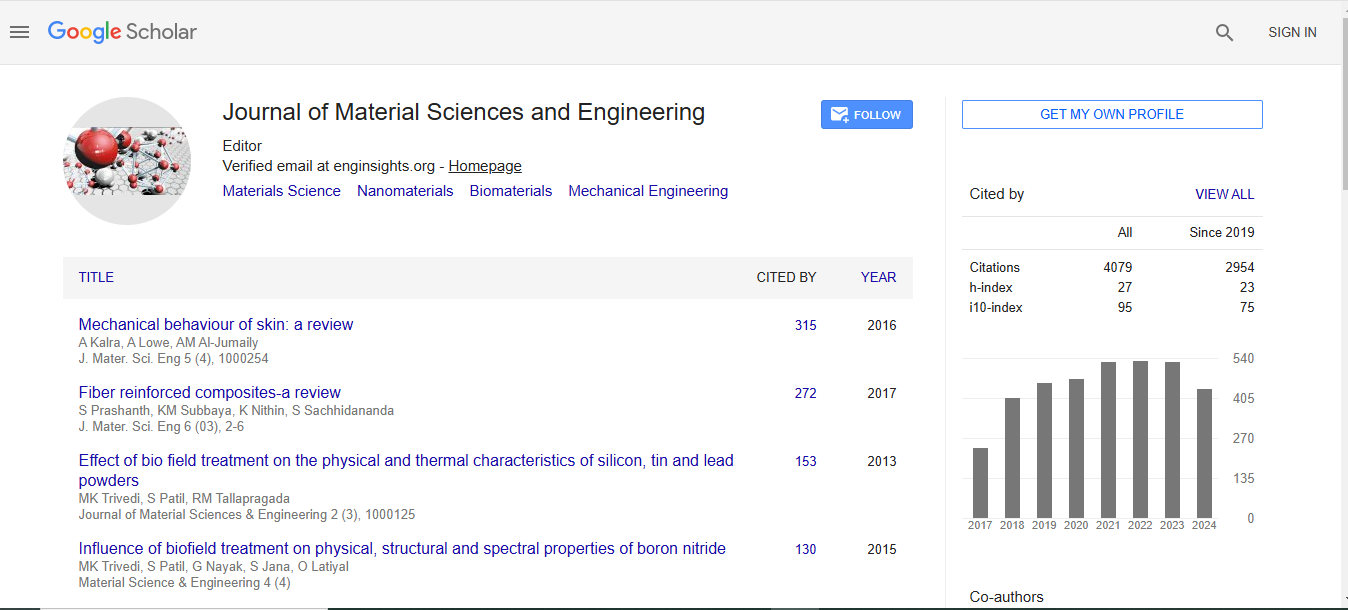
Journal of Material Sciences & Engineering received 3677 citations as per Google Scholar report
 Spanish
  Chinese
  Russian
  German
  French
  Japanese
  Portuguese
  Hindi
Hindi 