Perspective - (2025) Volume 9, Issue 6
Received: 01-Dec-2025, Manuscript No. jid-26-188368;
Editor assigned: 03-Dec-2025, Pre QC No. P-188368;
Reviewed: 17-Dec-2025, QC No. Q-188368;
Revised: 22-Dec-2025, Manuscript No. R-188368;
Published:
29-Dec-2025
, DOI: 10.37421/2684-4559.2025.9.360
Citation: Garcia, Isabella. "Whole-genome Sequencing: Tracking MDR Organisms in Long-Term Care." Clin Infect Dis 13 (2025):360.
Copyright: © 2025 Garcia I. This is an open-access article distributed under the terms of the Creative Commons Attribution License, which permits unrestricted use, distribution and reproduction in any medium, provided the original author and source are credited.
Genomic tracing has emerged as an indispensable tool for comprehending and managing outbreaks of multidrug-resistant (MDR) organisms within long-term care facilities (LTCFs) [1].
These environments are particularly susceptible to outbreaks due to the presence of vulnerable residents, high-risk settings, and frequent interactions with healthcare providers [1].
Whole-genome sequencing (WGS) offers an unprecedented level of detail in tracking pathogen transmission, identifying transmission chains, and evaluating the efficacy of implemented interventions, thereby aiding in rapid responses and the development of targeted infection control measures [1].
The application of WGS has fundamentally transformed our capacity to monitor the spread of multidrug-resistant bacteria in healthcare settings, especially within LTCFs [2].
It provides a high-resolution molecular fingerprint that allows for the precise identification of clonal relationships and distinct transmission events, which might otherwise be overlooked by conventional methodologies [2].
The detailed genomic data derived from WGS is essential for guiding public health interventions and infection control strategies aimed at curtailing the proliferation of resistant pathogens in these vulnerable patient populations [2].
LTCFs are recognized as significant reservoirs for multidrug-resistant organisms (MDOs) [3].
Genomic surveillance, particularly through the utilization of WGS, presents a potent strategy for mapping the intricate transmission networks of MDOs within these institutional settings [3].
By meticulously analyzing genomic data, researchers can pinpoint common sources of infection, persistent transmission pathways, and the precise impact of infection prevention measures, ultimately informing the development of more effective control strategies to safeguard residents [3].
The integration of genomic tracing techniques, prominently featuring WGS, is pivotal for dissecting the complex dynamics of MDR organism outbreaks occurring in LTCFs [4].
This advanced technology facilitates a granular understanding of pathogen dissemination among residents and between healthcare staff, thereby providing actionable intelligence for implementing targeted infection control interventions and enhancing public health preparedness in these high-risk environments [4].
Investigating outbreaks of multidrug-resistant organisms in LTCFs is significantly enhanced by the capabilities of genomic tracing [5].
WGS offers unparalleled resolution in determining the molecular relatedness of bacterial isolates, which is crucial for reconstructing transmission pathways and identifying key dissemination events [5].
This enables the deployment of more effective and precisely targeted infection control measures, ultimately reducing the overall burden of MDR infections in these particularly vulnerable patient groups [5].
Incorporating genomic data into surveillance efforts for MDR organisms within LTCFs offers a robust strategy for both outbreak detection and subsequent management [6].
WGS provides the necessary resolution to effectively differentiate between mere colonization and actual transmission events, identify introductions of resistant strains from the community, and critically assess the effectiveness of interventions designed to contain the spread of MDR pathogens within these facilities [6].
Understanding the transmission dynamics of MDR pathogens within LTCFs is of paramount importance for the prevention of large-scale outbreaks [7].
Genomic tracing, powered by WGS, furnishes an exceptional perspective on molecular evolution and pathogen spread, enabling the identification of distinct transmission clusters and a thorough assessment of their underlying drivers [7].
This crucial information is indispensable for tailoring appropriate public health responses within these vulnerable institutional settings [7].
The inherent high density of vulnerable residents coupled with frequent healthcare interactions positions LTCFs as significant hotspots for MDR organism outbreaks [8].
Genomic tracing, with WGS at its forefront, provides a powerful methodology for precisely delineating the routes and extent of MDO transmission within these facilities [8].
This capability is vital for implementing targeted infection control interventions and gaining a deeper comprehension of resistance emergence and its subsequent spread [8].
Genomic surveillance has evolved into an essential instrument for deciphering the intricate epidemiology of MDR organism outbreaks within LTCFs [9].
WGS provides the necessary resolution to accurately reconstruct transmission chains, identify the original sources of infection, and rigorously evaluate the impact of infection prevention and control (IPC) measures [9].
This enhances the robustness of responses to these persistent and challenging public health issues [9].
The effective management of MDR organism outbreaks in LTCFs is heavily reliant on the availability of accurate and timely epidemiological data [10].
Genomic tracing, primarily through WGS, presents a highly effective approach for identifying transmission events, meticulously tracking the spread of resistant strains, and evaluating the efficacy of implemented control strategies [10].
This ultimately contributes to improved patient outcomes and a reduced burden on the healthcare system [10].
Genomic tracing plays a critical role in understanding and controlling multidrug-resistant (MDR) organism outbreaks in long-term care facilities (LTCFs), where vulnerable residents and frequent healthcare interactions create a high-risk environment [1].
Whole-genome sequencing (WGS) allows for detailed tracking of pathogen transmission, identification of transmission chains, and assessment of intervention effectiveness, which aids in rapid response, targeted infection control measures, and public health policy development to mitigate MDR spread in LTCFs [1].
The application of whole-genome sequencing (WGS) has revolutionized our ability to track the transmission of multidrug-resistant bacteria within healthcare settings, particularly in long-term care facilities (LTCFs) [2].
WGS provides a high-resolution molecular fingerprint, enabling precise identification of clonal relationships and distinct transmission events that may be missed by traditional methods, guiding public health interventions and infection control strategies [2].
Long-term care facilities (LTCFs) are significant reservoirs for multidrug-resistant organisms (MDOs) [3].
Genomic surveillance, especially through whole-genome sequencing (WGS), offers a powerful tool to map the intricate transmission networks of MDOs within these environments, allowing researchers to identify common sources, persistent transmission pathways, and the impact of infection prevention measures [3].
The implementation of genomic tracing techniques, particularly whole-genome sequencing (WGS), is pivotal for dissecting the dynamics of multidrug-resistant (MDR) organism outbreaks in long-term care facilities (LTCFs) [4].
This technology allows for a granular understanding of how pathogens spread among residents and between staff, providing actionable insights for targeted infection control interventions and public health preparedness [4].
Investigating multidrug-resistant (MDR) outbreaks in long-term care facilities (LTCFs) benefits immensely from genomic tracing [5].
Whole-genome sequencing (WGS) provides unprecedented resolution in identifying the molecular relatedness of bacterial isolates, enabling the reconstruction of transmission pathways and the identification of key dissemination events for more effective and targeted infection control measures [5].
The integration of genomic data into surveillance efforts for multidrug-resistant (MDR) organisms in long-term care facilities (LTCFs) offers a powerful strategy for outbreak detection and management [6].
Whole-genome sequencing (WGS) provides the necessary resolution to distinguish between colonization and true transmission events, identify introductions from the community, and assess the effectiveness of interventions aimed at containing MDR spread [6].
Understanding the transmission dynamics of multidrug-resistant (MDR) pathogens in long-term care facilities (LTCFs) is critical for preventing widespread outbreaks [7].
Genomic tracing, using whole-genome sequencing (WGS), provides an unparalleled view of molecular evolution and spread, allowing for the identification of distinct transmission clusters and the assessment of their drivers, which is indispensable for tailoring public health responses [7].
The high density of vulnerable residents and frequent healthcare interactions make long-term care facilities (LTCFs) hotspots for multidrug-resistant (MDR) organism outbreaks [8].
Genomic tracing, particularly whole-genome sequencing (WGS), offers a powerful method to delineate the precise routes and extent of MDO transmission within these facilities, enabling targeted infection control interventions and a better understanding of resistance emergence and spread [8].
Genomic surveillance has become an indispensable tool for unraveling the complex epidemiology of multidrug-resistant (MDR) organism outbreaks in long-term care facilities (LTCFs) [9].
Whole-genome sequencing (WGS) provides the resolution to reconstruct transmission chains, identify sources of infection, and evaluate the impact of infection prevention and control (IPC) measures, thereby strengthening the response to these persistent public health challenges [9].
Effective management of multidrug-resistant (MDR) organism outbreaks in long-term care facilities (LTCFs) relies on accurate and timely epidemiological data [10].
Genomic tracing, through whole-genome sequencing (WGS), offers a powerful approach to identify transmission events, track the spread of resistant strains, and assess the effectiveness of implemented control strategies, ultimately improving patient outcomes and reducing the healthcare burden [10].
Long-term care facilities (LTCFs) are highly susceptible to outbreaks of multidrug-resistant (MDR) organisms due to vulnerable residents and frequent healthcare interactions. Whole-genome sequencing (WGS) is a crucial tool for genomic tracing in these settings, providing high-resolution data to track pathogen transmission, identify transmission chains, and assess the effectiveness of interventions. WGS enables precise identification of clonal relationships and transmission events, guiding public health responses and infection control strategies. It helps map intricate transmission networks, identify common sources and persistent pathways, and evaluate the impact of prevention measures. By dissecting pathogen spread among residents and staff, WGS provides actionable insights for targeted interventions and preparedness. The technology's ability to reconstruct transmission pathways and identify key dissemination events allows for more effective control measures and a reduced burden of MDR infections. WGS also distinguishes colonization from true transmission, identifies community introductions, and assesses intervention efficacy. This genomic approach is indispensable for tailoring public health responses and understanding resistance emergence and spread within LTCFs, ultimately improving patient outcomes.
None
None
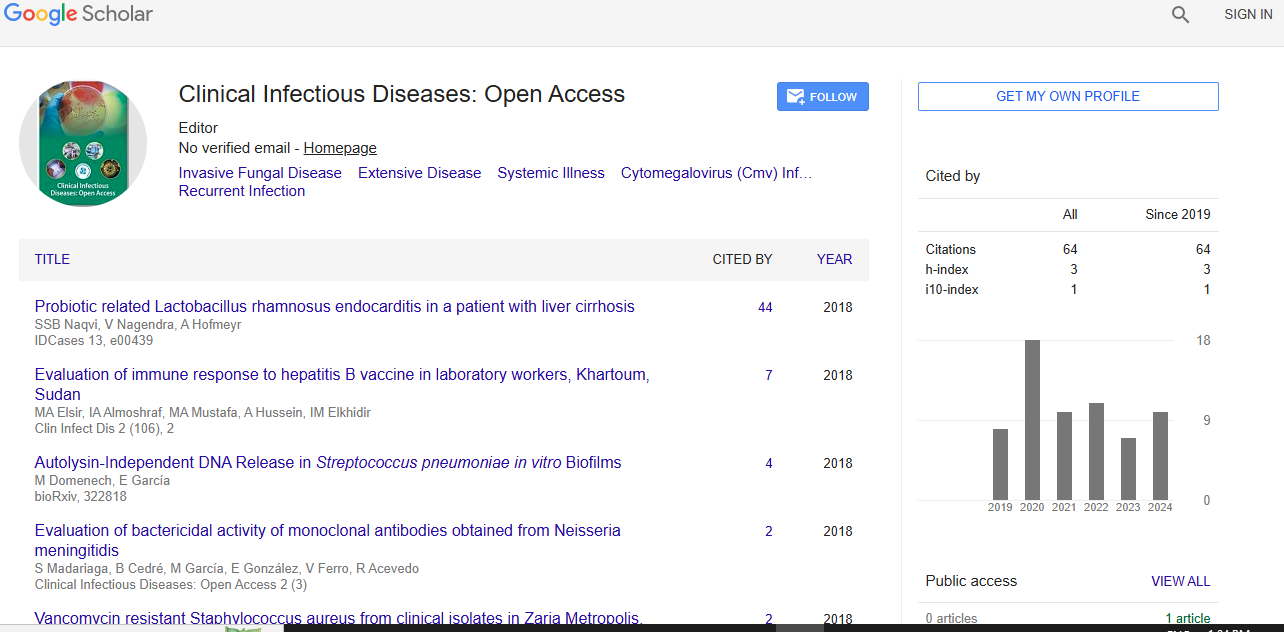
Clinical Infectious Diseases: Open Access received 1149 citations as per Google Scholar report