Opinion - (2025) Volume 16, Issue 2
Received: 01-Apr-2025, Manuscript No. jbsbe-26-183287;
Editor assigned: 03-Apr-2025, Pre QC No. P-183287;
Reviewed: 17-Apr-2025, QC No. Q-183287;
Revised: 22-Apr-2025, Manuscript No. R-183287;
Published:
29-Apr-2025
, DOI: 10.37421/2165-6210.2025.16.493
Citation: Rahman, Aisha. ”Wearable Biosensors: Transforming Health Monitoring With Innovation.” J Biosens Bioelectron 16 (2025):493.
Copyright: © 2025 Rahman A. This is an open-access article distributed under the terms of the Creative Commons Attribution License, which permits unrestricted use, distribution and reproduction in any medium, provided the original author and source are credited.
Wearable biosensors are at the forefront of revolutionizing continuous health monitoring, offering real-time and non-invasive data collection capabilities that seamlessly integrate into daily life. These advanced devices are designed to capture a wide array of physiological signals, including crucial metrics like glucose levels, electrocardiogram (ECG) readings, and oxygen saturation, thereby facilitating early disease detection, personalized treatment strategies, and proactive wellness management. Ongoing advancements in materials science and miniaturization are instrumental in driving the development of biosensors that exhibit enhanced sensitivity, specificity, and biocompatibility. Despite significant progress, challenges persist in areas such as ensuring long-term stability, safeguarding data security, and navigating the complexities of regulatory approval, yet the potential benefits for improving patient outcomes and substantially reducing healthcare costs remain substantial [1].
An exploration into the integration of advanced nanomaterials into wearable biosensor platforms highlights their role in significantly enhancing sensitivity and specificity for the detection of various biomarkers. Novel conductive polymers and metal nanoparticles are detailed for their ability to improve signal transduction and reduce detection limits, making them suitable for chronic disease management applications. The importance of surface functionalization for specific analyte binding is emphasized, alongside a discussion of fabrication techniques that enable mass production of these sophisticated devices [2].
Focusing specifically on the critical area of non-invasive glucose monitoring, this research introduces a novel electrochemical biosensor employing flexible electrodes and sophisticated enzyme immobilization techniques. The primary objective is to achieve continuous, real-time glucose readings without the need for invasive skin punctures. The study critically examines challenges associated with sweat analysis, such as analyte variability and sensor drift, and proposes effective solutions aimed at improving the accuracy and reliability of these biosensors in wearable formats [3].
This article provides a deep dive into the critical aspects of data security and privacy within wearable health monitoring systems, meticulously examining the vulnerabilities inherent in the transmission and storage of sensitive physiological data collected by biosensors. The authors advocate for robust encryption protocols and innovative blockchain-based solutions to ensure data integrity, confidentiality, and user control, thereby addressing key concerns that are crucial for the widespread adoption of these technologies [4].
The development of flexible and stretchable electronics is underscored as a fundamental requirement for the creation of comfortable and effective wearable biosensors. This paper reviews the most recent advancements in both materials and fabrication techniques essential for producing sensors that can adeptly conform to the body's natural movements without any compromise in performance. The potential of these advanced materials for integrating multiple sensing modalities into a single, unobtrusive device is thoroughly discussed [5].
This study concentrates on optical-based wearable biosensors designed for the continuous monitoring of vital physiological parameters such as blood oxygen saturation and heart rate. It thoroughly explores the application of photoplethysmography (PPG) integrated into wearable devices and critically discusses signal processing techniques necessary to extract reliable health metrics from inherently noisy optical signals. The research underscores the significant potential for non-invasive, continuous monitoring of cardiovascular health through these advanced optical sensors [6].
The examination of the challenges and opportunities surrounding the clinical translation of wearable biosensors is a central theme. This paper meticulously discusses the various hurdles encountered in achieving regulatory approval, ensuring rigorous clinical validation, and successfully integrating these innovative devices into existing healthcare workflows. A strong emphasis is placed on the essential need for multidisciplinary collaboration among engineers, clinicians, and regulatory bodies to significantly accelerate the adoption of wearable biosensors for the ultimate improvement of patient care [7].
The application of artificial intelligence (AI) and machine learning (ML) in the sophisticated analysis of the vast quantities of data generated by wearable biosensors is the primary focus of this review. It thoroughly explores how AI/ML algorithms can be effectively utilized for intricate pattern recognition, precise anomaly detection, and the generation of personalized health predictions. The paper highlights the profound potential for AI-driven insights to substantially enhance the overall utility and impact of continuous health monitoring systems [8].
The integration of microfluidics with wearable biosensors presents a powerful and versatile platform for enabling lab-on-a-chip applications within the realm of health monitoring. This article elaborates on how microfluidic channels can facilitate precise sample handling and effective pre-concentration of biomarkers derived from bodily fluids such as sweat or interstitial fluid. It further highlights the distinct advantages offered by miniaturization and the improved assay performance essential for the accurate detection of a wide spectrum of health conditions [9].
This research focuses on the critical development of biocompatible and energy-efficient power sources specifically tailored for wearable biosensors. It provides a comprehensive review of various energy harvesting technologies, including triboelectric and piezoelectric generators, alongside miniaturized batteries suitable for long-term, continuous monitoring applications. The overarching goal is to enable the creation of self-powered or long-lasting wearable systems, thereby overcoming the inherent limitations associated with conventional battery replacements and ensuring sustained functionality [10].
Wearable biosensors are revolutionizing continuous health monitoring by enabling real-time, non-invasive data collection, seamlessly integrating into daily life and capturing physiological signals like glucose levels, ECG, and oxygen saturation, which facilitates early disease detection, personalized treatment, and proactive wellness management. Advancements in materials science and miniaturization are driving the development of more sensitive, selective, and biocompatible sensors, though challenges remain in long-term stability, data security, and regulatory approval, the potential for improving patient outcomes and reducing healthcare costs is substantial [1].
This paper delves into the integration of advanced nanomaterials into wearable biosensor platforms, aiming to enhance sensitivity and specificity in detecting various biomarkers. It details how novel conductive polymers and metal nanoparticles improve signal transduction and reduce detection limits for applications in chronic disease management, emphasizing the importance of surface functionalization for specific analyte binding and discussing fabrication techniques that enable mass production [2].
Focusing on non-invasive glucose monitoring, this research presents a novel electrochemical biosensor utilizing flexible electrodes and advanced enzyme immobilization techniques to provide continuous, real-time glucose readings without skin punctures. The study discusses challenges related to sweat analysis, such as analyte variability and sensor drift, and proposes solutions for improving accuracy and reliability in wearable formats [3].
This article critically examines the vital aspect of data security and privacy for wearable health monitoring systems, analyzing vulnerabilities in transmitting and storing sensitive physiological data collected by biosensors. The authors propose robust encryption protocols and blockchain-based solutions to ensure data integrity, confidentiality, and user control, addressing key concerns for widespread adoption [4].
The development of flexible and stretchable electronics is highlighted as crucial for comfortable and effective wearable biosensors. This paper reviews the latest advancements in materials and fabrication techniques for creating sensors that conform to body movements without compromising performance, discussing the potential for integrating multiple sensing modalities into a single, unobtrusive device [5].
This study concentrates on optical-based wearable biosensors for monitoring physiological parameters like blood oxygen saturation and heart rate. It explores the use of photoplethysmography (PPG) integrated into wearable devices and discusses signal processing techniques to extract reliable health metrics from noisy optical signals, emphasizing the potential for non-invasive, continuous monitoring of cardiovascular health [6].
The challenges and opportunities in the clinical translation of wearable biosensors are examined. This paper discusses hurdles in achieving regulatory approval, ensuring clinical validation, and integrating these devices into existing healthcare workflows, stressing the need for multidisciplinary collaboration between engineers, clinicians, and regulatory bodies to accelerate adoption for improved patient care [7].
This review focuses on the application of artificial intelligence (AI) and machine learning (ML) in analyzing the vast amounts of data generated by wearable biosensors. It explores how AI/ML algorithms can be used for pattern recognition, anomaly detection, and personalized health predictions, discussing the potential for AI-driven insights to enhance the utility of continuous health monitoring systems [8].
The integration of microfluidics with wearable biosensors offers a powerful platform for lab-on-a-chip applications in health monitoring. This article discusses how microfluidic channels enable precise sample handling and pre-concentration of biomarkers from bodily fluids like sweat or interstitial fluid, highlighting the benefits of miniaturization and improved assay performance for detecting various health conditions [9].
This research explores the development of biocompatible and energy-efficient power sources for wearable biosensors. It reviews energy harvesting technologies, such as triboelectric and piezoelectric generators, and miniaturized batteries suitable for long-term, continuous monitoring, focusing on enabling self-powered or long-lasting systems to overcome conventional battery limitations [10].
Wearable biosensors are transforming health monitoring through real-time, non-invasive data collection. Advancements in materials science and miniaturization are leading to more sensitive and biocompatible devices capable of tracking physiological signals for early disease detection and personalized treatment. Nanomaterials enhance sensor performance, while flexible and stretchable electronics improve comfort and integration. Optical and electrochemical methods are employed for monitoring various biomarkers, including glucose. Addressing challenges like data security, privacy, and clinical translation is crucial for widespread adoption. Integration with microfluidics and the application of AI/ML for data analysis are further enhancing capabilities. Developing efficient and biocompatible power sources is also key to enabling long-term, continuous monitoring. These innovations hold significant promise for improving patient outcomes and reducing healthcare costs.
None
None
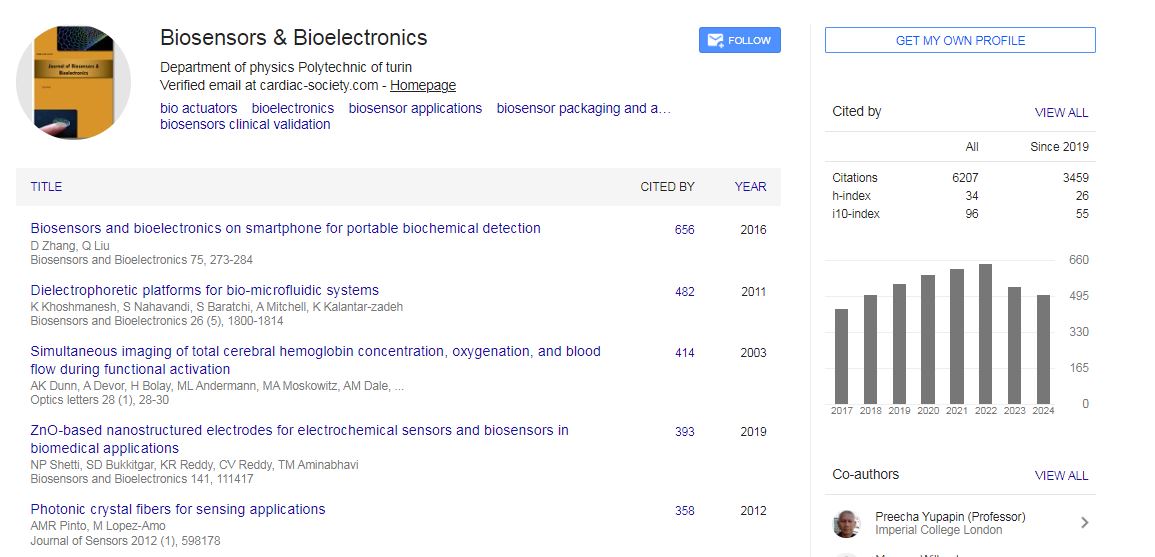
Biosensors & Bioelectronics received 6207 citations as per Google Scholar report