Opinion - (2025) Volume 14, Issue 3
Received: 01-Sep-2025, Manuscript No. jms-25-172640;
Editor assigned: 03-Sep-2025, Pre QC No. P-172640;
Reviewed: 17-Sep-2025, QC No. Q-172640;
Revised: 24-Sep-2025, Manuscript No. R-172640;
Published:
30-Sep-2025
, DOI: 10.37421/2167-0943.2024.14.413
Citation: Nkosi, Thabo. "Visceral Fat: Health Risks, Factors, and Strategies." J Metabolic Synd 14 (2025):413.
Copyright: © 2025 Nkosi T. This is an open-access article distributed under the terms of the Creative Commons Attribution License, which permits unrestricted use, distribution
and reproduction in any medium, provided the original author and source are credited.
Understanding the critical role of visceral adipose tissue (VAT) in various health risks is paramount. This tissue exhibits active metabolic and endocrine functions beyond simple energy storage. Its accumulation significantly contributes to metabolic syndrome, cardiovascular diseases, and certain cancers, influencing current knowledge and future research for therapeutic interventions[1].
Investigating the impact of diverse exercise modalities on reducing VAT and liver fat in overweight and obese adults, research indicates that both aerobic and resistance training are effective. Notably, High-Intensity Interval Training (HIIT) shows promising results for visceral fat reduction, providing clear guidance for exercise interventions[2].
Complementing exercise, various dietary strategies can reduce abdominal obesity. Evidence from randomized controlled trials identifies specific dietary patterns, such as reduced refined carbohydrates and increased fiber, consistently associated with significant reductions in belly fat, offering practical dietary recommendations[3].
The complex interplay between adipose tissue inflammation and fibrosis in obesity, particularly how these processes contribute to metabolic dysfunction, is crucial. An unhealthy expansion of belly fat leads to a chronic inflammatory state, exacerbating insulin resistance and other metabolic disorders through specific cellular and molecular mechanisms[4].
Significant sex differences exist in visceral adiposity accumulation and its distinct impacts on cardiometabolic health. Hormonal influences, especially sex hormones, contribute to varying patterns of belly fat distribution between men and women, translating into divergent risks for metabolic and cardiovascular diseases[5].
Furthermore, genetic and epigenetic factors govern adipose tissue development and function, shedding light on the predisposition to accumulate belly fat. Genetic variants and epigenetic modifications influence fat distribution, adipocyte biology, and overall metabolic health, suggesting avenues for personalized prevention and treatment strategies[6].
The relationship between psychological stress, cortisol levels, and abdominal adiposity accumulation is another key area. Chronic stress can dysregulate the Hypothalamic-Pituitary-Adrenal (HPA) axis, increasing cortisol secretion, which promotes visceral fat deposition and exacerbates metabolic risk factors, underscoring the importance of stress management in obesity prevention[7].
The intricate relationship between gut microbiota composition and visceral adiposity accumulation is also explored. Alterations in the gut microbial ecosystem can influence energy harvest, immune responses, and metabolic pathways, thereby contributing to the development and progression of belly fat and associated metabolic disorders[8].
Aging introduces changes in adipose tissue function and distribution, with an increased propensity for visceral fat accumulation. Aging leads to adipocyte senescence, inflammation, and metabolic dysfunction within belly fat, contributing to age-related metabolic diseases and highlighting potential therapeutic targets[9].
Ultimately, visceral adiposity is emphasized as a stronger predictor of cardiovascular disease risk than general obesity measures like Body Mass Index (BMI). The unique pathological contributions of belly fat to atherosclerosis, hypertension, and heart failure clarify why a shift towards direct assessment of visceral fat is urged for better risk stratification and management[10].
Visceral adipose tissue (VAT), commonly known as belly fat, plays a critical and active role in various health risks, extending beyond simple energy storage [1]. This tissue performs dynamic metabolic and endocrine functions, significantly contributing to conditions like metabolic syndrome, cardiovascular diseases, and certain cancers, guiding future therapeutic interventions [1]. Notably, visceral adiposity is a stronger predictor of cardiovascular disease risk than general obesity measures like Body Mass Index (BMI) [10]. Its unique pathological contributions to atherosclerosis, hypertension, and heart failure underscore the imperative for direct assessment of visceral fat for improved risk stratification and clinical management [10].
Effective strategies for managing and reducing visceral fat largely involve lifestyle modifications. A systematic review and meta-analysis demonstrated that diverse exercise modalities can reduce visceral adipose tissue and liver fat in overweight and obese adults [2]. Both aerobic and resistance training are effective, with High-Intensity Interval Training (HIIT) showing promising results for visceral fat reduction, offering clear guidance for interventions [2]. Alongside exercise, specific dietary approaches are crucial for combating abdominal obesity [3]. Randomized controlled trials reveal that dietary patterns, such as reduced refined carbohydrates and increased fiber, are consistently linked to significant reductions in belly fat, providing practical dietary recommendations [3].
The biological underpinnings of visceral fat accumulation and its health impacts are complex. Adipose tissue inflammation and fibrosis are key processes contributing to metabolic dysfunction in obesity [4]. The unhealthy expansion of belly fat leads to a chronic inflammatory state, exacerbating insulin resistance and other metabolic disorders at cellular and molecular levels [4]. Furthermore, genetic and epigenetic factors regulate adipose tissue development and function, providing insights into predispositions for belly fat accumulation [6]. Genetic variants and epigenetic modifications influence fat distribution, adipocyte biology, and overall metabolic health, suggesting avenues for personalized prevention and treatment [6].
Beyond genetics, various environmental and internal factors profoundly influence visceral adiposity. Chronic psychological stress is robustly linked to elevated cortisol levels and subsequent abdominal adiposity [7]. Persistent stress can dysregulate the Hypothalamic-Pituitary-Adrenal (HPA) axis, increasing cortisol secretion, which promotes visceral fat deposition and worsens metabolic risk factors, emphasizing stress management in obesity prevention [7]. The intricate relationship between gut microbiota composition and visceral adiposity is also significant [8]. Alterations in the gut microbial ecosystem influence energy harvest, immune responses, and metabolic pathways, contributing to belly fat development and associated metabolic disorders [8]. Moreover, aging leads to changes in adipose tissue function and distribution, with an increased propensity for visceral fat accumulation. This involves adipocyte senescence, inflammation, and metabolic dysfunction within belly fat, contributing to age-related metabolic diseases and highlighting therapeutic targets [9].
It is essential to acknowledge significant sex differences in visceral adiposity accumulation and its distinct impacts on cardiometabolic health [5]. Hormonal influences, particularly sex hormones, contribute to varying patterns of belly fat distribution between men and women. These differences translate into divergent risks for metabolic and cardiovascular diseases, necessitating sex-specific considerations in prevention and treatment [5]. The collective research presented underscores that a thorough understanding of the multifaceted nature of visceral adipose tissue is crucial for developing targeted interventions and improving public health outcomes across diverse populations.
Visceral adipose tissue (VAT) is recognized as a metabolically active and endocrine organ, playing a critical role in various health risks beyond simple energy storage. Its accumulation significantly contributes to metabolic syndrome, cardiovascular diseases, and certain cancers, underscoring its importance in health outcomes. Effective strategies for reducing VAT include both aerobic and resistance exercise, with High-Intensity Interval Training showing particular promise. Dietary interventions, such as reducing refined carbohydrates and increasing fiber, are also consistently linked to significant reductions in abdominal fat. Underlying mechanisms involve complex interactions like adipose tissue inflammation and fibrosis, which exacerbate metabolic dysfunction and insulin resistance. Genetic and epigenetic factors influence fat distribution and adipocyte biology, offering insights for personalized prevention strategies. Psychological stress, elevated cortisol levels, and gut microbiota composition are identified as crucial environmental and internal factors affecting visceral fat accumulation. Aging processes also contribute to increased visceral fat, involving adipocyte senescence and inflammation. Furthermore, significant sex differences exist in how visceral adiposity accumulates and impacts cardiometabolic health, influenced by hormonal factors. Finally, visceral adiposity is highlighted as a stronger predictor of cardiovascular disease risk than Body Mass Index, urging a shift towards direct assessment for better risk management.
None
None
Indexed at, Google Scholar, Crossref
Indexed at, Google Scholar, Crossref
Indexed at, Google Scholar, Crossref
Indexed at, Google Scholar, Crossref
Indexed at, Google Scholar, Crossref
Indexed at, Google Scholar, Crossref
Indexed at, Google Scholar, Crossref
Indexed at, Google Scholar, Crossref
Indexed at, Google Scholar, Crossref
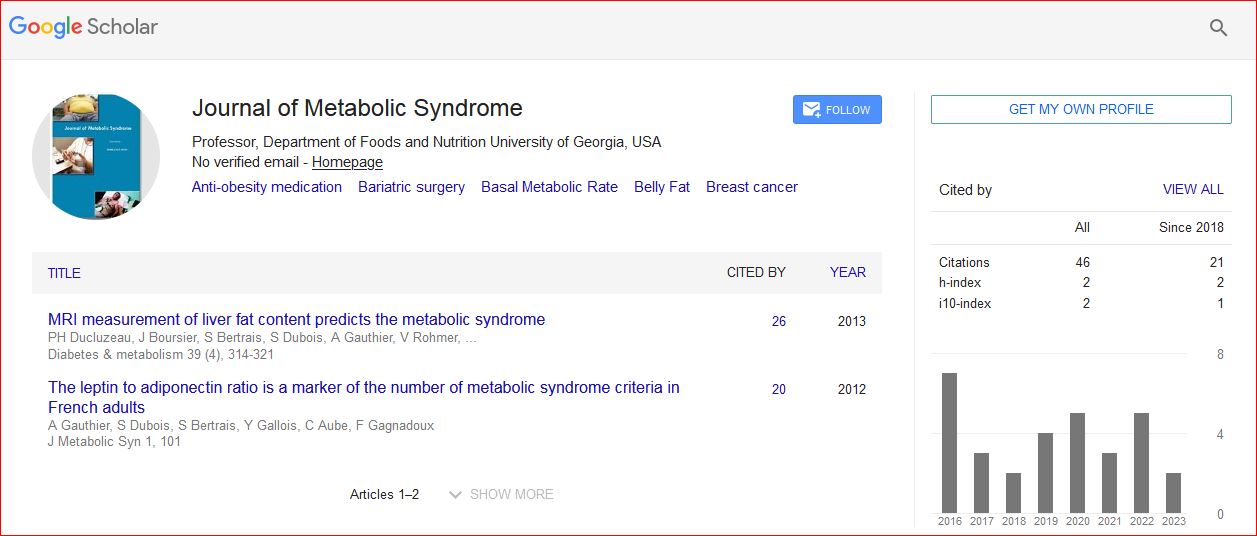
Journal of Metabolic Syndrome received 48 citations as per Google Scholar report