Perspective - (2025) Volume 16, Issue 3
Received: 02-Jun-2025, Manuscript No. jvst-26-188014;
Editor assigned: 04-Jun-2025, Pre QC No. P-188014;
Reviewed: 18-Jun-2025, QC No. Q-188014;
Revised: 23-Jun-2025, Manuscript No. R-188014;
Published:
30-Jun-2025
, DOI: 10.37421/2157-7579.2025.16.300
Citation: Benali, Youssef. ”Veterinary Viral Threats: A One Health
Imperative.” J Vet Sci Techno 16 (2025):300.
Copyright: © 2025 Benali Y. This is an open-access article distributed under the terms of the Creative Commons Attribution License, which permits unrestricted use, distribution
and reproduction in any medium, provided the original author and source are credited.
Emerging viral infections in veterinary medicine present a complex and ever-changing hurdle, with significant ramifications for animal welfare, public health, and the global economy. This dynamic field requires continuous investigation and adaptation to effectively manage novel zoonotic and non-zoonotic viral threats. Understanding these emerging threats involves a multi-faceted approach, encompassing enhanced surveillance systems to detect early signs of disease outbreaks and track their spread.
The rapid identification and characterization of novel viral agents are paramount in controlling emerging infectious diseases, allowing for timely interventions and mitigation strategies. These advancements are critical for early detection and targeted intervention strategies, enabling swift responses to potential pandemics. Zoonotic viral spillover events, where viruses jump from animals to humans, pose a persistent threat to both animal and human populations, necessitating a thorough understanding of the factors driving these events. The complex interplay of ecological, environmental, and anthropogenic factors contributes to the emergence and transmission of these viruses in veterinary settings. The development of effective vaccines against emerging viral pathogens is a critical component of disease control in veterinary medicine, offering a proactive defense against widespread outbreaks. Recent advancements in vaccine platforms hold significant promise for rapid deployment against novel viral threats. Antiviral therapies play a crucial role in managing outbreaks of emerging viral infections in veterinary medicine, providing direct means to combat active infections. An overview of current and experimental antiviral drugs highlights the ongoing efforts to develop new therapeutic options. Surveillance of emerging viral infections in wildlife is fundamental for early detection and prevention of spillover events, acting as an early warning system for potential threats to domestic animals and humans. Robust wildlife surveillance programs are essential for identifying novel viruses and understanding their dynamics. Understanding the host-pathogen interactions at the molecular level is critical for developing effective control measures against emerging viral diseases, providing insights into how viruses cause disease. This deeper comprehension aids in developing targeted interventions. The economic impact of emerging viral infections on the livestock industry is substantial, necessitating effective risk management strategies to protect food security and livelihoods. Analyzing the economic consequences of outbreaks highlights the importance of robust disease control. The role of arthropod vectors in the transmission of emerging viral infections in animals is a critical area of research, particularly in the context of changing environmental conditions. Investigating the epidemiology and control of arboviral diseases affecting livestock is crucial for preventing widespread disease. Public health preparedness for emerging viral diseases requires strong collaboration between veterinary and human health sectors, underscoring the interconnectedness of animal and human well-being. Integrated strategies and challenges in managing zoonotic viral threats are essential for a comprehensive response.Emerging viral infections in veterinary medicine represent a significant and evolving challenge, impacting animal health, public health, and global economies. This review delves into the latest developments in understanding, diagnosing, and controlling these novel zoonotic and non-zoonotic viral threats. Key insights include the critical role of enhanced surveillance systems, the application of advanced molecular diagnostics and sequencing technologies for rapid pathogen identification, and the development of innovative vaccine and therapeutic strategies. The importance of interdisciplinary collaboration, involving veterinarians, epidemiologists, virologists, and public health officials, is highlighted as essential for effective preparedness and response to future outbreaks [1].
The rapid identification and characterization of novel viral agents are paramount in controlling emerging infectious diseases. This paper discusses the utility of next-generation sequencing (NGS) technologies in veterinary diagnostics, enabling the swift discovery of previously unknown viruses and providing insights into their genetic diversity and evolutionary trajectories. The application of bioinformatics tools for sequence analysis and phylogenetic reconstruction is also emphasized, facilitating an understanding of viral transmission patterns and origins. This technological advancement is crucial for early detection and targeted intervention strategies [2].
Zoonotic viral spillover events pose a persistent threat to animal and human populations. This article examines the complex interplay of ecological, environmental, and anthropogenic factors that contribute to the emergence and transmission of zoonotic viruses in veterinary settings. It highlights the importance of a 'One Health' approach, advocating for integrated efforts across human, animal, and environmental health sectors to predict, prevent, and respond to these cross-species infections. Strategies for risk assessment and mitigation at the human-animal interface are explored [3].
The development of effective vaccines against emerging viral pathogens is a critical component of disease control in veterinary medicine. This review focuses on recent advancements in vaccine platforms, including mRNA, viral vector, and subunit vaccines, and their potential for rapid deployment against novel viral threats. Challenges related to vaccine efficacy, safety, and equitable global distribution are discussed. The role of animal vaccination in preventing zoonotic transmission and mitigating economic losses is also underscored [4].
Antiviral therapies play a crucial role in managing outbreaks of emerging viral infections in veterinary medicine. This article provides an overview of current and experimental antiviral drugs targeting a range of veterinary viruses. It examines the mechanisms of action, pharmacokinetic properties, and clinical efficacy of these agents. The challenges associated with drug resistance, treatment accessibility, and the need for broad-spectrum antivirals are also addressed, emphasizing the ongoing research efforts to develop new therapeutic options [5].
Surveillance of emerging viral infections in wildlife is fundamental for early detection and prevention of spillover events. This paper highlights the importance of robust wildlife surveillance programs, employing diverse diagnostic techniques and epidemiological approaches. It discusses the challenges in sampling and detecting novel viruses in wild animal populations and emphasizes the value of international collaboration and data sharing for understanding viral dynamics and host-pathogen interactions. This proactive approach is key to mitigating future pandemics [6].
Understanding the host-pathogen interactions at the molecular level is critical for developing effective control measures against emerging viral diseases. This study investigates the cellular and molecular mechanisms by which a novel veterinary virus infects its host, focusing on viral entry, replication, and immune evasion strategies. The findings provide insights into potential therapeutic targets and strategies for host resistance, contributing to a deeper comprehension of viral pathogenesis [7].
The economic impact of emerging viral infections on the livestock industry is substantial, necessitating effective risk management strategies. This article analyzes the economic consequences of recent viral outbreaks in livestock, including direct losses from mortality and morbidity, as well as indirect costs associated with trade restrictions, disease control measures, and reduced productivity. It underscores the importance of biosecurity, early detection, and rapid response systems to mitigate these economic burdens and ensure food security [8].
The role of arthropod vectors in the transmission of emerging viral infections in animals is a critical area of research. This paper investigates the epidemiology and control of arboviral diseases affecting livestock, examining the complex interplay between vector populations, host susceptibility, and viral circulation. It highlights the impact of climate change on vector distribution and the emergence of novel arboviral threats. Integrated pest management and vector control strategies are discussed as essential components of disease prevention [9].
Public health preparedness for emerging viral diseases requires strong collaboration between veterinary and human health sectors. This article examines the interdisciplinary strategies and challenges in managing zoonotic viral threats, emphasizing the need for integrated surveillance, data sharing, and joint response mechanisms. It highlights the importance of training veterinary professionals in public health principles and the role of diagnostic laboratories in detecting and characterizing novel zoonotic agents. A unified 'One Health' approach is crucial for safeguarding both animal and human populations [10].
Emerging viral infections in veterinary medicine pose significant threats to animal and public health, requiring robust strategies for understanding, diagnosis, and control. Key advancements include enhanced surveillance, rapid pathogen identification through next-generation sequencing, and innovative vaccine and therapeutic development. Zoonotic spillover events are driven by complex ecological and anthropogenic factors, emphasizing the need for a 'One Health' approach. Wildlife surveillance and molecular studies of host-pathogen interactions are crucial for early detection and effective interventions. The economic impact on the livestock sector necessitates strong risk management, while understanding vector-borne transmission is vital for prevention. Interdisciplinary collaboration between veterinary and human health sectors is essential for comprehensive preparedness and response to global viral threats.
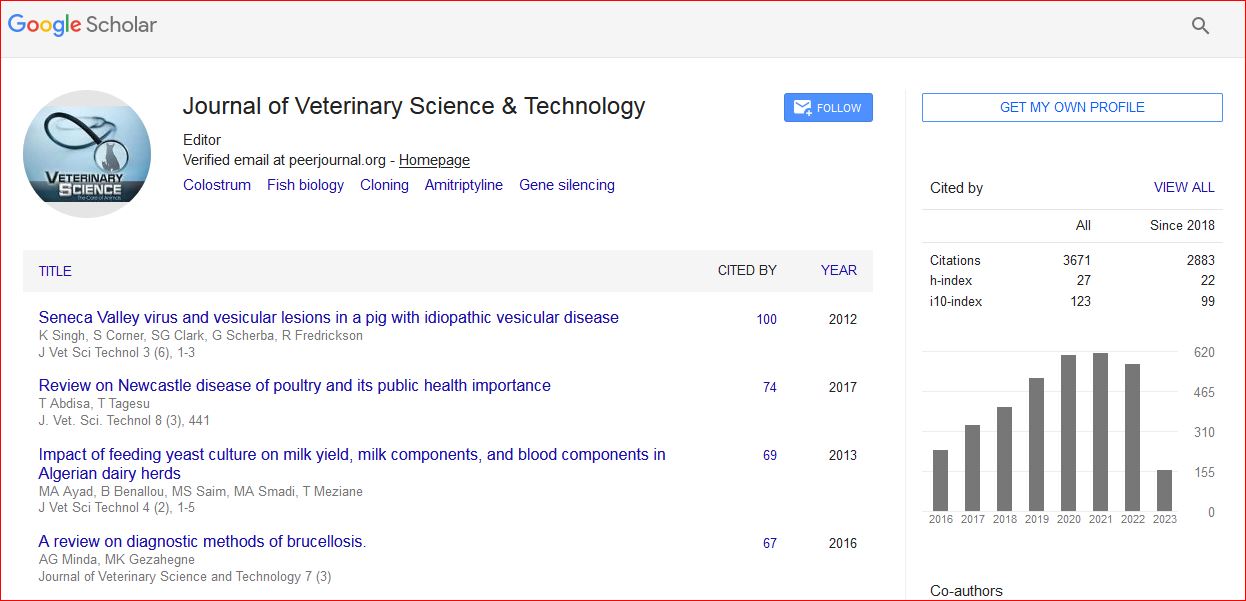
Veterinary Science & Technology received 4472 citations as per Google Scholar report