Perspective - (2025) Volume 16, Issue 6
Received: 01-Dec-2025, Manuscript No. jvst-26-188139;
Editor assigned: 03-Dec-2025, Pre QC No. P-188139;
Reviewed: 17-Dec-2025, QC No. Q-188139;
Revised: 22-Dec-2025, Manuscript No. R-188139;
Published:
29-Dec-2025
, DOI: 10.37421/2157-7579.2025.16.331
Citation: Bianchi, Lucia. ”Veterinary Science Advancements:
Diverse Species, Novel Solutions.” J Vet Sci Techno 16 (2025):331.
Copyright: © 2025 Bianchi L. This is an open-access article distributed under the terms of the Creative Commons Attribution License, which permits unrestricted use,
distribution and reproduction in any medium, provided the original author and source are credited.
The field of veterinary science is continually advancing, driven by the need to enhance animal health, welfare, and productivity across diverse species. Significant research efforts are directed towards understanding and mitigating diseases that affect livestock, companion animals, and laboratory animals alike. One critical area of investigation involves the development of novel interventions, such as dietary supplements, that can bolster the immune system and improve overall health outcomes in cattle. These interventions aim to increase disease resistance, thereby reducing economic losses and improving the sustainability of animal agriculture [1].
In parallel, the rapid detection and control of infectious diseases in poultry are paramount to ensuring food security and preventing widespread outbreaks. The development of highly sensitive and specific diagnostic assays plays a crucial role in disease surveillance and management strategies for commercial flocks. Such tools allow for timely identification of pathogens, enabling prompt implementation of containment measures and minimizing the spread of infection [2].
The growing concern over antimicrobial resistance (AMR) presents a global health challenge that extends to veterinary medicine. Understanding the prevalence and the underlying risk factors associated with AMR in companion animals is essential for developing effective strategies to combat this threat. This research is vital for guiding responsible antimicrobial stewardship in veterinary practice to preserve the efficacy of these critical drugs [3].
Protecting livestock from endemic and emerging diseases remains a priority, and the development of effective vaccines is a cornerstone of preventative medicine. The evaluation of new vaccine candidates against specific tick-borne diseases in sheep, for instance, is crucial for enhancing herd immunity and reducing the incidence of clinical disease. Successful vaccination strategies can lead to significant improvements in animal welfare and farm economics [4].
Epidemiological studies provide invaluable insights into the distribution and patterns of infectious diseases within animal populations. A thorough retrospective analysis of epidemiological data for canine leptospirosis, for example, can identify geographical hotspots and seasonal trends. This information is fundamental for designing targeted prevention and control programs, ultimately reducing disease burden in canine populations [5].
Animal welfare is an increasingly important consideration in various settings, including research. Investigating the impact of environmental enrichment on the welfare and stress levels of laboratory rodents is critical for ensuring ethical research practices and obtaining reliable scientific data. Understanding how environmental stimuli influence physiological and behavioral indicators of well-being is key to improving the quality of life for these animals [6].
The genetic diversity within parasitic organisms that affect livestock is a significant factor influencing disease pathogenesis and the potential for resistance to control measures. Characterizing the genetic makeup of these parasites, including their evolutionary potential, provides a basis for developing more effective and sustainable parasite control strategies, safeguarding animal health and productivity [7].
Technological advancements are revolutionizing veterinary diagnostics, with artificial intelligence (AI) emerging as a powerful tool. The application of AI in analyzing veterinary radiographic images for diagnosing skeletal abnormalities in horses, for example, offers the potential for more accurate and efficient diagnostic processes. This can lead to earlier detection and improved treatment outcomes for equine patients [8].
The judicious use of antimicrobial drugs in food-producing animals is essential for both animal health and public health. Understanding the pharmacokinetic profile of new antimicrobial agents in swine is crucial for optimizing their efficacy and minimizing the development of resistance. This involves detailed studies of how these drugs are absorbed, distributed, metabolized, and excreted in the target species [9].
Zoonotic diseases, which can be transmitted between animals and humans, pose a significant public health concern. Research into the molecular mechanisms underlying these diseases, including host-pathogen interactions, is vital for developing effective antiviral therapies and public health interventions. A deeper understanding of these interactions can lead to improved prevention and treatment strategies for both animals and humans [10].
The impact of innovative dietary supplements on the immune response and gut microbiota of cattle is a subject of considerable research interest. Such supplements are being investigated for their potential to enhance disease resistance and promote overall health in livestock. Preliminary findings indicate that these supplements can induce significant shifts in the composition of specific bacterial populations within the gut, alongside an upregulation of immune marker expression. This suggests a promising pathway for improving the health and management of cattle populations, potentially leading to reduced reliance on antibiotics and improved animal welfare [1].
In the realm of avian health, the development and validation of novel diagnostic assays for the early detection of viral pathogens are of paramount importance. A recent study focused on the efficacy of a new assay for identifying avian influenza virus. Validation against established gold-standard methods confirmed high levels of sensitivity and specificity. This advancement provides a valuable tool for rapid disease surveillance and the implementation of effective control strategies in commercial poultry operations, thereby safeguarding animal health and agricultural output [2].
Antimicrobial resistance (AMR) represents a growing threat in both human and animal health. Research efforts are underway to understand the prevalence and associated risk factors of AMR in companion animals. Analysis of clinical isolates has revealed concerning patterns in resistance, highlighting an urgent need for responsible antimicrobial stewardship within veterinary practice. This includes promoting judicious antibiotic use and exploring alternative therapeutic approaches to preserve the effectiveness of existing antimicrobial drugs [3].
The efficacy of novel vaccine formulations against prevalent animal diseases is a critical area of research aimed at improving animal health outcomes. A study examining a new vaccine against a specific tick-borne disease in sheep demonstrated significant benefits. Field trials reported a marked reduction in clinical signs and parasite load in vaccinated animals, indicating enhanced protection and improved disease management for affected flocks [4].
Epidemiological surveillance and analysis are fundamental for understanding and controlling infectious diseases in animal populations. A retrospective analysis of epidemiological data pertaining to leptospirosis in dogs has provided valuable insights. The findings have elucidated geographical hotspots and seasonal variations in disease occurrence, offering crucial information for the development of targeted prevention and control strategies to mitigate the impact of this zoonotic disease [5].
Animal welfare is a cornerstone of ethical research and responsible animal husbandry. Investigations into the effects of environmental enrichment on the welfare and stress physiology of laboratory rodents have yielded significant results. The study demonstrated that providing appropriate environmental stimuli led to a notable reduction in corticosterone levels, a key stress hormone, and improved behavioral indicators associated with well-being, contributing to more humane research practices [6].
Understanding the genetic diversity of pathogens and parasites is crucial for developing effective disease control strategies. Research focused on characterizing the genetic makeup of a key parasitic organism affecting livestock has revealed the presence of distinct genetic lineages. Furthermore, the study identified potential evolutionary pathways that could lead to the development of resistance, informing the design of future control measures to ensure their long-term efficacy [7].
The integration of advanced technologies, such as artificial intelligence (AI), is transforming diagnostic capabilities in veterinary medicine. A study exploring the application of AI in analyzing radiographic images of horses for skeletal abnormalities has shown promising results. The preliminary findings suggest that AI algorithms can achieve accuracy rates comparable to those of experienced radiologists, paving the way for more efficient and reliable diagnoses of equine orthopedic conditions [8].
The pharmacokinetic properties of antimicrobial agents are essential for their rational use in animal health. Research has been conducted to investigate the pharmacokinetic profile of a novel antimicrobial drug in swine. Understanding the absorption, distribution, metabolism, and excretion of this drug is vital for establishing optimal dosage regimens, ensuring therapeutic efficacy, and minimizing the risk of developing antimicrobial resistance in swine populations [9].
Zoonotic diseases, which can be transmitted between animals and humans, require in-depth investigation to develop effective countermeasures. A study examining the molecular mechanisms underlying a specific zoonotic disease has identified novel viral targets and elucidated key host-pathogen interactions. This fundamental research has the potential to inform the development of improved antiviral therapies and public health interventions to combat these diseases [10].
This collection of research highlights advancements in veterinary science across various animal species. Studies cover the development of novel dietary supplements to boost cattle immunity and gut health, alongside new diagnostic assays for early detection of diseases in poultry. Significant attention is given to addressing antimicrobial resistance in companion animals and evaluating new vaccine efficacy for sheep. Epidemiological analyses are providing insights into disease patterns, while research on environmental enrichment aims to improve laboratory animal welfare. Genetic characterization of parasites informs control strategies, and the application of artificial intelligence is enhancing equine diagnostics. Finally, studies on pharmacokinetics of antimicrobial drugs in swine and molecular mechanisms of zoonotic diseases are crucial for effective treatment and public health interventions.
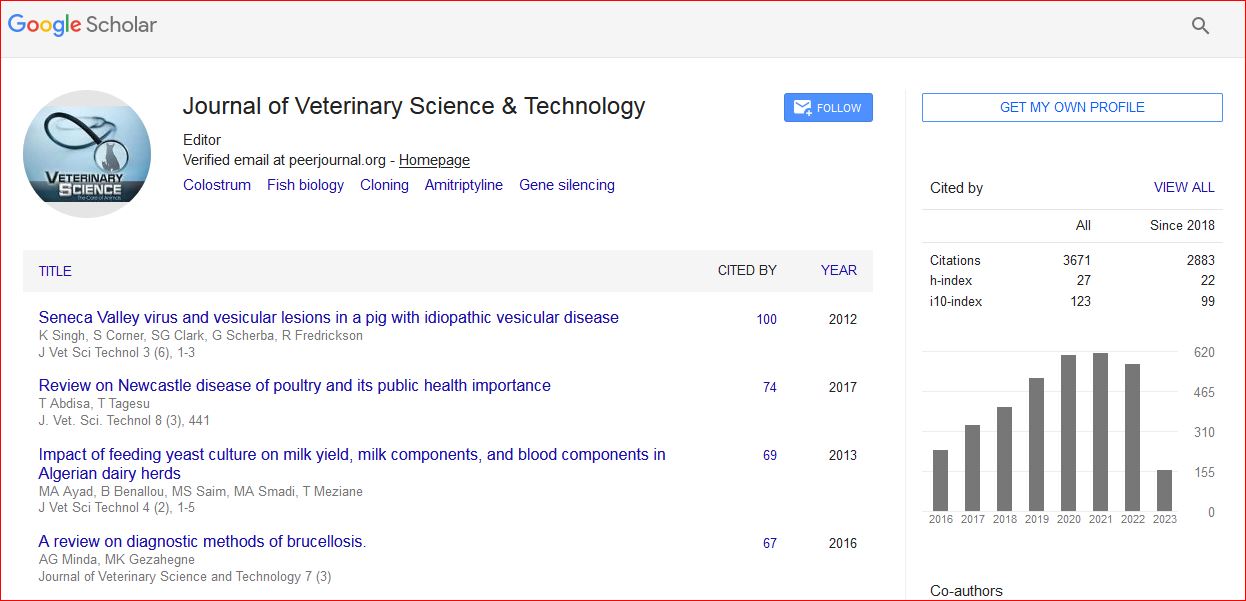
Veterinary Science & Technology received 4472 citations as per Google Scholar report