Brief Report - (2025) Volume 16, Issue 6
Received: 01-Dec-2025, Manuscript No. jvst-26-188137;
Editor assigned: 03-Dec-2025, Pre QC No. P-188137;
Reviewed: 17-Dec-2025, QC No. Q-188137;
Revised: 22-Dec-2025, Manuscript No. R-188137;
Published:
29-Dec-2025
, DOI: 10.37421/2157-7579.2025.16.329
Citation: El-Sayed, Ahmed. ”Veterinary Diagnostics: Advancements
in Technology and Precision.” J Vet Sci Techno 16 (2025):329.
Copyright: © 2025 El-Sayed A. This is an open-access article distributed under the terms of the Creative Commons Attribution License, which permits unrestricted use,
distribution and reproduction in any medium, provided the original author and source are credited.
Recent advancements in veterinary diagnostics are rapidly transforming disease detection and management, offering unprecedented capabilities for animal health professionals. Molecular techniques such as Polymerase Chain Reaction (PCR) and sequencing are now providing unparalleled sensitivity and specificity for identifying a wide range of pathogens. These sophisticated methods allow for the early and accurate detection of infectious agents, which is crucial for timely intervention and effective control strategies. Imaging technologies, including advanced Magnetic Resonance Imaging (MRI) and Computed Tomography (CT) scans, are providing detailed anatomical insights.
This level of detail is particularly crucial for diagnosing complex neurological and orthopedic conditions that might otherwise be challenging to assess. Point-of-care diagnostics and the development of biosensors are fundamentally changing how veterinary diagnostics are performed. These technologies enable faster, in-field testing, significantly reducing turnaround times. This acceleration facilitates immediate treatment decisions and improves overall patient care. Artificial intelligence (AI) and machine learning algorithms are increasingly being integrated into veterinary diagnostics. They are instrumental in analyzing large datasets, predicting potential disease outbreaks, and aiding in the interpretation of complex diagnostic images, thereby improving diagnostic accuracy and efficiency in veterinary practice. The application of next-generation sequencing (NGS) in veterinary diagnostics is revolutionizing our ability to identify and characterize infectious agents with remarkable precision. NGS allows for comprehensive pathogen detection, including novel or previously uncharacterized viruses, bacteria, and fungi, directly from clinical samples, offering a powerful tool for emerging disease identification. Point-of-care diagnostic tools are significantly improving the speed and accessibility of veterinary disease diagnosis, with devices ranging from rapid antigen tests to portable PCR systems enabling immediate testing at the farm or clinic. This rapid turnaround time is critical for prompt therapeutic interventions and effective disease control strategies. Artificial intelligence (AI) is emerging as a powerful adjunct in veterinary diagnostic imaging, with machine learning algorithms capable of detecting subtle abnormalities in radiographs, CT scans, and MRI images that might be missed by the human eye. This technological integration promises earlier disease detection and more precise treatment planning. The integration of omics technologies, such as genomics, transcriptomics, proteomics, and metabolomics, is providing a deeper understanding of disease mechanisms and aiding in the development of novel diagnostic biomarkers. These comprehensive analyses of biological systems are crucial for early disease detection and understanding complex host-pathogen interactions. Digital PCR (dPCR) offers enhanced precision and sensitivity for nucleic acid quantification compared to traditional quantitative PCR (qPCR). This technology is proving invaluable in veterinary diagnostics for detecting low-level infections and quantifying pathogen load with exceptional accuracy. The development of biosensors for veterinary disease diagnostics is paving the way for rapid, on-site detection of various analytes, including pathogens, antibodies, and disease biomarkers. These portable devices promise to reduce diagnostic times and improve disease surveillance, particularly in field settings. CRISPR-based diagnostic platforms are emerging as highly sensitive and specific tools for detecting nucleic acids of infectious agents in veterinary samples. These systems leverage the precision of CRISPR-Cas technology for rapid, cost-effective, and portable detection of specific DNA or RNA sequences. Liquid biopsies, encompassing the analysis of cell-free DNA (cfDNA) and circulating tumor DNA (ctDNA) in body fluids, are showing significant promise for non-invasive disease detection, particularly in veterinary oncology. These methods can aid in early diagnosis and monitoring treatment response, offering a less invasive alternative to traditional diagnostic procedures. [1] Recent advancements in veterinary diagnostics are rapidly transforming disease detection and management, offering unprecedented capabilities for animal health professionals. Molecular techniques such as Polymerase Chain Reaction (PCR) and sequencing are now providing unparalleled sensitivity and specificity for identifying a wide range of pathogens. These sophisticated methods allow for the early and accurate detection of infectious agents, which is crucial for timely intervention and effective control strategies. Imaging technologies, including advanced Magnetic Resonance Imaging (MRI) and Computed Tomography (CT) scans, are providing detailed anatomical insights. This level of detail is particularly crucial for diagnosing complex neurological and orthopedic conditions that might otherwise be challenging to assess. Point-of-care diagnostics and the development of biosensors are fundamentally changing how veterinary diagnostics are performed. These technologies enable faster, in-field testing, significantly reducing turnaround times. This acceleration facilitates immediate treatment decisions and improves overall patient care. Artificial intelligence (AI) and machine learning algorithms are increasingly being integrated into veterinary diagnostics. They are instrumental in analyzing large datasets, predicting potential disease outbreaks, and aiding in the interpretation of complex diagnostic images, thereby improving diagnostic accuracy and efficiency in veterinary practice. [2] The application of next-generation sequencing (NGS) in veterinary diagnostics is revolutionizing our ability to identify and characterize infectious agents with remarkable precision. NGS allows for comprehensive pathogen detection, including novel or previously uncharacterized viruses, bacteria, and fungi, directly from clinical samples, offering a powerful tool for emerging disease identification. Point-of-care diagnostic tools are significantly improving the speed and accessibility of veterinary disease diagnosis, with devices ranging from rapid antigen tests to portable PCR systems enabling immediate testing at the farm or clinic. This rapid turnaround time is critical for prompt therapeutic interventions and effective disease control strategies. Artificial intelligence (AI) is emerging as a powerful adjunct in veterinary diagnostic imaging, with machine learning algorithms capable of detecting subtle abnormalities in radiographs, CT scans, and MRI images that might be missed by the human eye. This technological integration promises earlier disease detection and more precise treatment planning. [3] The integration of omics technologies, such as genomics, transcriptomics, proteomics, and metabolomics, is providing a deeper understanding of disease mechanisms and aiding in the development of novel diagnostic biomarkers. These comprehensive analyses of biological systems are crucial for early disease detection and understanding complex host-pathogen interactions. Digital PCR (dPCR) offers enhanced precision and sensitivity for nucleic acid quantification compared to traditional quantitative PCR (qPCR). This technology is proving invaluable in veterinary diagnostics for detecting low-level infections and quantifying pathogen load with exceptional accuracy. The development of biosensors for veterinary disease diagnostics is paving the way for rapid, on-site detection of various analytes, including pathogens, antibodies, and disease biomarkers. These portable devices promise to reduce diagnostic times and improve disease surveillance, particularly in field settings. [4] Digital PCR (dPCR) offers enhanced precision and sensitivity for nucleic acid quantification compared to traditional quantitative PCR (qPCR). This technology is proving invaluable in veterinary diagnostics for detecting low-level infections and quantifying pathogen load with exceptional accuracy. The development of biosensors for veterinary disease diagnostics is paving the way for rapid, on-site detection of various analytes, including pathogens, antibodies, and disease biomarkers. These portable devices promise to reduce diagnostic times and improve disease surveillance, particularly in field settings. CRISPR-based diagnostic platforms are emerging as highly sensitive and specific tools for detecting nucleic acids of infectious agents in veterinary samples. These systems leverage the precision of CRISPR-Cas technology for rapid, cost-effective, and portable detection of specific DNA or RNA sequences. [5] The development of biosensors for veterinary disease diagnostics is paving the way for rapid, on-site detection of various analytes, including pathogens, antibodies, and disease biomarkers. These portable devices promise to reduce diagnostic times and improve disease surveillance, particularly in field settings. CRISPR-based diagnostic platforms are emerging as highly sensitive and specific tools for detecting nucleic acids of infectious agents in veterinary samples. These systems leverage the precision of CRISPR-Cas technology for rapid, cost-effective, and portable detection of specific DNA or RNA sequences. Liquid biopsies, encompassing the analysis of cell-free DNA (cfDNA) and circulating tumor DNA (ctDNA) in body fluids, are showing significant promise for non-invasive disease detection, particularly in veterinary oncology. These methods can aid in early diagnosis and monitoring treatment response, offering a less invasive alternative to traditional diagnostic procedures. [6] CRISPR-based diagnostic platforms are emerging as highly sensitive and specific tools for detecting nucleic acids of infectious agents in veterinary samples. These systems leverage the precision of CRISPR-Cas technology for rapid, cost-effective, and portable detection of specific DNA or RNA sequences. Liquid biopsies, encompassing the analysis of cell-free DNA (cfDNA) and circulating tumor DNA (ctDNA) in body fluids, are showing significant promise for non-invasive disease detection, particularly in veterinary oncology. These methods can aid in early diagnosis and monitoring treatment response, offering a less invasive alternative to traditional diagnostic procedures. Mass spectrometry-based proteomics is increasingly utilized for identifying novel biomarkers and understanding complex disease mechanisms in veterinary medicine. This technology allows for the high-throughput identification and quantification of proteins within biological samples. [7] Liquid biopsies, encompassing the analysis of cell-free DNA (cfDNA) and circulating tumor DNA (ctDNA) in body fluids, are showing significant promise for non-invasive disease detection, particularly in veterinary oncology. These methods can aid in early diagnosis and monitoring treatment response, offering a less invasive alternative to traditional diagnostic procedures. Mass spectrometry-based proteomics is increasingly utilized for identifying novel biomarkers and understanding complex disease mechanisms in veterinary medicine. This technology allows for the high-throughput identification and quantification of proteins within biological samples. The integration of omics technologies, such as genomics, transcriptomics, proteomics, and metabolomics, is providing a deeper understanding of disease mechanisms and aiding in the development of novel diagnostic biomarkers. [8] Mass spectrometry-based proteomics is increasingly utilized for identifying novel biomarkers and understanding complex disease mechanisms in veterinary medicine. This technology allows for the high-throughput identification and quantification of proteins within biological samples. The integration of omics technologies, such as genomics, transcriptomics, proteomics, and metabolomics, is providing a deeper understanding of disease mechanisms and aiding in the development of novel diagnostic biomarkers. These comprehensive analyses of biological systems are crucial for early disease detection and understanding complex host-pathogen interactions. Artificial intelligence (AI) and machine learning algorithms are increasingly being integrated into veterinary diagnostics. [9] The integration of omics technologies, such as genomics, transcriptomics, proteomics, and metabolomics, is providing a deeper understanding of disease mechanisms and aiding in the development of novel diagnostic biomarkers. These comprehensive analyses of biological systems are crucial for early disease detection and understanding complex host-pathogen interactions. Artificial intelligence (AI) and machine learning algorithms are increasingly being integrated into veterinary diagnostics. They are instrumental in analyzing large datasets, predicting potential disease outbreaks, and aiding in the interpretation of complex diagnostic images, thereby improving diagnostic accuracy and efficiency in veterinary practice. Point-of-care diagnostic tools are significantly improving the speed and accessibility of veterinary disease diagnosis. [10]Recent advancements in veterinary diagnostics are rapidly transforming disease detection and management, offering unprecedented capabilities for animal health professionals. Molecular techniques such as Polymerase Chain Reaction (PCR) and sequencing are now providing unparalleled sensitivity and specificity for identifying a wide range of pathogens. These sophisticated methods allow for the early and accurate detection of infectious agents, which is crucial for timely intervention and effective control strategies. Imaging technologies, including advanced Magnetic Resonance Imaging (MRI) and Computed Tomography (CT) scans, are providing detailed anatomical insights. This level of detail is particularly crucial for diagnosing complex neurological and orthopedic conditions that might otherwise be challenging to assess. Point-of-care diagnostics and the development of biosensors are fundamentally changing how veterinary diagnostics are performed. These technologies enable faster, in-field testing, significantly reducing turnaround times. This acceleration facilitates immediate treatment decisions and improves overall patient care.
Artificial intelligence (AI) and machine learning algorithms are increasingly being integrated into veterinary diagnostics. They are instrumental in analyzing large datasets, predicting potential disease outbreaks, and aiding in the interpretation of complex diagnostic images, thereby improving diagnostic accuracy and efficiency in veterinary practice. The application of next-generation sequencing (NGS) in veterinary diagnostics is revolutionizing our ability to identify and characterize infectious agents with remarkable precision. NGS allows for comprehensive pathogen detection, including novel or previously uncharacterized viruses, bacteria, and fungi, directly from clinical samples, offering a powerful tool for emerging disease identification. Point-of-care diagnostic tools are significantly improving the speed and accessibility of veterinary disease diagnosis, with devices ranging from rapid antigen tests to portable PCR systems enabling immediate testing at the farm or clinic. This rapid turnaround time is critical for prompt therapeutic interventions and effective disease control strategies. Artificial intelligence (AI) is emerging as a powerful adjunct in veterinary diagnostic imaging, with machine learning algorithms capable of detecting subtle abnormalities in radiographs, CT scans, and MRI images that might be missed by the human eye. This technological integration promises earlier disease detection and more precise treatment planning. [1] The application of next-generation sequencing (NGS) in veterinary diagnostics is revolutionizing our ability to identify and characterize infectious agents with remarkable precision. NGS allows for comprehensive pathogen detection, including novel or previously uncharacterized viruses, bacteria, and fungi, directly from clinical samples, offering a powerful tool for emerging disease identification. Point-of-care diagnostic tools are significantly improving the speed and accessibility of veterinary disease diagnosis, with devices ranging from rapid antigen tests to portable PCR systems enabling immediate testing at the farm or clinic. This rapid turnaround time is critical for prompt therapeutic interventions and effective disease control strategies. Artificial intelligence (AI) is emerging as a powerful adjunct in veterinary diagnostic imaging, with machine learning algorithms capable of detecting subtle abnormalities in radiographs, CT scans, and MRI images that might be missed by the human eye. This technological integration promises earlier disease detection and more precise treatment planning. [2] Point-of-care diagnostic tools are significantly improving the speed and accessibility of veterinary disease diagnosis, with devices ranging from rapid antigen tests to portable PCR systems enabling immediate testing at the farm or clinic. This rapid turnaround time is critical for prompt therapeutic interventions and effective disease control strategies. Artificial intelligence (AI) is emerging as a powerful adjunct in veterinary diagnostic imaging, with machine learning algorithms capable of detecting subtle abnormalities in radiographs, CT scans, and MRI images that might be missed by the human eye. This technological integration promises earlier disease detection and more precise treatment planning. The integration of omics technologies, such as genomics, transcriptomics, proteomics, and metabolomics, is providing a deeper understanding of disease mechanisms and aiding in the development of novel diagnostic biomarkers. [3] Artificial intelligence (AI) is emerging as a powerful adjunct in veterinary diagnostic imaging, with machine learning algorithms capable of detecting subtle abnormalities in radiographs, CT scans, and MRI images that might be missed by the human eye. This technological integration promises earlier disease detection and more precise treatment planning. The integration of omics technologies, such as genomics, transcriptomics, proteomics, and metabolomics, is providing a deeper understanding of disease mechanisms and aiding in the development of novel diagnostic biomarkers. These comprehensive analyses of biological systems are crucial for early disease detection and understanding complex host-pathogen interactions. Digital PCR (dPCR) offers enhanced precision and sensitivity for nucleic acid quantification compared to traditional quantitative PCR (qPCR). [4] The integration of omics technologies, such as genomics, transcriptomics, proteomics, and metabolomics, is providing a deeper understanding of disease mechanisms and aiding in the development of novel diagnostic biomarkers. These comprehensive analyses of biological systems are crucial for early disease detection and understanding complex host-pathogen interactions. Digital PCR (dPCR) offers enhanced precision and sensitivity for nucleic acid quantification compared to traditional quantitative PCR (qPCR). This technology is proving invaluable in veterinary diagnostics for detecting low-level infections and quantifying pathogen load with exceptional accuracy. The development of biosensors for veterinary disease diagnostics is paving the way for rapid, on-site detection of various analytes. [5] Digital PCR (dPCR) offers enhanced precision and sensitivity for nucleic acid quantification compared to traditional quantitative PCR (qPCR). This technology is proving invaluable in veterinary diagnostics for detecting low-level infections and quantifying pathogen load with exceptional accuracy. The development of biosensors for veterinary disease diagnostics is paving the way for rapid, on-site detection of various analytes, including pathogens, antibodies, and disease biomarkers. These portable devices promise to reduce diagnostic times and improve disease surveillance, particularly in field settings. CRISPR-based diagnostic platforms are emerging as highly sensitive and specific tools for detecting nucleic acids of infectious agents in veterinary samples. [6] The development of biosensors for veterinary disease diagnostics is paving the way for rapid, on-site detection of various analytes, including pathogens, antibodies, and disease biomarkers. These portable devices promise to reduce diagnostic times and improve disease surveillance, particularly in field settings. CRISPR-based diagnostic platforms are emerging as highly sensitive and specific tools for detecting nucleic acids of infectious agents in veterinary samples. These systems leverage the precision of CRISPR-Cas technology for rapid, cost-effective, and portable detection of specific DNA or RNA sequences. Liquid biopsies, encompassing the analysis of cell-free DNA (cfDNA) and circulating tumor DNA (ctDNA) in body fluids, are showing significant promise for non-invasive disease detection. [7] CRISPR-based diagnostic platforms are emerging as highly sensitive and specific tools for detecting nucleic acids of infectious agents in veterinary samples. These systems leverage the precision of CRISPR-Cas technology for rapid, cost-effective, and portable detection of specific DNA or RNA sequences. Liquid biopsies, encompassing the analysis of cell-free DNA (cfDNA) and circulating tumor DNA (ctDNA) in body fluids, are showing significant promise for non-invasive disease detection, particularly in veterinary oncology. These methods can aid in early diagnosis and monitoring treatment response, offering a less invasive alternative to traditional diagnostic procedures. Mass spectrometry-based proteomics is increasingly utilized for identifying novel biomarkers and understanding complex disease mechanisms in veterinary medicine. [8] Liquid biopsies, encompassing the analysis of cell-free DNA (cfDNA) and circulating tumor DNA (ctDNA) in body fluids, are showing significant promise for non-invasive disease detection, particularly in veterinary oncology. These methods can aid in early diagnosis and monitoring treatment response, offering a less invasive alternative to traditional diagnostic procedures. Mass spectrometry-based proteomics is increasingly utilized for identifying novel biomarkers and understanding complex disease mechanisms in veterinary medicine. This technology allows for the high-throughput identification and quantification of proteins within biological samples. The integration of omics technologies, such as genomics, transcriptomics, proteomics, and metabolomics, is providing a deeper understanding of disease mechanisms. [9] Mass spectrometry-based proteomics is increasingly utilized for identifying novel biomarkers and understanding complex disease mechanisms in veterinary medicine. This technology allows for the high-throughput identification and quantification of proteins within biological samples. The integration of omics technologies, such as genomics, transcriptomics, proteomics, and metabolomics, is providing a deeper understanding of disease mechanisms and aiding in the development of novel diagnostic biomarkers. These comprehensive analyses of biological systems are crucial for early disease detection and understanding complex host-pathogen interactions. Artificial intelligence (AI) and machine learning algorithms are increasingly being integrated into veterinary diagnostics. [10]Veterinary diagnostics are undergoing rapid advancements, driven by molecular techniques like PCR and sequencing for pathogen identification, and enhanced imaging technologies such as MRI and CT for anatomical insights. Point-of-care diagnostics and biosensors are accelerating in-field testing, enabling quicker treatment decisions. Artificial intelligence and machine learning are being integrated to analyze data and improve diagnostic accuracy. Next-generation sequencing (NGS) offers comprehensive pathogen detection, including novel agents. Digital PCR (dPCR) provides precise nucleic acid quantification. Biosensors facilitate rapid on-site detection of analytes. CRISPR-based platforms offer sensitive and specific nucleic acid detection. Liquid biopsies are emerging as non-invasive tools, particularly in veterinary oncology. Omics technologies like genomics and proteomics are deepening the understanding of disease mechanisms and biomarker discovery.
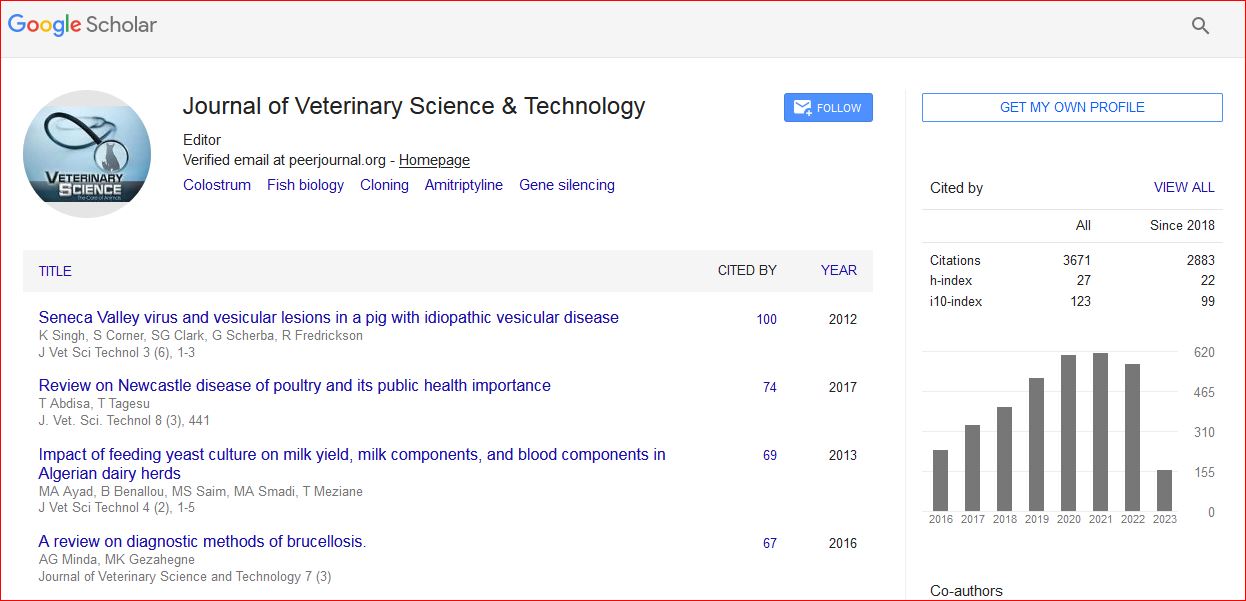
Veterinary Science & Technology received 4472 citations as per Google Scholar report