Commentary - (2025) Volume 16, Issue 6
Received: 01-Dec-2025, Manuscript No. jar-25-177624;
Editor assigned: 03-Dec-2025, Pre QC No. P-177624;
Reviewed: 17-Dec-2025, QC No. Q-177624;
Revised: 22-Dec-2025, Manuscript No. R-177624;
Published:
29-Dec-2025
, DOI: 10.37421/2155-6113.2025.16.1093
Citation: Costa, Daniel. ”U=U: HIV Care Beyond Viral Control.”
J AIDS Clin Res 16 (2025):1093.
Copyright: © 2025 Costa D. This is an open-access article distributed under the terms of the Creative Commons Attribution License, which permits unrestricted use, distribution
and reproduction in any medium, provided the original author and source are credited.
The landscape of HIV management has been profoundly reshaped by the concept of "Undetectable = Untransmittable" (U=U), a message that highlights how individuals maintaining an undetectable viral load through effective treatment cannot sexually transmit HIV. This revolutionary understanding has significantly influenced public health strategies, fostering greater treatment adherence and dramatically reducing the stigma associated with living with HIV globally [1].
Achieving and maintaining sustained virologic suppression is paramount for people with HIV, primarily relying on advancements in antiretroviral therapy (ART). However, significant challenges persist, including issues of treatment adherence, the emergence of drug resistance, and the critical need for equitable access to treatment worldwide. Ongoing strategies are vital to overcome these hurdles and ensure long-term virologic control, which is essential for both individual health and the broader goal of preventing HIV transmission [2].
Despite the success of achieving suppressed viral loads, people living with HIV face elevated risks for various comorbidities. For instance, there's a recognized increased risk for cardiovascular disease. This highlights a critical need to integrate proactive cardiovascular risk assessment and management into the routine care protocols for individuals on effective ART [3].
Similarly, even with long-term viral suppression dueved by ART, reduced bone mineral density is a frequent concern among people with HIV. This underscores the importance of routine monitoring and proactive management of bone health as a crucial element of comprehensive care, addressing a significant long-term comorbidity in this population [4].
Beyond these physical health challenges, a persistent latent HIV reservoir remains even with effective ART leading to viral suppression, preventing a complete cure. Extensive research explores ongoing strategies aimed at reducing or eliminating this dormant reservoir, a crucial step towards developing a functional cure and potentially allowing individuals to discontinue lifelong ART [5].
Mental health outcomes also present significant challenges for people living with HIV, even those who have achieved sustained virologic suppression. This makes it imperative to integrate comprehensive mental health services into routine HIV care, recognizing that holistic well-being extends far beyond merely achieving viral control [6].
Furthermore, despite successfully suppressed viral loads on ART, many people with HIV experience persistent inflammation and immune activation. These lingering immune abnormalities contribute to various non-AIDS comorbidities, emphasizing the necessity for strategies specifically designed to mitigate chronic immune dysregulation [7].
As effective treatments extend the lifespan of people with HIV, understanding the unique challenges and successes of aging with the virus becomes increasingly important, especially concerning the achievement and maintenance of viral suppression. Research provides critical insights into the specific health outcomes and care needs of older adults living with virally suppressed HIV [8].
Achieving widespread viral suppression globally, particularly in resource-limited settings like Sub-Saharan Africa, encounters varied and complex challenges. Identifying crucial determinants, ranging from individual adherence behaviors and pervasive stigma to the capacities of local healthcare systems, is essential for informing and implementing targeted interventions that can facilitate or impede successful viral control [9].
While virologic suppression is undeniably paramount for the physical health of people with HIV, understanding its broader impact on quality of life is equally significant. Examining how long-term viral control influences various dimensions of well-being, including physical, psychological, and social aspects, helps highlight areas where additional support and intervention may be needed to improve overall patient experiences [10].
The concept of "Undetectable = Untransmittable" (U=U) has revolutionized the approach to HIV, fundamentally shifting public health strategies and significantly reducing stigma. This powerful message clarifies that individuals maintaining an undetectable viral load through effective treatment cannot sexually transmit HIV, thereby fostering treatment adherence and empowering people globally. Sustained viral suppression relies heavily on advancements in antiretroviral therapy (ART), yet faces persistent challenges such as adherence issues, the development of drug resistance, and the ongoing struggle for equitable access to treatment. These hurdles necessitate a continuous review of current strategies to ensure long-term virologic control, which is vital for both individual health and effective transmission prevention. Beyond the direct impact of viral suppression, understanding its broader effects, including on quality of life, encompasses physical, psychological, and social aspects, highlighting areas requiring further support.
Despite the significant success in achieving suppressed viral loads, people living with HIV exhibit an elevated risk for various comorbidities. Cardiovascular disease, for instance, remains a notable concern, emphasizing the critical need for integrating proactive risk assessment and management into the routine care of individuals on ART. Similarly, long-term viral suppression does not eliminate issues like reduced bone mineral density, which frequently affects this population. This highlights the importance of routine monitoring and proactive management of bone health as a crucial component of comprehensive care, addressing another important long-term comorbidity. These findings collectively underscore that while ART is highly effective, it does not mitigate all health challenges.
Furthermore, mental health challenges often persist even when individuals achieve sustained virologic suppression. This situation underscores the necessity of integrating comprehensive mental health services into routine HIV care, acknowledging that holistic well-being extends beyond viral control alone. Persistent inflammation and immune activation are also observed in many people with HIV, even with successfully suppressed viral loads. These lingering immune abnormalities contribute to non-AIDS comorbidities, emphasizing the need for strategies to mitigate chronic immune dysregulation. Addressing these ongoing health issues is key to improving the overall health outcomes for people living with HIV.
A significant barrier to a complete cure for HIV is the latent HIV reservoir that persists despite effective ART and viral suppression. Research actively explores various strategies aimed at reducing or eliminating this dormant reservoir, representing a crucial step towards developing a functional cure that could potentially allow individuals to discontinue lifelong ART. As people with HIV are living longer due to effective treatment, understanding the unique challenges and successes of aging with the virus, particularly in achieving and maintaining viral suppression, becomes critical. Insights from cohort studies reveal specific health outcomes and care needs of older adults with virally suppressed HIV, providing valuable guidance for care provision.
Finally, achieving widespread viral suppression, especially in regions like Sub-Saharan Africa, faces diverse challenges. Key determinants, ranging from individual adherence and the pervasive impact of stigma to the capacities of healthcare systems, either facilitate or impede successful viral control. Identifying these factors is crucial for informing targeted interventions that can improve health outcomes globally. The sustained efforts in research and clinical practice highlight the multifaceted nature of HIV management, moving beyond just viral control to encompass holistic patient well-being and addressing a spectrum of related health concerns.
The U=U message has fundamentally transformed HIV prevention and stigma reduction, confirming that people with undetectable viral loads cannot transmit HIV sexually. While antiretroviral therapy (ART) enables sustained viral suppression, challenges like adherence, drug resistance, and equitable access persist globally. Despite successful suppression, people with HIV face elevated risks for cardiovascular disease, reduced bone mineral density, and significant mental health challenges. Persistent inflammation and immune activation also contribute to non-AIDS comorbidities, underscoring the need for integrated care beyond just viral control. A latent HIV reservoir prevents a complete cure, driving research into its elimination. As people with HIV age, understanding their unique health outcomes and needs becomes critical. Determinants of widespread suppression, particularly in regions like Sub-Saharan Africa, vary from individual factors to healthcare system capacities. The overall impact of long-term viral control on quality of life, encompassing physical, psychological, and social aspects, is also a crucial area of study, emphasizing that comprehensive care addresses a broad spectrum of well-being.
Indexed at, Google Scholar, Crossref
Indexed at, Google Scholar, Crossref
Indexed at, Google Scholar, Crossref
Indexed at, Google Scholar, Crossref
Indexed at, Google Scholar, Crossref
Indexed at, Google Scholar, Crossref
Indexed at, Google Scholar, Crossref
Indexed at, Google Scholar, Crossref
Indexed at, Google Scholar, Crossref
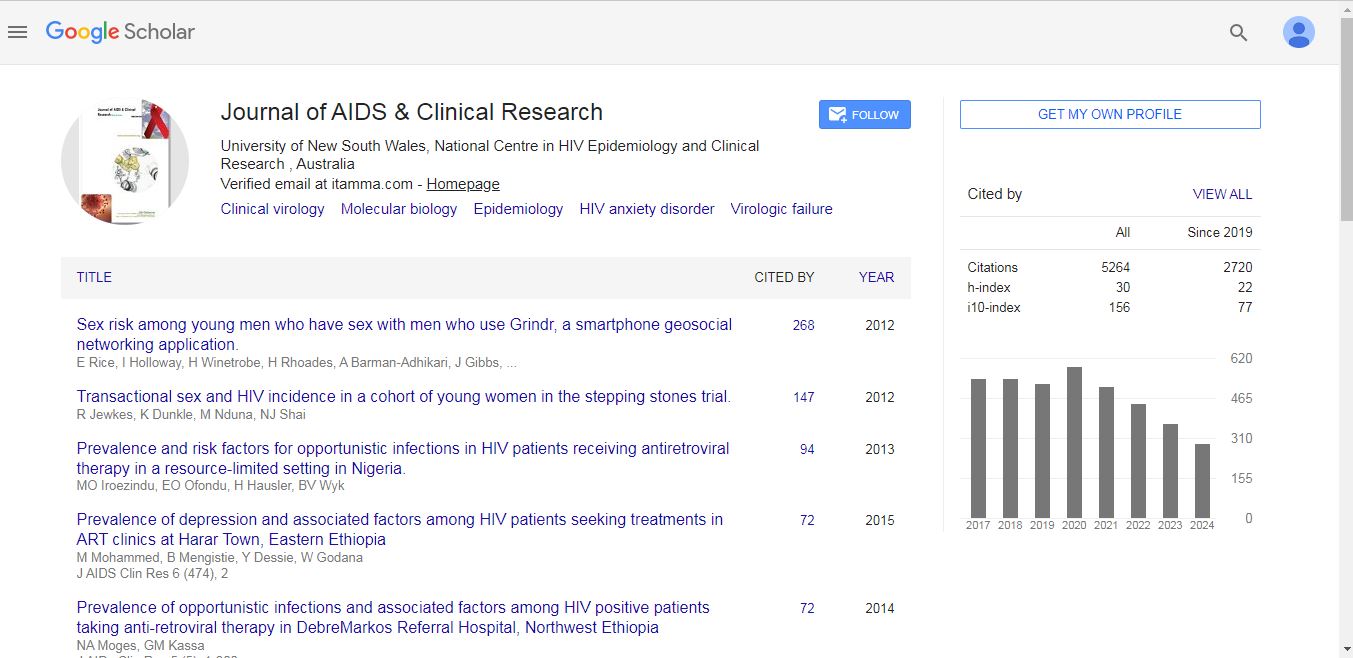
Journal of AIDS & Clinical Research received 5264 citations as per Google Scholar report