Opinion - (2025) Volume 16, Issue 6
Received: 01-Nov-2025, Manuscript No. hycr-25-175048;
Editor assigned: 03-Nov-2025, Pre QC No. P-175048;
Reviewed: 17-Nov-2025, QC No. Q-175048;
Revised: 24-Nov-2025, Manuscript No. R-175048;
Published:
01-Dec-2025
, DOI: 10.37421/2157-7587.2025.16.630
Citation: Whitcomb, Henry. ”Urban Stormwater: Challenges, Strategies, Resilience.” Hydrol Current Res 16 (2025):630.
Copyright: © 2025 Whitcomb H. This is an open-access article distributed under the terms of the Creative Commons Attribution License, which permits unrestricted use,
distribution and reproduction in any medium, provided the original author and source are credited.
Urban stormwater management presents a complex, multifaceted challenge, demanding innovative and integrated approaches to protect environmental health and enhance urban resilience. This compilation of reviews offers a broad perspective on the current state of knowledge, highlighting key practices, emerging issues, technological advancements, and economic considerations in this vital domain. From leveraging natural systems to addressing novel pollutants and optimizing infrastructure through data, the landscape of stormwater management is evolving rapidly. A significant focus within contemporary stormwater management revolves around the deployment of Green Infrastructure (GI) and Low Impact Development (LID) practices. GI offers a comprehensive strategy for stormwater management, integrating natural processes into urban planning to provide hydrological benefits along with ecological and social co-benefits. This approach emphasizes addressing deployment challenges and the need for adaptive management strategies[1].
Similarly, LID practices, such as rain gardens, permeable pavements, and green roofs, are reviewed for their effectiveness in mitigating stormwater runoff and improving water quality. These decentralized solutions mimic natural hydrological processes, making them fundamental for sustainable urban water management by reducing runoff volume and pollutant concentrations[4].
Another critical area of concern is the presence of emerging contaminants (ECs) in urban stormwater runoff. Understanding the types, sources, pathways, and environmental fates of ECs is crucial for addressing these pollutants, which are often overlooked by conventional management practices. Research in this area identifies significant knowledge gaps and proposes future directions for improved monitoring, risk assessment, and the development of effective treatment strategies[2].
To bolster pollutant removal, novel filter media are being developed and evaluated. These innovative materials, including biochar and modified natural substances, show promise in enhancing the removal of heavy metals, nutrients, and organic pollutants, suggesting advancements in treatment system efficiency and sustainability[6].
Further, biofilters are assessed for their performance in treating stormwater runoff, with ongoing work identifying recent advances and challenges in optimizing their design, media configurations, and overall effectiveness for removing suspended solids, nutrients, and heavy metals in diverse urban environments[10].
Beyond direct pollution control, the potential for urban stormwater harvesting as a means to augment water supply is gaining attention. This strategy explores treated stormwater as a non-conventional water source for various urban applications, particularly in water-scarce regions. However, it also highlights significant hurdles such as water quality concerns, public perception, regulatory frameworks, and economic viability, stressing the need for integrated water management and advanced treatment technologies to realize its full potential[5].
Directly related to reuse, microbial risk assessment of stormwater is essential, especially when intended for urban applications. This involves compiling data on common microbial contaminants, their sources, and the associated health risks for different reuse scenarios, underscoring the necessity of robust treatment trains and comprehensive monitoring to ensure public safety[8].
Effective stormwater management also relies heavily on robust modeling and economic planning. Various stormwater quality models used for urban areas are systematically reviewed, categorizing them by complexity, application scope, and data requirements. This highlights the importance of appropriate model selection, calibration, validation, and uncertainty analysis for accurate prediction of pollutant loads and evaluation of management practices[3].
Complementing this, an economic analysis of stormwater control measures (SCMs) evaluates their cost-effectiveness and financial implications. This involves synthesizing studies on capital, operation, and maintenance costs against benefits like reduced flood damage and improved water quality, emphasizing the need for standardized assessment approaches to guide policy and investment in sustainable management[7].
Finally, the field is being revolutionized by advancements in technology. Recent progress in sensing, monitoring, and data analytics is transforming stormwater management into a smarter, more adaptive discipline. Real-time sensors, Internet of Things (IoT) devices, and Artificial Intelligence (AI) are enabling more efficient monitoring of stormwater quantity and quality, facilitating predictive modeling, and supporting adaptive control of infrastructure. These data-driven approaches are pivotal for optimizing urban drainage systems, improving flood resilience, and enhancing overall water resource management[9].
Together, these areas of research demonstrate a concerted effort to develop more sustainable, efficient, and resilient urban stormwater management systems.
The comprehensive body of work on urban stormwater management underscores its multifaceted nature, covering environmental protection, resource sustainability, and urban resilience. One of the primary areas of focus involves the integration of natural systems into urban planning to manage runoff effectively. Green Infrastructure (GI) provides a detailed review of practices, challenges, and future opportunities, highlighting its role in offering not just hydrological benefits but also ecological and social co-benefits. This integration requires adaptive management strategies to overcome inherent implementation hurdles [1]. Complementing GI, Low Impact Development (LID) practices are extensively reviewed for their performance in mitigating stormwater runoff and improving water quality. Techniques like rain gardens, permeable pavements, and green roofs are evaluated for their effectiveness in reducing runoff volume and pollutant concentrations, affirming their crucial role in sustainable urban water management by mimicking natural hydrological processes [4].
Addressing water quality remains a paramount concern, particularly with the emergence of new pollutants. A significant review delves into the presence and implications of emerging contaminants (ECs) in urban stormwater runoff. This research summarizes the current understanding of EC types, their sources, pathways, and environmental fates, highlighting detection and removal challenges. It also outlines critical knowledge gaps and proposes future research directions for better monitoring, risk assessment, and the development of effective treatment strategies for these contaminants, which conventional methods often miss [2]. To enhance pollutant removal, studies also focus on novel filter media. This includes critically evaluating innovative materials like biochar, industrial by-products, and modified natural materials for their efficacy in removing heavy metals, nutrients, and organic pollutants from stormwater runoff. Discussions include removal mechanisms, material properties, and practical implementation challenges, suggesting these advanced media can significantly improve treatment efficiency and sustainability [6]. Further advancements in treatment are explored through biofilters, with a performance assessment focusing on recent progress and ongoing challenges. The effectiveness of various biofilter designs and media configurations in removing suspended solids, nutrients, and heavy metals is analyzed, pointing to the need for more long-term monitoring data and standardized guidelines to optimize their efficiency and reliability across diverse urban settings [10].
Beyond managing pollution, the potential for stormwater as a resource is thoroughly investigated. Urban stormwater harvesting for augmenting water supply presents both opportunities and challenges. This critical review discusses the viability of treated stormwater as a non-conventional water source, particularly in water-scarce regions, for uses such as irrigation or industrial applications. However, it also emphasizes significant hurdles including water quality concerns, public perception, regulatory frameworks, and economic viability, stressing the need for integrated water management strategies and advanced treatment technologies [5]. Central to ensuring the safety of stormwater reuse is microbial risk assessment. A review focusing on this aspect compiles information on common microbial contaminants, their sources, and the health risks associated with different reuse applications. It discusses methodologies for risk assessment and challenges in quantifying risks due to variable stormwater quality, underscoring the necessity for robust treatment trains and comprehensive monitoring programs to protect public health [8].
Effective planning and management are heavily supported by modeling and economic analyses. A systematic review of stormwater quality models for urban areas examines their capabilities, limitations, and future research needs. Models are categorized by complexity, application scope, and data requirements, highlighting how different approaches serve varied management objectives. This research emphasizes the importance of model calibration, validation, and uncertainty analysis for accurate prediction of pollutant loads and evaluation of best management practices [3]. Concurrently, an economic analysis of stormwater control measures (SCMs) provides crucial insights into their cost-effectiveness and financial implications. This systematic review synthesizes studies on capital, operation, and maintenance costs alongside benefits like reduced flood damage and improved water quality, highlighting complexities in assessments and the need for standardized approaches to inform policy and investment in sustainable stormwater management [7].
Finally, the evolution of stormwater management is significantly influenced by technological innovations. Recent advances in sensing, monitoring, and data analytics are transforming traditional stormwater practices into "smart" systems. The review highlights how technologies like real-time sensors, Internet of Things (IoT) devices, and Artificial Intelligence (AI) enable more efficient monitoring of stormwater quantity and quality, facilitate predictive modeling, and support adaptive control of infrastructure. This data-driven approach is key to optimizing urban drainage systems, improving flood resilience, and enhancing overall water resource management [9]. Collectively, these reviews paint a picture of a dynamic field, constantly seeking innovative solutions for sustainable and resilient urban water systems.
Managing urban stormwater effectively is a pressing environmental challenge, encompassing a range of issues from pollution to flood control and resource scarcity. This body of research provides a comprehensive overview of current practices, challenges, and opportunities in this critical field. Here, various strategies for managing stormwater runoff and improving water quality are explored. Green Infrastructure (GI) and Low Impact Development (LID) practices are key, integrating natural processes into urban planning to offer hydrological, ecological, and social benefits, alongside reducing runoff volume and pollutant concentrations. These decentralized solutions mimic natural hydrological processes, proving crucial for sustainable urban water management. The data also addresses significant threats to water quality, such as emerging contaminants (ECs) in stormwater runoff. Understanding their sources, pathways, and environmental fates is essential for developing effective detection and removal strategies, which conventional methods often miss. Complementing this, novel filter media, including biochar and modified natural materials, are being developed to enhance the removal of heavy metals, nutrients, and organic pollutants from stormwater. Biofilters also show promise, with ongoing research into optimizing their design and media for various pollutant types. Beyond managing pollution, the collection highlights opportunities for urban stormwater harvesting to augment water supply, especially in water-scarce regions. This requires careful microbial risk assessment and robust treatment technologies to ensure safety for urban reuse applications. Economic analysis of stormwater control measures is equally important, assessing cost-effectiveness and financial implications to inform policy and investment. Finally, the role of advanced technologies like real-time sensors, Internet of Things (IoT) devices, and Artificial Intelligence (AI) in smart stormwater management is explored. These innovations promise more efficient monitoring, predictive modeling, and adaptive control, ultimately enhancing urban flood resilience and overall water resource management.
None
None
Indexed at, Google Scholar, Crossref
Indexed at, Google Scholar, Crossref
Indexed at, Google Scholar, Crossref
Indexed at, Google Scholar, Crossref
Indexed at, Google Scholar, Crossref
Indexed at, Google Scholar, Crossref
Indexed at, Google Scholar, Crossref
Indexed at, Google Scholar, Crossref
Indexed at, Google Scholar, Crossref
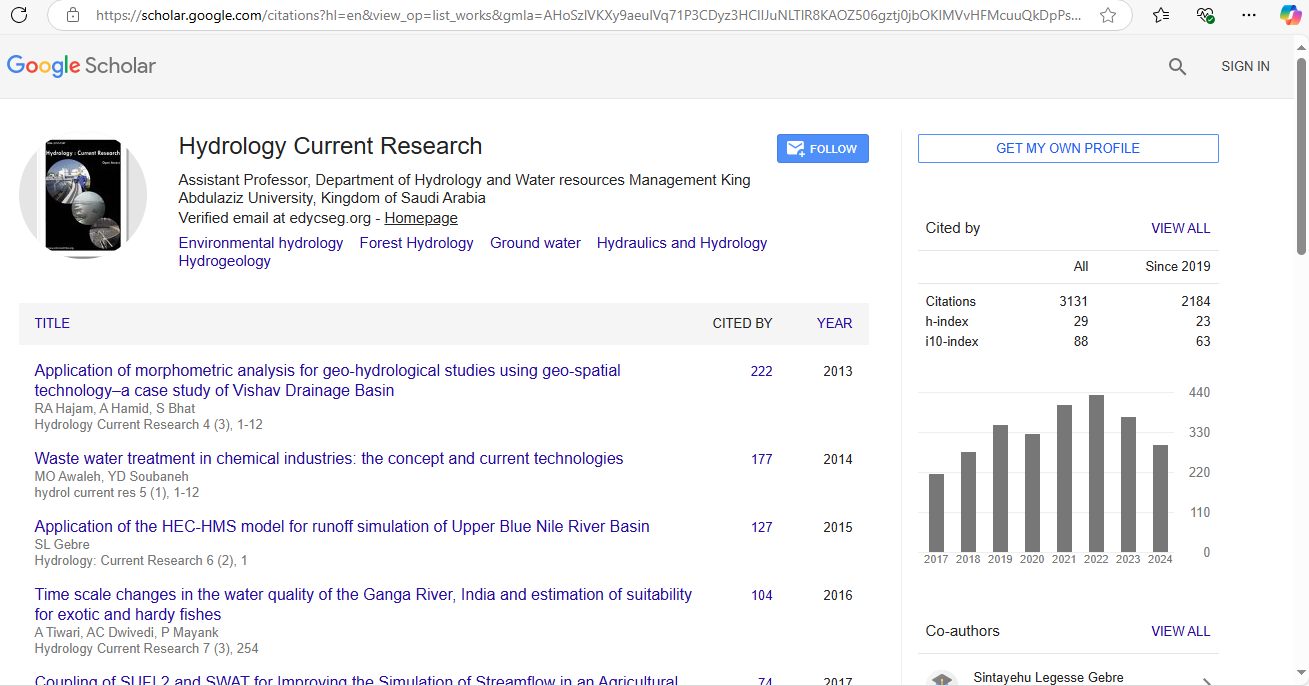
Hydrology: Current Research received 2843 citations as per Google Scholar report