Short Communication - (2025) Volume 15, Issue 5
Received: 02-Oct-2025, Manuscript No. jeat-26-188645;
Editor assigned: 06-Oct-2025, Pre QC No. P-188645;
Reviewed: 20-Oct-2025, QC No. Q-188645;
Revised: 23-Oct-2025, Manuscript No. R-188645;
Published:
30-Oct-2025
, DOI: 10.37421/2161-0525.2025.15.865
Citation: Smith, David. ”Urban Dust: Toxic Metal Monitoring For
Health.” J Environ Anal Toxicol 15 (2025):865.
Copyright: © 2025 Smith D. This is an open-access article distributed under the terms of the Creative Commons Attribution License, which permits unrestricted use, distribution
and reproduction in any medium, provided the original author and source are credited.
The analytical determination of toxic metals in urban dust is a crucial area of environmental monitoring with significant implications for public health. This research underscores the importance of accurately quantifying heavy metal concentrations to assess pollution sources and their impact on urban ecosystems. Understanding the spatial distribution and elemental composition of urban dust provides vital data for risk assessment and the development of effective environmental management strategies [1].
Investigating the speciation of toxic metals in urban dust is paramount for comprehending their bioavailability and potential health risks. Advanced analytical techniques are employed to differentiate metal forms, offering a more nuanced perspective on metal behavior within the environment. The findings highlight the necessity of speciation analysis in regulatory frameworks, moving beyond total metal content to evaluate actual exposure pathways [2].
This study evaluates the effectiveness of various sample preparation and analytical methodologies for determining trace toxic metals in urban dust. A comparative analysis of techniques such as microwave digestion and spectroscopic methods, including ICP-MS and AAS, aims to identify the most suitable approaches for reliable and sensitive quantification. The research offers valuable guidance for laboratories engaged in similar environmental analyses [3].
The spatial variability of toxic metals within urban dust across a metropolitan region is examined through the application of geostatistical tools. This mapping of key metal distributions helps identify pollution hotspots and ascertain the influence of traffic and industrial activities. The insights gained are essential for implementing targeted pollution control and urban planning to mitigate exposure risks [4].
This work delves into the role of urban dust as a reservoir for toxic metals and their potential translocation into the built environment. By analyzing particle size fractions, the study aims to determine which fractions are most susceptible to inhalation or ingestion. The research underscores the persistent nature of metal contamination in urban settings and its consequences for indoor air quality [5].
A comparative study focuses on the concentration of toxic metals found in urban dust collected from various cities, with the objective of identifying trends and common pollution sources. The analysis reveals substantial variations in metal levels and profiles, which are then correlated with local industrial, traffic, and meteorological conditions. This global perspective is vital for grasping the broader effects of urbanization on metal pollution [6].
This research explores the potential for toxic metals present in urban dust to leach into water bodies, thereby assessing the environmental risks associated with stormwater runoff. Analytical methods are utilized to quantify leachable metal fractions and their mobility. The study emphasizes the critical need for managing urban dust to prevent the secondary contamination of aquatic ecosystems [7].
The critical evaluation of chemical extractants for the sequential extraction of toxic metals within urban dust is presented. This paper outlines a robust analytical protocol designed to determine metal partitioning across different fractions, including exchangeable, carbonate-bound, iron-manganese oxide-bound, organic matter-bound, and residual fractions. This partitioning is fundamental to understanding metal mobility and bioavailability [8].
This study investigates the contribution of traffic emissions to the concentration of toxic metals found in urban dust. Through the application of isotopic analysis and multivariate statistical methods, the research successfully identifies specific vehicular sources and quantifies their impact. The findings are instrumental for the implementation of effective measures to reduce metal pollution originating from transportation [9].
This research introduces a novel application of nanomaterials for the pre-concentration and detection of toxic metals in urban dust samples. This innovative method enhances analytical sensitivity and significantly reduces the time required for sample preparation. The study demonstrates the substantial potential of advancements in material science for improving the field of environmental analytical chemistry [10].
The analytical determination of toxic metals in urban dust represents a critical component of environmental monitoring essential for safeguarding public health. The methodologies detailed within this research focus on the accurate quantification of heavy metal concentrations, emphasizing their significance in identifying pollution sources and evaluating their influence on urban ecosystems. The spatial distribution and elemental composition data derived from urban dust analysis are indispensable for comprehensive risk assessments and the formulation of effective environmental management strategies [1].
Investigating the speciation of toxic metals within urban dust is of paramount importance for understanding their bioavailability and potential health implications. This paper presents sophisticated analytical techniques designed to differentiate various forms of metals, thereby providing a more detailed understanding of their environmental behavior. The outcomes of this research underscore the necessity of speciation analysis within regulatory frameworks, moving beyond simple measurements of total metal content to a more accurate assessment of actual human exposure pathways [2].
This study is dedicated to evaluating the efficacy of diverse sample preparation and analytical procedures for the precise determination of trace toxic metals in urban dust samples. It involves a comparative assessment of techniques such as microwave digestion alongside various spectroscopic methods, including Inductively Coupled Plasma Mass Spectrometry (ICP-MS) and Atomic Absorption Spectrometry (AAS), to identify the most suitable methods for sensitive and reliable quantification. The findings from this research offer valuable insights and practical guidance for laboratories undertaking similar environmental analytical tasks [3].
The spatial variability of toxic metals present in urban dust across a broad metropolitan area is meticulously examined in this paper. Employing advanced geostatistical tools, the study maps the geographical distribution of key metals, thereby pinpointing pollution hotspots and elucidating the impact of vehicular and industrial activities. The conclusions drawn are vital for the strategic implementation of pollution control measures and for informing urban planning decisions aimed at minimizing exposure risks for the population [4].
This research investigates the multifaceted role of urban dust as a significant reservoir for toxic metals and explores their potential for translocation into indoor environments. A key aspect of the study involves analyzing the particle size distribution of dust to ascertain which fractions are most likely to be inhaled or ingested by humans. The findings highlight the persistent challenge of metal contamination in urban settings and its direct implications for the quality of indoor air [5].
A comparative study was conducted to analyze the concentration of toxic metals found in urban dust samples collected from various cities worldwide. The primary objective was to identify overarching trends and common sources of pollution. The analysis revealed considerable variations in both the levels and profiles of metals, which were subsequently linked to specific local industrial activities, traffic patterns, and prevailing meteorological conditions. This broad, comparative perspective is crucial for understanding the widespread consequences of urbanization on metal pollution [6].
This research explores the propensity of toxic metals contained within urban dust to leach into adjacent water bodies, thereby assessing the environmental hazards posed by stormwater runoff. The study employs precise analytical methods to quantify the leachable fractions of these metals and their associated mobility. A significant conclusion of this work is the emphasis placed on effective management of urban dust as a means to prevent the secondary contamination of valuable aquatic ecosystems [7].
This paper critically evaluates the application of chemical extractants for the sequential extraction of toxic metals present in urban dust. It systematically outlines a robust analytical protocol designed to determine the partitioning of metals among different chemical fractions. Understanding this partitioning (exchangeable, carbonate-bound, iron-manganese oxide-bound, organic matter-bound, and residual) is fundamental to accurately assessing metal mobility and bioavailability in the environment [8].
This study focuses on elucidating the contribution of vehicular emissions to the overall concentration of toxic metals found in urban road dust. Utilizing sophisticated techniques such as isotopic analysis and multivariate statistical modeling, the research successfully identifies specific sources related to traffic and quantifies their precise impact. The derived findings are essential for developing and implementing targeted strategies to mitigate metal pollution stemming from transportation-related activities [9].
The research presented here introduces an innovative application of advanced nanomaterials for the effective pre-concentration and subsequent detection of toxic metals within urban dust samples. This novel methodology significantly enhances analytical sensitivity and substantially reduces the time and complexity associated with sample preparation. The study demonstrates the considerable potential of cutting-edge material science to drive improvements in the field of environmental analytical chemistry [10].
This collection of research highlights the critical importance of analyzing toxic metals in urban dust for environmental monitoring and public health. Studies explore advanced analytical techniques for quantifying metal concentrations, understanding their speciation, and developing reliable methodologies for sample preparation and determination. The research also addresses the spatial distribution of these metals, identifying pollution sources such as traffic emissions and industrial activities. Furthermore, the potential for toxic metals to leach into water bodies and impact indoor air quality is investigated, emphasizing the need for effective urban dust management. Novel approaches using nanomaterials are also presented to enhance analytical sensitivity.
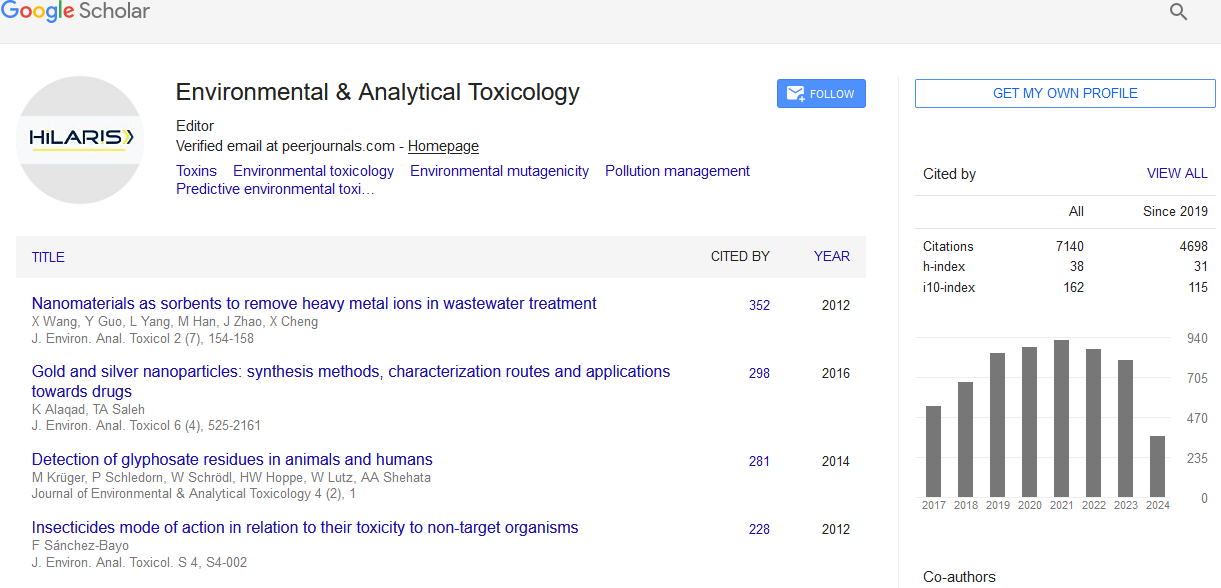
Environmental & Analytical Toxicology received 6818 citations as per Google Scholar report