Brief Report - (2025) Volume 15, Issue 6
Received: 02-Dec-2025, Manuscript No. jeat-26-188662;
Editor assigned: 04-Dec-2025, Pre QC No. P-188662;
Reviewed: 18-Dec-2025, QC No. Q-188662;
Revised: 23-Dec-2025, Manuscript No. R-188662;
Published:
30-Dec-2025
, DOI: 10.37421/2161-0525.2025.15.882
Citation: Ramirez, Pedro. ”Urban Air Pollution: Sources, Impacts,
and Solutions.” J Environ Anal Toxicol 15 (2025):882.
Copyright: © 2025 Ramirez P. This is an open-access article distributed under the terms of the Creative Commons Attribution License, which permits unrestricted use,
distribution and reproduction in any medium, provided the original author and source are credited.
This analytical study investigates the presence and distribution of key toxic compounds in environmental air samples collected from various urban and industrial areas. The research highlights the significant impact of anthropogenic activities on air quality, identifying specific pollutants like polycyclic aromatic hydrocarbons (PAHs), volatile organic compounds (VOCs), and heavy metals. The findings emphasize the urgent need for targeted monitoring and effective emission control strategies to mitigate public health risks associated with long-term exposure to these environmental toxins. Advanced analytical techniques, such as gas chromatography-mass spectrometry (GC-MS) and inductively coupled plasma-mass spectrometry (ICP-MS), were employed to ensure accurate and sensitive detection of these contaminants [1].
This work focuses on the development and validation of novel analytical methods for the sensitive detection of emerging atmospheric pollutants. The study details the application of hyphenated techniques to identify and quantify trace levels of specific endocrine-disrupting compounds (EDCs) in ambient air. The results underscore the importance of continuously updating analytical protocols to address evolving environmental concerns and protect vulnerable populations from exposure to newly identified toxic substances. The data collected will inform future environmental policies and risk assessments [2].
This research examines the spatio-temporal variations of airborne particulate matter (PM) and associated heavy metal contamination in an industrial city. The study utilized a combination of gravimetric analysis for PM mass concentration and ICP-MS for elemental profiling, identifying lead (Pb), cadmium (Cd), and arsenic (As) as major contributors to the observed toxicity. The findings illustrate how localized industrial emissions significantly influence local air quality and pose localized health risks. Effective industrial zoning and emission control measures are recommended [3].
This study investigates the occurrence and characteristics of polycyclic aromatic hydrocarbons (PAHs) in urban air samples, focusing on their sources and health implications. Using GC-MS, the research identified dominant PAH congeners and attributed their presence to incomplete combustion processes from vehicular traffic and industrial activities. The article emphasizes the chronic health risks associated with prolonged exposure to these carcinogenic compounds and advocates for stricter regulations on emission standards [4].
This paper presents an assessment of volatile organic compounds (VOCs) in indoor and outdoor air of a metropolitan area. The study employed gas chromatography (GC) coupled with flame ionization detection (FID) and mass spectrometry (MS) to identify and quantify a range of VOCs. The research found elevated levels of benzene, toluene, and xylenes, primarily linked to vehicular emissions and industrial solvent use, highlighting significant indoor-outdoor air quality linkages and potential health impacts [5].
This study focuses on the analysis of organochlorine pesticides (OCPs) in atmospheric samples collected near agricultural regions. The research employed high-performance liquid chromatography (HPLC) to quantify OCP residues, revealing their widespread presence and persistence in the environment. The findings indicate potential long-range transport of these toxic compounds and raise concerns about their accumulation in food chains and potential human exposure [6].
This research investigates the atmospheric deposition of heavy metals in a sensitive ecological area. Using advanced spectroscopic techniques, the study quantified deposition rates of lead, cadmium, and copper, identifying industrial and vehicular emissions as primary sources. The findings highlight the detrimental effects of atmospheric heavy metal deposition on soil and water ecosystems, emphasizing the need for regional emission control strategies [7].
This study evaluates the effectiveness of air quality monitoring networks in identifying and quantifying toxic air pollutants in urban environments. The research details the use of passive sampling devices and active sampling methods coupled with GC-MS and HPLC analysis. The results demonstrate the importance of comprehensive monitoring strategies for assessing public exposure and informing pollution control policies [8].
This research focuses on the characterization of airborne dioxins and furans in industrial emission plumes. The study employed high-resolution gas chromatography coupled with high-resolution mass spectrometry (HRGC-HRMS) to identify and quantify these persistent organic pollutants. The findings provide crucial data on the emission profiles of specific industrial processes and contribute to understanding their environmental fate and potential health risks [9].
This paper investigates the impact of traffic-related air pollution (TRAP) on the concentration of specific toxic compounds in urban roadside environments. Using advanced analytical techniques, the study quantified levels of nitrogen oxides (NOx), ozone (O3), and particulate matter (PM2.5) and their association with adverse health outcomes. The research emphasizes the need for effective traffic management and emission reduction strategies to improve urban air quality and public health [10].
The presence and distribution of critical toxic compounds within urban and industrial air samples form the subject of an intensive analytical investigation. This research underscores the substantial influence of human-driven activities on atmospheric quality, specifically pinpointing pollutants such as polycyclic aromatic hydrocarbons (PAHs), volatile organic compounds (VOCs), and heavy metals. The presented findings strongly advocate for the implementation of precise monitoring protocols and robust emission control mechanisms to safeguard public health from the detrimental effects of prolonged exposure to these environmental toxins. The study leveraged sophisticated analytical methodologies, including gas chromatography-mass spectrometry (GC-MS) and inductively coupled plasma-mass spectrometry (ICP-MS), to achieve precise and sensitive contaminant detection [1].
A significant contribution to the field is the development and rigorous validation of innovative analytical techniques designed for the highly sensitive detection of emerging atmospheric contaminants. This work elaborates on the application of hyphenated analytical approaches for the accurate identification and quantification of trace quantities of specific endocrine-disrupting compounds (EDCs) present in ambient air. The outcomes derived from this study emphasize the imperative of continually refining analytical procedures to address evolving environmental challenges and ensure the protection of susceptible populations from exposure to newly identified harmful substances. The collected data are poised to play a crucial role in shaping future environmental policies and informing risk assessment frameworks [2].
An examination of the temporal and spatial dynamics of airborne particulate matter (PM) alongside associated heavy metal contamination within an industrial urban setting has been conducted. The methodology employed involved a dual approach: gravimetric analysis for PM mass concentration determination and ICP-MS for detailed elemental profiling. This analysis identified lead (Pb), cadmium (Cd), and arsenic (As) as principal contributors to the observed toxicity levels. The study's conclusions illuminate the profound impact of localized industrial emissions on ambient air quality and the associated localized health hazards. Consequently, the implementation of effective industrial zoning regulations and emission mitigation measures is strongly advised [3].
An investigation into the occurrence patterns and characteristic profiles of polycyclic aromatic hydrocarbons (PAHs) within urban air samples has been undertaken, with a specific focus on their origins and implications for human health. Employing GC-MS, this research successfully identified the predominant PAH congeners and attributed their presence to incomplete combustion processes stemming from vehicular traffic and industrial operations. The paper highlights the long-term health risks associated with sustained exposure to these carcinogenic substances and strongly supports the adoption of more stringent emission standard regulations [4].
This paper meticulously assesses the levels of volatile organic compounds (VOCs) detected in both indoor and outdoor air environments within a major metropolitan area. The research utilized gas chromatography (GC) in conjunction with flame ionization detection (FID) and mass spectrometry (MS) to precisely identify and quantify a broad spectrum of VOCs. Key findings revealed elevated concentrations of benzene, toluene, and xylenes, with vehicular emissions and the use of industrial solvents identified as the primary sources, thereby emphasizing the significant interplay between indoor and outdoor air quality and potential health consequences [5].
The focus of this study is the detailed analysis of organochlorine pesticides (OCPs) in atmospheric samples procured from agricultural vicinities. Employing high-performance liquid chromatography (HPLC) for the quantification of OCP residues, the research uncovered evidence of their pervasive presence and environmental persistence. The findings suggest the potential for long-range atmospheric transport of these toxic substances and raise significant concerns regarding their bioaccumulation within food webs and subsequent human exposure pathways [6].
This research delves into the phenomenon of atmospheric deposition of heavy metals within an ecologically sensitive zone. Through the utilization of advanced spectroscopic techniques, the study accurately quantified deposition rates for lead, cadmium, and copper, identifying industrial activities and vehicular exhausts as the principal emission sources. The results underscore the adverse impacts of atmospheric heavy metal deposition on terrestrial and aquatic ecosystems, thereby stressing the critical necessity for implementing coordinated regional emission control strategies [7].
This study provides an in-depth evaluation of the efficacy of established air quality monitoring networks in the precise identification and quantification of toxic air pollutants within urban landscapes. The research methodology incorporated both passive sampling devices and active sampling techniques, further complemented by GC-MS and HPLC analytical procedures. The findings emphatically demonstrate the indispensable role of comprehensive monitoring frameworks in accurately assessing public exposure levels and effectively guiding the development of pollution mitigation policies [8].
This research centers on the detailed characterization of airborne dioxins and furans emanating from industrial emission plumes. Employing high-resolution gas chromatography in tandem with high-resolution mass spectrometry (HRGC-HRMS), the study achieved precise identification and quantification of these persistent organic pollutants. The data generated offers invaluable insights into the emission profiles associated with specific industrial processes, contributing significantly to the understanding of their environmental behavior and potential human health risks [9].
This paper scrutinizes the influence of traffic-related air pollution (TRAP) on the concentration of specific toxic compounds found in urban roadside environments. Utilizing sophisticated analytical instruments, the study quantified levels of nitrogen oxides (NOx), ozone (O3), and fine particulate matter (PM2.5), and examined their correlations with adverse health outcomes. The research strongly advocates for the implementation of robust traffic management and emission reduction measures to enhance urban air quality and promote better public health outcomes [10].
This collection of research highlights critical concerns regarding toxic air pollutants in urban and industrial environments. Studies investigate the presence and distribution of compounds such as PAHs, VOCs, heavy metals, and OCPs, emphasizing the significant impact of anthropogenic activities. Advanced analytical techniques including GC-MS, ICP-MS, and HPLC are employed for accurate detection and quantification. The findings consistently point to vehicular traffic and industrial emissions as major sources, underscoring the risks of long-term exposure to public health and ecosystems. Recommendations include targeted monitoring, effective emission control strategies, stricter regulations, and comprehensive air quality management. The research also addresses the development of new analytical methods to detect emerging pollutants and evaluates the effectiveness of monitoring networks. Overall, the studies collectively advocate for urgent action to improve air quality and mitigate associated health and environmental risks.
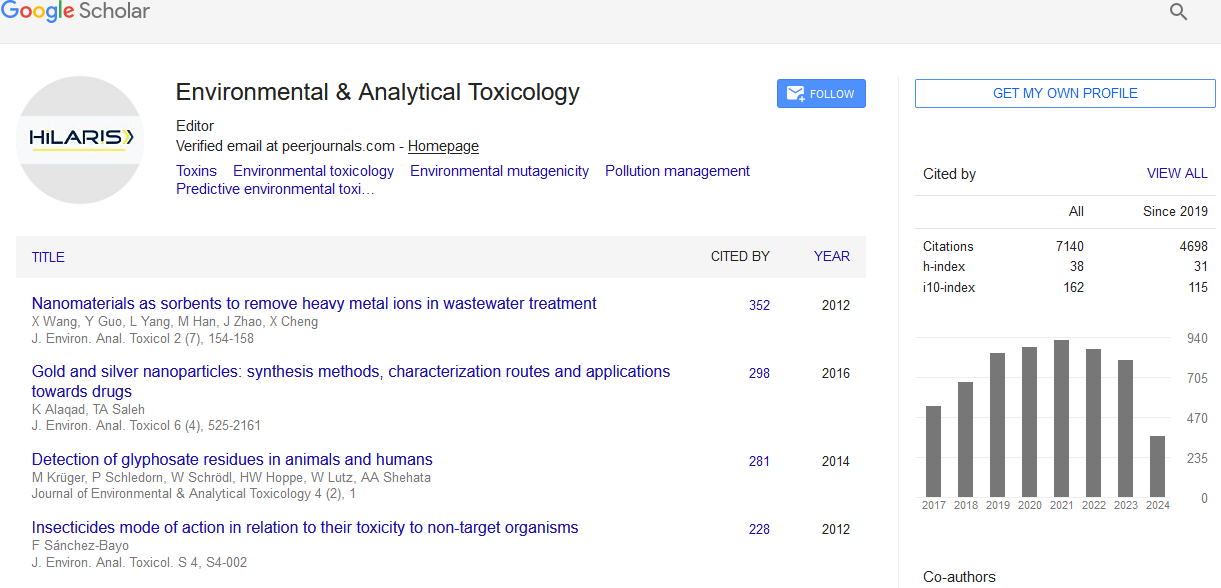
Environmental & Analytical Toxicology received 6818 citations as per Google Scholar report