Brief Report - (2025) Volume 16, Issue 5
Received: 01-Oct-2025, Manuscript No. jar-25-177612;
Editor assigned: 03-Oct-2025, Pre QC No. P-177612;
Reviewed: 17-Oct-2025, QC No. Q-177612;
Revised: 22-Oct-2025, Manuscript No. R-177612;
Published:
29-Oct-2025
, DOI: 10.37421/2155-6113.2025.16.1082
Citation: Tanaka, Rina. ”HIV-1 vs. HIV-2: Profound Clinical
Differences.” J AIDS Clin Res 16 (2025):1082.
Copyright: © 2025 Tanaka R. This is an open-access article distributed under the terms of the Creative Commons Attribution License, which permits unrestricted use,
distribution and reproduction in any medium, provided the original author and source are credited.
HIV-1 and HIV-2, while both causing AIDS, show distinct clinical courses; HIV-2 generally progresses slower with lower viral loads and reduced transmission efficiency compared to HIV-1, impacting prognosis and management strategies. This review highlights key differences in their pathogenicity and clinical presentation.[1] Differentiating between HIV-1 and HIV-2 infection is crucial for proper clinical management, yet diagnostic assays can sometimes present challenges, especially in regions where both viruses co-circulate, requiring careful interpretation and confirmation to avoid misdiagnosis and suboptimal treatment.[2]
HIV-1 and HIV-2 exhibit distinct patterns of susceptibility and resistance to antiretroviral drugs; specifically, HIV-2 is inherently resistant to non-nucleoside reverse transcriptase inhibitors (NNRTIs), which significantly influences treatment choices and the development of drug resistance mutations, necessitating different therapeutic strategies.[3] The host immune response differs between HIV-1 and HIV-2 infections, with HIV-2 often associated with a more robust and effective anti-viral immune control, contributing to its slower disease progression and lower viral set point compared to HIV-1, offering insights into potential protective mechanisms.[4] While HIV-1 dominates globally, HIV-2 is largely endemic to West Africa, where its prevalence is declining, and understanding this shifting epidemiology is vital for targeted prevention and treatment strategies in co-circulating regions to effectively address both epidemics.[5] HIV-2 consistently exhibits lower plasma viral loads compared to HIV-1, a key factor contributing to its slower disease progression and reduced transmissibility, a difference that profoundly impacts monitoring and treatment efficacy, and highlights distinct viral dynamics.[6] Co-infection with both HIV-1 and HIV-2 is rare but poses unique diagnostic and therapeutic challenges, often presenting with features more akin to HIV-1 infection due to its dominance, necessitating careful consideration of both viral types for optimal patient management.[7] Significant genomic diversity exists between HIV-1 and HIV-2, impacting vaccine development efforts; HIV-2 exhibits less genetic variability and distinct accessory gene profiles (e.g., absence of vpu, presence of vpx) which are crucial for understanding their pathogenesis and designing effective interventions.[8] While both HIV-1 and HIV-2 establish viral reservoirs, studies suggest differences in their establishment, maintenance, and potential for cure, with HIV-2 potentially having a smaller and less stable reservoir, offering distinct avenues for latency reversal strategies and eradication efforts.[9] HIV-2 exhibits significantly lower transmission efficiency compared to HIV-1, attributable to its lower viral loads in bodily fluids and potentially reduced pathogenicity, which has implications for public health interventions and understanding global epidemic patterns and spread.[10]HIV-1 and HIV-2, while both responsible for AIDS, present with notable differences in their clinical progression and pathogenicity [1]. HIV-2, for instance, typically advances at a slower rate, characterized by lower viral loads and reduced transmission efficiency when compared to HIV-1 [1, 6, 10]. This inherent distinction in viral dynamics profoundly influences prognosis, patient management strategies, and public health interventions globally [1, 6, 10]. The epidemiology of these viruses also differs significantly, with HIV-1 being globally dominant while HIV-2 is primarily endemic to West Africa, though its prevalence there is declining. Understanding these shifting geographical landscapes is critical for effective prevention and treatment in regions where both viruses co-circulate [5].
Accurate diagnosis between HIV-1 and HIV-2 is essential for proper clinical care, yet diagnostic assays can be challenging, particularly where both types are present. This necessitates careful interpretation to prevent misdiagnosis and ensure appropriate treatment [2]. Adding to the complexity, co-infection with both HIV-1 and HIV-2 is rare. However, when it occurs, the clinical presentation often mirrors that of HIV-1 due to its dominant characteristics, requiring clinicians to consider both viral types for optimal patient outcomes [7].
Therapeutic approaches must also account for the distinct antiretroviral drug susceptibility and resistance profiles of the two viruses [3]. Notably, HIV-2 demonstrates intrinsic resistance to non-nucleoside reverse transcriptase inhibitors (NNRTIs), which directly impacts treatment selection and the evolution of drug resistance mutations. This difference mandates tailored therapeutic strategies for each viral type [3].
The host immune response to HIV-1 and HIV-2 infections also shows variations [4]. HIV-2 infection is often linked to a more robust and effective anti-viral immune control, which contributes to its slower disease progression and a lower viral set point compared to HIV-1. These insights offer valuable information regarding potential protective immunological mechanisms [4]. Furthermore, significant genomic diversity exists between HIV-1 and HIV-2, presenting challenges for vaccine development efforts. HIV-2 exhibits less genetic variability and possesses unique accessory gene profiles, such as the absence of vpu and the presence of vpx, which are crucial for comprehending their pathogenesis and designing targeted interventions [8].
Despite both viruses establishing viral reservoirs, research suggests differences in how these reservoirs are formed, maintained, and their potential for eradication [9]. HIV-2 may form a smaller and less stable reservoir, which could open new avenues for latency reversal strategies and lead to more effective cure efforts [9]. These combined factors underscore the importance of distinguishing between HIV-1 and HIV-2 for effective public health strategies and individualized patient care.
HIV-1 and HIV-2, both causative agents of AIDS, present with notable clinical and biological distinctions. HIV-2 typically shows a slower disease progression, lower viral loads, and reduced transmission efficiency compared to HIV-1, factors that significantly influence patient prognosis and management approaches. Accurate differential diagnosis is crucial, though it can be challenging in regions where both viruses co-circulate, potentially leading to misdiagnosis if not carefully managed. Furthermore, co-infection is rare, but usually presents more like HIV-1 due to its dominance, demanding tailored management. A critical difference impacting treatment is HIV-2's inherent resistance to non-nucleoside reverse transcriptase inhibitors (NNRTIs), which dictates specific antiretroviral strategies and influences drug resistance mutation development. The host immune response in HIV-2 infection is often more robust, contributing to its generally milder course and lower viral set point. Epidemiologically, HIV-1 has a global reach, while HIV-2 is largely confined to West Africa, where its prevalence is decreasing, highlighting a shifting landscape vital for targeted public health efforts. Significant genomic diversity exists between the two viruses, affecting vaccine development, with HIV-2 showing less genetic variability and distinct accessory gene profiles. Moreover, differences in viral reservoir establishment and maintenance suggest HIV-2 might have a smaller, less stable reservoir, offering distinct avenues for latency reversal and eradication strategies. These profound differences underscore the necessity for specific diagnostic, therapeutic, and preventative strategies for each HIV type.
Indexed at, Google Scholar, Crossref
Indexed at, Google Scholar, Crossref
Indexed at, Google Scholar, Crossref
Indexed at, Google Scholar, Crossref
Indexed at, Google Scholar, Crossref
Indexed at, Google Scholar, Crossref
Indexed at, Google Scholar, Crossref
Indexed at, Google Scholar, Crossref
Indexed at, Google Scholar, Crossref
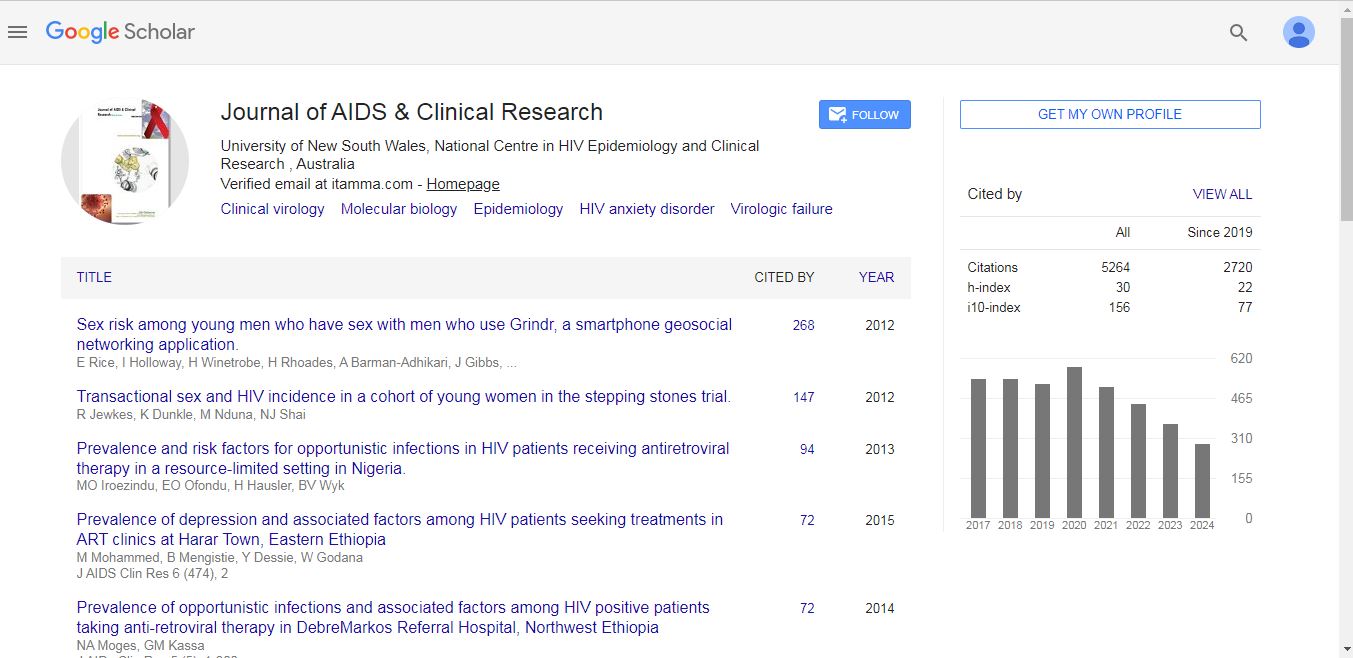
Journal of AIDS & Clinical Research received 5264 citations as per Google Scholar report