Opinion - (2025) Volume 19, Issue 6
Received: 01-Dec-2025, Manuscript No. jmgm-26-188391;
Editor assigned: 03-Dec-2025, Pre QC No. P-188391;
Reviewed: 17-Dec-2025, QC No. Q-188391;
Revised: 22-Dec-2025, Manuscript No. R-188391;
Published:
29-Dec-2025
, DOI: 10.37421/1747-0862.2025.19.759
Citation: Johnson, Samuel T.. ”Transcriptomics: Unlocking Disease Insights for Precision Medicine.” J Mol Genet Med 19 (2025):759.
Copyright: © 2025 Johnson T. Samuel This is an open-access article distributed under the terms of the Creative Commons Attribution License, which permits unrestricted use, distribution and reproduction in any medium, provided the original author and source are credited.
Transcriptomics offers a powerful lens to understand disease mechanisms at the RNA level, moving beyond static genomic information to capture dynamic cellular responses. In clinical practice, this means identifying disease signatures, predicting patient outcomes, and guiding therapeutic decisions. By analyzing gene expression profiles, clinicians can potentially diagnose diseases earlier, stratify patients for targeted treatments, and monitor treatment efficacy in real-time. This approach promises to personalize medicine by tailoring interventions based on an individual's unique RNA landscape [1].
The advent of single-cell RNA sequencing scRNA-seq has revolutionized transcriptomics by allowing for the analysis of gene expression at an unprecedented resolution. This technology is crucial for understanding cellular heterogeneity within tissues, identifying rare cell populations involved in disease, and dissecting complex cellular interactions. In a clinical context, scRNA-seq can illuminate the specific cell types driving a disease, enabling the development of therapies that target these precise cellular culprits [2].
Computational approaches are indispensable for extracting meaningful insights from large-scale transcriptomic data. Machine learning and bioinformatics tools are employed for quality control, normalization, differential expression analysis, pathway enrichment, and the identification of diagnostic or prognostic biomarkers. These computational pipelines enable the translation of raw RNA sequencing data into clinically actionable information, facilitating the development of predictive models for disease progression and treatment response [3].
The clinical utility of transcriptomics lies in its ability to uncover novel disease subtypes and mechanisms that are not apparent through traditional diagnostic methods. By identifying distinct gene expression patterns associated with different disease states or responses to therapy, transcriptomic profiling can refine diagnostic categories and guide personalized treatment strategies. This deep understanding of molecular pathology at the RNA level is a cornerstone of precision medicine [4].
Translating transcriptomic discoveries into routine clinical practice faces hurdles related to standardization, cost, and the interpretation of complex data. Developing robust protocols for sample collection, RNA extraction, sequencing, and data analysis is crucial for ensuring reproducibility and reliability. Furthermore, building comprehensive reference databases and validating biomarkers in large, diverse patient cohorts are essential steps towards integrating transcriptomics into standard diagnostic workflows [5].
Transcriptomics plays a vital role in cancer research and clinical management by identifying driver mutations, predicting treatment response, and monitoring minimal residual disease. Gene expression signatures can distinguish between different cancer subtypes, predict prognosis, and guide the selection of targeted therapies or immunotherapies. The dynamic monitoring of the tumor transcriptome over time offers opportunities for early detection of relapse and adaptation of treatment strategies [6].
In infectious diseases, transcriptomics can elucidate host-pathogen interactions, identify biomarkers for disease severity, and monitor antimicrobial resistance. By analyzing the RNA profiles of infected cells and pathogens, researchers can uncover mechanisms of pathogenesis, predict disease outcomes, and develop novel diagnostic and therapeutic strategies. This granular understanding of molecular events during infection is essential for combating emerging and established infectious agents [7].
The integration of transcriptomics with other omics data, such as genomics, proteomics, and metabolomics, provides a more holistic view of disease pathophysiology. Multi-omics approaches can reveal complex regulatory networks and identify key molecular players that would be missed by single-omic analyses. This systems biology perspective is critical for understanding the multifaceted nature of many complex diseases and for developing more effective interventions [8].
Pharmacogenomics, informed by transcriptomic insights, is emerging as a key area in personalized medicine. By analyzing how an individual's gene expression profile influences drug response, clinicians can optimize drug selection and dosage, thereby improving efficacy and reducing adverse effects. This individualized approach to pharmacotherapy, guided by RNA-level information, promises to enhance patient safety and treatment outcomes [9].
The development of robust analytical pipelines and user-friendly software is essential for making transcriptomics accessible to a wider clinical audience. As computational tools become more sophisticated and integrated with electronic health records, the translation of transcriptomic data into diagnostic and prognostic information will accelerate. This ongoing technological advancement is critical for realizing the full potential of transcriptomics in patient care [10].
Transcriptomics offers a powerful lens to understand disease mechanisms at the RNA level, moving beyond static genomic information to capture dynamic cellular responses. In clinical practice, this means identifying disease signatures, predicting patient outcomes, and guiding therapeutic decisions. By analyzing gene expression profiles, clinicians can potentially diagnose diseases earlier, stratify patients for targeted treatments, and monitor treatment efficacy in real-time. This approach promises to personalize medicine by tailoring interventions based on an individual's unique RNA landscape [1].
The advent of single-cell RNA sequencing scRNA-seq has revolutionized transcriptomics by allowing for the analysis of gene expression at an unprecedented resolution. This technology is crucial for understanding cellular heterogeneity within tissues, identifying rare cell populations involved in disease, and dissecting complex cellular interactions. In a clinical context, scRNA-seq can illuminate the specific cell types driving a disease, enabling the development of therapies that target these precise cellular culprits [2].
Computational approaches are indispensable for extracting meaningful insights from large-scale transcriptomic data. Machine learning and bioinformatics tools are employed for quality control, normalization, differential expression analysis, pathway enrichment, and the identification of diagnostic or prognostic biomarkers. These computational pipelines enable the translation of raw RNA sequencing data into clinically actionable information, facilitating the development of predictive models for disease progression and treatment response [3].
The clinical utility of transcriptomics lies in its ability to uncover novel disease subtypes and mechanisms that are not apparent through traditional diagnostic methods. By identifying distinct gene expression patterns associated with different disease states or responses to therapy, transcriptomic profiling can refine diagnostic categories and guide personalized treatment strategies. This deep understanding of molecular pathology at the RNA level is a cornerstone of precision medicine [4].
Translating transcriptomic discoveries into routine clinical practice faces hurdles related to standardization, cost, and the interpretation of complex data. Developing robust protocols for sample collection, RNA extraction, sequencing, and data analysis is crucial for ensuring reproducibility and reliability. Furthermore, building comprehensive reference databases and validating biomarkers in large, diverse patient cohorts are essential steps towards integrating transcriptomics into standard diagnostic workflows [5].
Transcriptomics plays a vital role in cancer research and clinical management by identifying driver mutations, predicting treatment response, and monitoring minimal residual disease. Gene expression signatures can distinguish between different cancer subtypes, predict prognosis, and guide the selection of targeted therapies or immunotherapies. The dynamic monitoring of the tumor transcriptome over time offers opportunities for early detection of relapse and adaptation of treatment strategies [6].
In infectious diseases, transcriptomics can elucidate host-pathogen interactions, identify biomarkers for disease severity, and monitor antimicrobial resistance. By analyzing the RNA profiles of infected cells and pathogens, researchers can uncover mechanisms of pathogenesis, predict disease outcomes, and develop novel diagnostic and therapeutic strategies. This granular understanding of molecular events during infection is essential for combating emerging and established infectious agents [7].
The integration of transcriptomics with other omics data, such as genomics, proteomics, and metabolomics, provides a more holistic view of disease pathophysiology. Multi-omics approaches can reveal complex regulatory networks and identify key molecular players that would be missed by single-omic analyses. This systems biology perspective is critical for understanding the multifaceted nature of many complex diseases and for developing more effective interventions [8].
Pharmacogenomics, informed by transcriptomic insights, is emerging as a key area in personalized medicine. By analyzing how an individual's gene expression profile influences drug response, clinicians can optimize drug selection and dosage, thereby improving efficacy and reducing adverse effects. This individualized approach to pharmacotherapy, guided by RNA-level information, promises to enhance patient safety and treatment outcomes [9].
The development of robust analytical pipelines and user-friendly software is essential for making transcriptomics accessible to a wider clinical audience. As computational tools become more sophisticated and integrated with electronic health records, the translation of transcriptomic data into diagnostic and prognostic information will accelerate. This ongoing technological advancement is critical for realizing the full potential of transcriptomics in patient care [10].
Transcriptomics provides a dynamic view of cellular responses at the RNA level, offering insights into disease mechanisms that go beyond static genomic data. This technology is crucial for clinical applications such as disease signature identification, outcome prediction, and personalized therapeutic guidance. Advances like single-cell RNA sequencing enable high-resolution analysis of gene expression, revealing cellular heterogeneity and identifying specific cell types involved in disease. Computational tools are essential for processing and interpreting large transcriptomic datasets, leading to the identification of biomarkers and the development of predictive models. The clinical utility of transcriptomics lies in its ability to uncover novel disease subtypes and guide personalized treatment strategies, forming a cornerstone of precision medicine. However, challenges remain in standardization, cost, and data interpretation. Transcriptomics is vital in cancer research for identifying therapeutic targets and monitoring disease, and in infectious diseases for understanding host-pathogen interactions and resistance mechanisms. Integrating transcriptomics with other omics data offers a comprehensive view of disease pathophysiology. Pharmacogenomics, leveraging transcriptomic insights, is enhancing personalized drug selection and dosage. The development of user-friendly analytical tools is key to accelerating the clinical translation of transcriptomic discoveries.
None
None
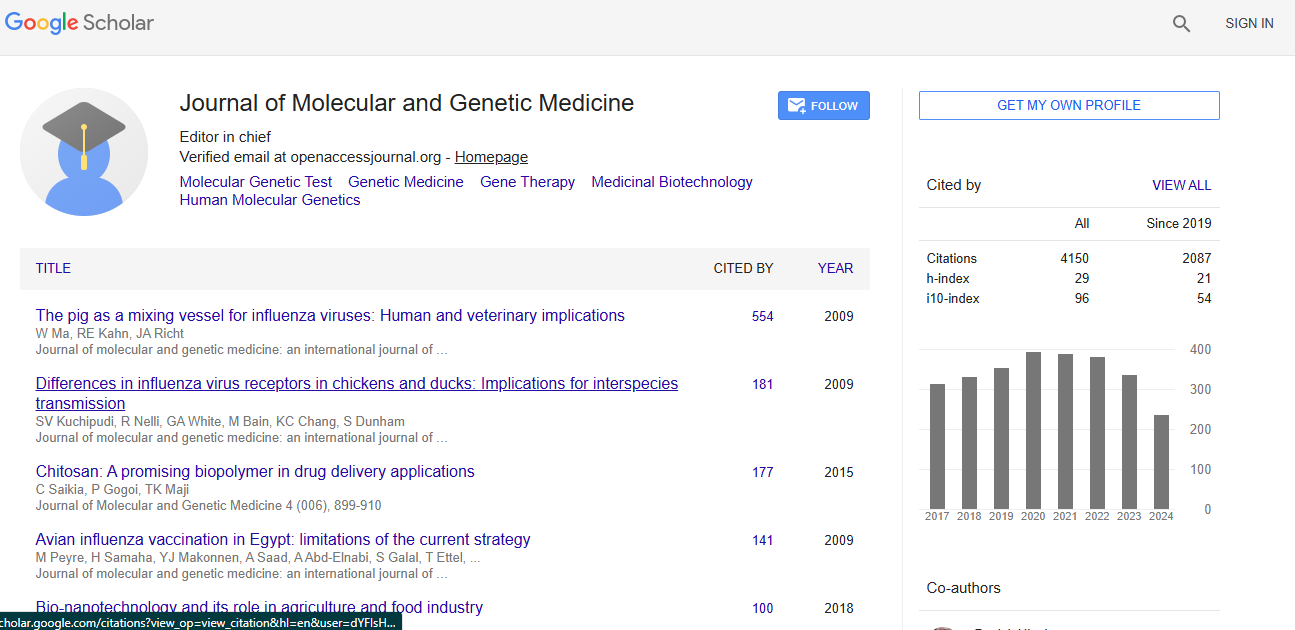
Molecular and Genetic Medicine received 3919 citations as per Google Scholar report