Opinion - (2025) Volume 9, Issue 4
Received: 01-Aug-2025, Manuscript No. jgge-25-174633;
Editor assigned: 04-Aug-2025, Pre QC No. P-174633;
Reviewed: 18-Aug-2025, QC No. Q-174633;
Revised: 22-Aug-2025, Manuscript No. R-174633;
Published:
29-Aug-2025
, DOI: 10.37421/2684-4567.2025.9.185
Citation: Ofori, Daniel K.. ”Transcriptomics: Transforming Insights to Precision Medicine.” J Genet Genom 09 (2025):185.
Copyright: © 2025 Ofori K. Daniel This is an open-access article distributed under the terms of the Creative Commons Attribution License, which permits unrestricted use,
distribution and reproduction in any medium, provided the original author and source are credited.
This paper gives a great overview of how single-cell and spatial transcriptomics are changing cancer research. It details how these technologies allow us to see the molecular details of tumors and their microenvironment at an unprecedented resolution, which is critical for understanding disease progression and finding new treatment targets. This provides critical insights for understanding disease progression, identifying novel biomarkers, and ultimately finding new treatment targets that are precisely tailored to individual tumor characteristics. This level of detail profoundly impacts cancer research [1].
This article explores the current landscape of RNA sequencing (RNA-seq) technologies, really laying out the different approaches available. It goes beyond just gene expression, touching on how these methods are evolving to tackle more complex questions in genetics and disease, and where the field is likely headed next and also provides a forward-looking perspective on where the field is likely headed next, including the integration of multi-omics data for a more holistic view of biological systems [2].
This review dives into spatial transcriptomics, explaining the various techniques and how they're being used. What's key here is how these methods allow us to understand gene expression while keeping the tissue context, which is a major leap for fields like developmental biology and pathology. developmental biology, neuroscience, and pathology. The ability to visualize gene activity in its native spatial context fundamentally transforms our approach to complex biological systems [3].
This recent work looks at how transcriptomics is applied to understand disease mechanisms and guide treatments. It highlights the hurdles we face in translating these vast datasets into clinical practice and points towards future directions for overcoming those challenges, which is super important for patient care. which is profoundly important for improving personalized patient care and developing more effective therapeutic strategies based on individual molecular profiles. Overcoming these challenges is a key focus for researchers [4].
This review from 2020 gives a solid look at RNA sequencing (RNA-seq), covering the core technology, its wide-ranging applications, and the real-world challenges researchers face. Itâ??s a good foundational piece for understanding the landscape of bulk transcriptomics and its impact on biomedical studies. its profound impact on a broad range of biomedical studies, from basic discovery to translational research, setting the stage for subsequent technological advancements [5].
This article focuses on Circular RNAs (circRNAs), which are a fascinating subset of the transcriptome. It highlights their roles in both healthy states and various diseases, suggesting they could be important new therapeutic targets. This moves beyond traditional linear RNA, showing the depth of transcriptomic complexity. showing the remarkable depth and previously unrecognized complexity of the transcriptome, opening new avenues for research into RNA-based therapies [6].
This paper discusses long-read RNA sequencing, which is a game-changer for getting full-length transcripts. It talks about the techniques, where they're being applied in eukaryotes, and the difficulties in handling such extensive data. This is crucial for truly understanding alternative splicing and gene isoforms. alternative splicing events, complex gene isoforms, and detecting novel transcripts that are often missed by shorter read technologies. This has significant implications for understanding gene regulation [7].
This paper discusses metatranscriptomics, showing how it lets us peek into what microbial communities are actually doing rather than just who's there. It's a powerful way to understand host-microbe interactions and the functional dynamics of complex microbiomes, which is very exciting for personalized medicine. for personalized medicine, infectious disease research, and environmental microbiology, revealing the active metabolic pathways within these intricate biological networks [8].
This article explores the journey of transcriptomics from lab research to actual clinical use, particularly in precision medicine. It shows how gene expression data is becoming vital for identifying biomarkers and tailoring treatments, which really changes how we approach patient care based on individual molecular profiles. based on individual molecular profiles. This transformation underscores transcriptomics' central role in the future of healthcare and diagnostic development [9].
This paper focuses on the computational side of single-cell RNA sequencing (scRNA-seq), which is essential because the data is incredibly complex. It reviews the various analytical tools and pipelines, showing how bioinformatics is critical for making sense of cellular heterogeneity and extracting meaningful biological insights from these vast datasets. these vast datasets. Effective computational strategies are thus indispensable for unlocking the full potential of single-cell transcriptomic research and its applications [10].
Transcriptomics, encompassing the study of all RNA molecules in a cell or organism, is a cornerstone of modern biological research. Various RNA sequencing technologies currently available allow us to explore beyond mere gene expression, addressing complex questions in genetics and disease, while also charting future directions for the field [2]. An early yet foundational review from 2020 provided a comprehensive look at RNA sequencing (RNA-seq), detailing its core technology, diverse applications, and inherent real-world challenges. This work remains crucial for understanding bulk transcriptomics and its broader impact on biomedical studies [5].
Significant advancements have pushed transcriptomics beyond bulk analysis. Single-cell and spatial transcriptomics, for instance, are profoundly changing cancer research by offering molecular detail of tumors and their microenvironment at unprecedented resolution. This capability is vital for understanding disease progression and identifying new treatment targets [1]. Specifically, spatial transcriptomics allows researchers to understand gene expression while meticulously preserving the tissue context. This represents a major leap for fields such as developmental biology and pathology, where maintaining spatial information is key to deciphering complex biological processes [3].
The transcriptome itself is more complex than once thought, with fascinating subsets like Circular RNAs (circRNAs) gaining attention. These non-linear RNA molecules play diverse roles in both healthy states and various diseases, suggesting their potential as novel therapeutic targets and highlighting the intricate depth of transcriptomic complexity beyond traditional linear RNAs [6]. Complementing this, long-read RNA sequencing has emerged as a game-changer, enabling the capture of full-length transcripts. This technology is instrumental for studying alternative splicing and gene isoforms in eukaryotes, despite challenges associated with handling extensive data, providing a more complete picture of gene expression [7].
Beyond individual organisms, metatranscriptomics offers a unique lens into the functional activities of microbial communities, revealing what microbes are *doing* rather than just *who they are*. This powerful approach helps understand host-microbe interactions and the functional dynamics of complex microbiomes, offering exciting prospects for personalized medicine [8]. The journey of transcriptomics from basic lab research to clinical use, especially in precision medicine, underscores its growing importance. Gene expression data is increasingly vital for identifying biomarkers and tailoring treatments, fundamentally reshaping patient care based on individual molecular profiles [9]. However, translating these vast datasets into clinical practice faces hurdles, and addressing these challenges is crucial for future patient care. Current research focuses on overcoming these translation gaps and exploring future directions for transcriptomics in disease and treatment [4]. Underpinning all these advanced applications is the indispensable role of computational biology. Single-cell RNA sequencing (scRNA-seq) data, due to its inherent complexity, relies heavily on sophisticated analytical tools and pipelines. Bioinformatics is therefore critical for making sense of cellular heterogeneity and extracting meaningful biological insights from these enormous datasets [10].
Transcriptomics provides an essential framework for understanding gene expression, from bulk RNA sequencing to highly detailed single-cell and spatial analyses. These technologies are fundamentally transforming fields such as cancer research, offering unparalleled insights into tumor microenvironments and paving the way for targeted therapies. Advanced methods like long-read RNA sequencing enhance our understanding of full-length transcripts and alternative splicing, while the discovery of non-linear RNAs, such as Circular RNAs (circRNAs), reveals the transcriptome's intricate complexity. Beyond individual cells, metatranscriptomics uncovers the functional dynamics of microbial communities, enriching our comprehension of host-microbe interactions and their implications for personalized medicine. The clinical application of transcriptomics is rapidly expanding, moving from basic research to precision medicine by facilitating biomarker identification and personalized treatment strategies. However, the translation of extensive transcriptomic datasets into clinical practice presents significant challenges. Overcoming these hurdles, along with developing robust computational approaches, is vital for effectively managing the complex data generated by single-cell RNA sequencing (scRNA-seq) and other high-throughput methods. These computational tools are indispensable for extracting meaningful biological insights and driving future advancements in disease understanding and patient care. The field continues to evolve, promising deeper molecular insights and innovative therapeutic opportunities.
None
None
Mengqi Z, Jieying L, Xinyu Z. "Single-cell and spatial transcriptomics: A comprehensive review of advances in cancer research".J Exp Clin Cancer Res 42 (2023):297.
Indexed at, Google Scholar, Crossref
Jun D, Huibin C, Xiaolong W. "RNA sequencing: current technologies and future applications".J Med Genet 59 (2022):625-633.
Indexed at, Google Scholar, Crossref
Mengyang F, Ruihong C, Mingxuan L. "Spatial transcriptomics: an overview of technologies and applications".Genome Biol 22 (2021):236.
Indexed at, Google Scholar, Crossref
Minghao W, Jian S, Longping W. "Transcriptomics in disease and treatment: Current challenges and future prospects".Life Sci 341 (2024):122421.
Indexed at, Google Scholar, Crossref
Muhammad I, Wajeeha A, Anum K. "RNA-seq: A review of the technology, applications, and challenges in biomedical research".Genomics 112 (2020):4075-4084.
Indexed at, Google Scholar, Crossref
Tingting Z, Lingling L, Linlin G. "Circular RNA (circRNA) in health and disease: a review of current knowledge and therapeutic potential".Cell Death Dis 14 (2023):730.
Indexed at, Google Scholar, Crossref
Yiqing Y, Qingyu W, Ying L. "Long-read RNA sequencing: methods, applications, and challenges for eukaryotic transcriptomics".Front Genet 13 (2022):966289.
Indexed at, Google Scholar, Crossref
Li W, Qian Z, Qi L. "Metatranscriptomics: A tool for exploring microbial community functions and host-microbe interactions".Curr Microbiol 78 (2021):3881-3888.
Indexed at, Google Scholar, Crossref
Jing Z, Qian C, Yiyang C. "Clinical applications of transcriptomics: from basic research to precision medicine".J Transl Med 21 (2023):757.
Indexed at, Google Scholar, Crossref
Fan Z, Xiaomin Z, Wen L. "Computational approaches for single-cell RNA-seq data analysis".Brief Bioinform 21 (2020):2133-2144.
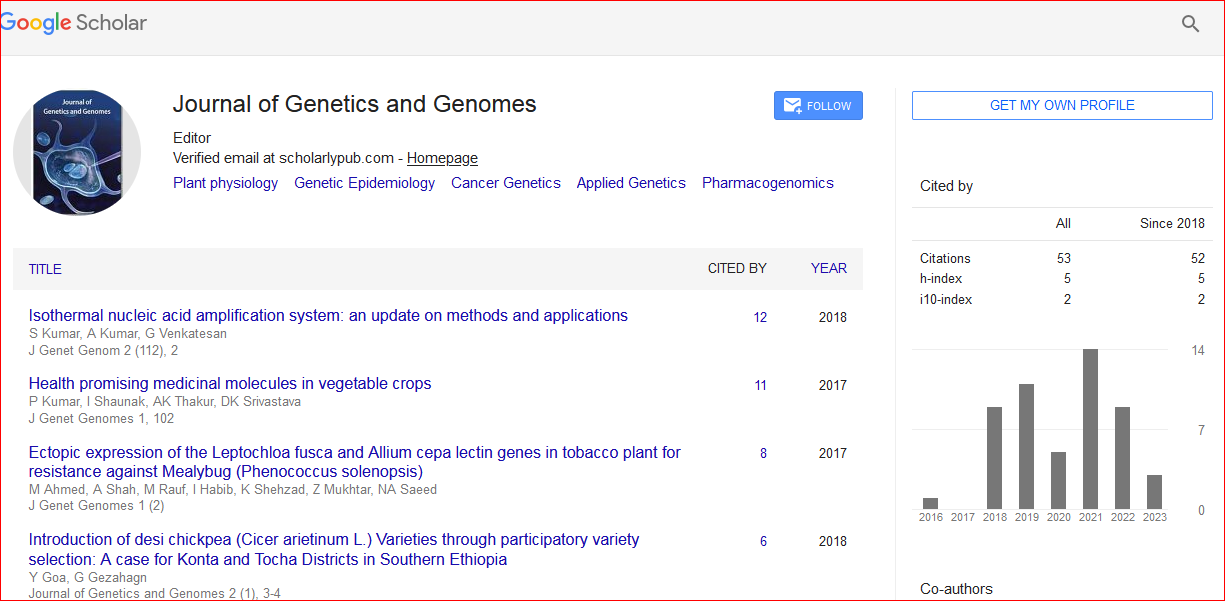
Journal of Genetics and Genomes received 65 citations as per Google Scholar report