Commentary - (2025) Volume 11, Issue 2
Received: 31-Mar-2025, Manuscript No. aso-25-166073;
Editor assigned: 02-Apr-2025, Pre QC No. P-166073;
Reviewed: 16-Apr-2025, QC No. Q-166073;
Revised: 24-Apr-2025, Manuscript No. R-166073;
Published:
30-Apr-2025
, DOI: 10.37421/2471-2671.2025.10.159
Citation: Leoo, Shingo. “The Role of Oncogene Addiction in Tumor Maintenance and Targeted Therapy Response.” Arch Surg Oncol 10 (2025): 159.
Copyright: © 2025 Leoo S. This is an open-access article distributed under the terms of the Creative Commons Attribution License, which permits unrestricted use, distribution and reproduction in any medium, provided the original author and source are credited.
The biological foundation of oncogene addiction lies in the intricate signaling networks that govern cell behavior. Oncogenes encode proteins involved in critical cellular processes such as signal transduction, cell cycle regulation, apoptosis inhibition, and metabolic control. When mutated or aberrantly expressed, these proteins drive tumorigenesis by promoting proliferation and preventing programmed cell death. However, cancer cells become so reliant on the signaling pathways initiated by these oncogenes that inhibition of their function disrupts multiple downstream processes essential for tumor survival. This dependency contrasts with the relative independence of normal cells from these oncogenes, providing a therapeutic window wherein selective targeting can achieve maximal antitumor effects with reduced toxicity [2].
Numerous examples of oncogene addiction have been identified across various cancer types. One of the most well-studied cases involves tumors with activating mutations in the gene encoding the epidermal growth factor receptor [3]. These mutations lead to constitutive receptor activation and downstream signaling that drives tumor growth. Treatment with agents specifically designed to inhibit this receptor has yielded significant clinical benefits, demonstrating the effectiveness of exploiting oncogene addiction. Similarly, chronic myeloid leukemia is characterized by a fusion gene that produces an aberrant tyrosine kinase oncogene, which is essential for leukemia cell survival. Targeted therapies that inhibit this kinase have transformed the prognosis of this disease from fatal to manageable chronic condition. Other examples include tumors addicted to mutated forms of the genes encoding BRAF, ALK, and HER2, each of which has led to the development of highly effective targeted inhibitors [4].
The clinical implications of oncogene addiction extend beyond the initial response to targeted therapies. While tumors dependent on a single oncogene often exhibit dramatic regression upon treatment, the development of resistance remains a major obstacle. Resistance mechanisms are diverse and include secondary mutations that prevent drug binding, activation of alternative signaling pathways, phenotypic changes such as epithelial-to-mesenchymal transition, and alterations in the tumor microenvironment. These adaptations allow cancer cells to bypass the blockade of the addicted oncogene and resume growth. Understanding the molecular basis of resistance is critical for designing combination therapies or sequential treatment strategies that can sustain clinical benefit and delay or overcome resistance [5].
Google Scholar Cross Ref Indexed at
Google Scholar Cross Ref Indexed at
Google Scholar Cross Ref Indexed at
Google Scholar Cross Ref Indexed at
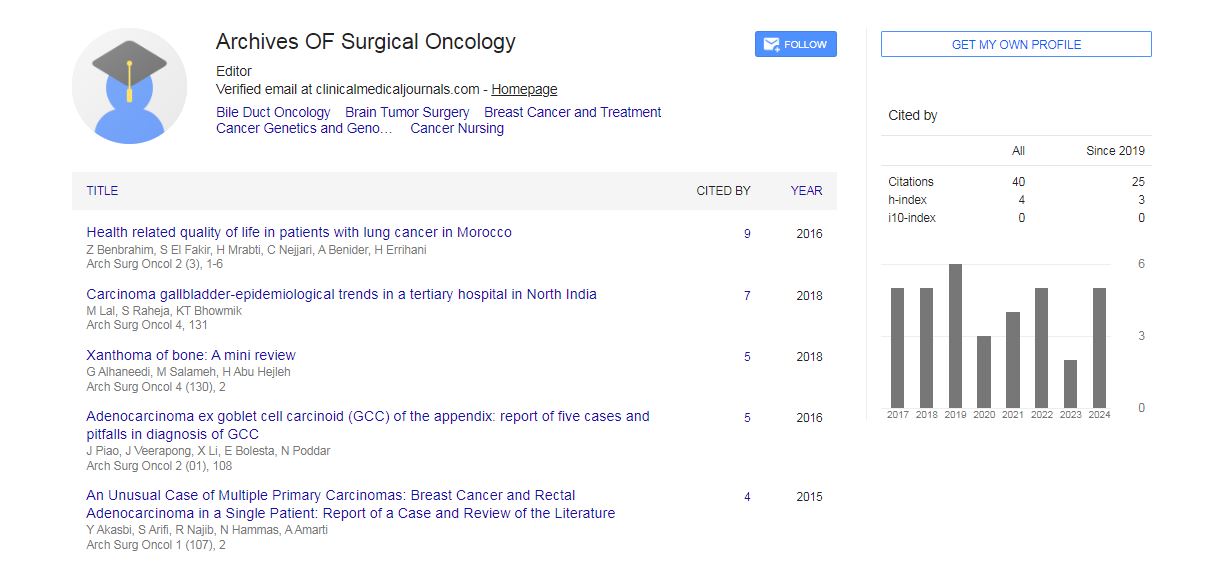
Archives of Surgical Oncology received 37 citations as per Google Scholar report