Brief Report - (2025) Volume 15, Issue 2
Received: 01-Apr-2025, Manuscript No. jeat-26-188593;
Editor assigned: 03-Apr-2025, Pre QC No. P-188593;
Reviewed: 17-Apr-2025, QC No. Q-188593;
Revised: 22-Apr-2025, Manuscript No. R-188593;
Published:
29-Apr-2025
, DOI: 10.37421/2161-0525.2025.15.835
Citation: Mehta, Aarav. ”Heavy Metal Contamination: Detection,
Risks, and Remediation.” J Environ Anal Toxicol 15 (2025):835.
Copyright: © 2025 Mehta A. This is an open-access article distributed under the terms of the Creative Commons Attribution License, which permits unrestricted use, distribution
and reproduction in any medium, provided the original author and source are credited.
The pervasive issue of heavy metal contamination in the environment poses significant risks to ecosystems and human health, necessitating robust analytical approaches for its detection and quantification [1].
The intricate nature of environmental matrices, such as sediments and water bodies, presents unique challenges in accurately assessing heavy metal burdens [2].
Effective remediation strategies are paramount for mitigating the adverse impacts of heavy metals on agricultural lands and ensuring the safety of food production [3].
Contamination of drinking water sources with heavy metals represents a critical public health concern, demanding vigilant monitoring and improved treatment processes [4].
The speciation of heavy metals in atmospheric particulate matter is crucial for understanding their bioavailability and potential toxicity, impacting respiratory health in urban populations [5].
Bioaccumulation of heavy metals in edible aquatic organisms raises serious food safety concerns, highlighting the need for rigorous monitoring of seafood quality [6].
Anthropogenic activities, including traffic emissions and waste disposal, significantly contribute to heavy metal contamination in urban soils, affecting green spaces and public health [7].
The development of advanced analytical tools, such as novel electrochemical sensors, offers promising solutions for rapid and cost-effective on-site detection of heavy metals in various samples [8].
Understanding the transfer pathways of heavy metals from contaminated soils to crops is essential for managing dietary exposure and safeguarding agricultural productivity [9].
Investigating the spatial distribution and sources of heavy metals in urban dust provides critical insights into the pervasive influence of human activities on the urban environment and associated health risks [10].
Current analytical methodologies are integral to the comprehensive assessment of heavy metal contamination across diverse environmental samples, offering insights into detection and quantification challenges [1].
Studies focusing on riverine sediments utilize advanced techniques like ICP-MS to trace the distribution and sources of heavy metals, often implicating industrial activities and vehicular emissions [2].
Research into soil remediation techniques, including phytoremediation and soil washing, demonstrates their efficacy in removing specific heavy metals from contaminated agricultural lands, thereby restoring soil health [3].
Evaluations of drinking water quality frequently identify heavy metal contamination above permissible limits, necessitating improved water treatment and public awareness initiatives to prevent adverse health outcomes [4].
Analysis of atmospheric particulate matter, particularly PM2.5, through speciation studies is vital for determining the bioavailability and toxicity of associated heavy metals, with implications for respiratory health [5].
Investigations into the bioaccumulation of heavy metals in edible fish species from polluted waters use techniques like AAS to quantify metal levels, directly linking environmental contamination to potential human dietary exposure [6].
The impact of anthropogenic activities on urban soils is frequently assessed using a combination of rapid screening and confirmatory analytical methods to identify sources and levels of heavy metal contamination [7].
The development of novel sensors, such as electrochemical devices, provides innovative and portable alternatives for the simultaneous and sensitive detection of heavy metals in water samples, facilitating on-site monitoring [8].
Research examining the transfer of heavy metals from soil to crops, often employing isotope dilution ICP-MS, is crucial for understanding dietary exposure routes in agricultural areas impacted by industrial activities [9].
Studies on urban dust analyze the spatial distribution and sources of heavy metals using geostatistical tools and multivariate analysis, revealing the significant contributions of traffic and industrial processes to environmental pollution [10].
This collection of research highlights critical aspects of heavy metal contamination in various environmental matrices including water, soil, air, and food. It underscores the importance of advanced analytical techniques like ICP-MS, AAS, and XRF for accurate detection and quantification. Studies address challenges in sample preparation, source apportionment of pollutants, and the ecological and health risks associated with heavy metals. Remediation strategies such as phytoremediation and soil washing are explored, alongside the development of novel sensors for on-site monitoring. The research emphasizes the need for quality assurance, effective pollution control measures, and robust monitoring programs to safeguard environmental and public health.
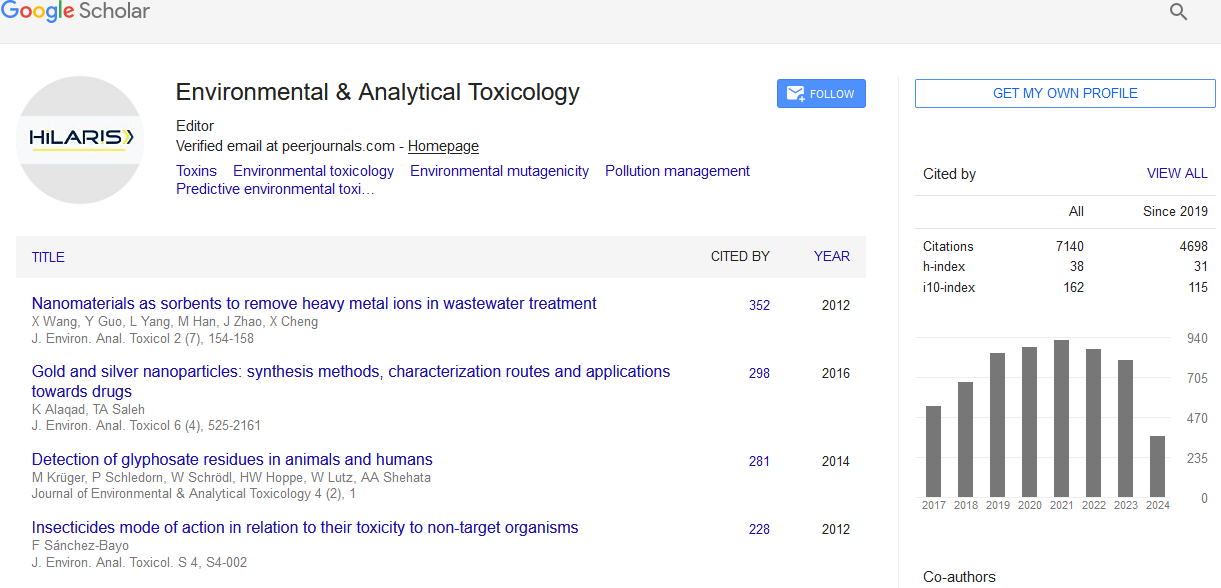
Environmental & Analytical Toxicology received 6818 citations as per Google Scholar report