Perspective - (2025) Volume 14, Issue 3
Received: 02-Jun-2025, Manuscript No. jnc-25-171664;
Editor assigned: 04-Jun-2025, Pre QC No. P-171664;
Reviewed: 16-Jun-2025, QC No. Q-171664;
Revised: 23-Jun-2025, Manuscript No. R-171664;
Published:
30-Jun-2025
, DOI: 10.37421/2167-1168.2025.14.714
Citation: Hanafi, Eraslan. “The Impact of Preoperative Patient Education by Nurses on Postoperative Recovery Times.” J Nurs Care 14 (2025): 714.
Copyright: © 2025 Hanafi E. This is an open-access article distributed under the terms of the Creative Commons Attribution License, which permits unrestricted use, distribution and reproduction in any medium, provided the original author and source are credited.
Preoperative education encompasses information shared with patients prior to surgery regarding the surgical procedure, anesthesia, expected outcomes, pain management, physical activity, diet, wound care and possible complications. Delivered effectively, it prepares patients mentally and physically, enabling smoother postoperative transitions and enhanced recovery. A key strength of nursing-led preoperative education is the ability to tailor content based on individual assessments. Nurses evaluate patientsâ?? health literacy, cultural background, anxiety levels, prior surgical experiences and comorbidities to personalize education. This approach ensures relevance and promotes active patient participation in recovery. Preoperative anxiety is known to negatively impact surgical outcomes. Elevated anxiety can increase pain perception, prolong anesthesia recovery and delay wound healing. Studies show that structured education reduces anxiety by clarifying the surgical process, correcting misconceptions and fostering a sense of control. Nurses employ calm communication, therapeutic presence and relaxation techniques to build patient confidence [2].
Educating patients about postoperative pain control including medication schedules, non-pharmacologic methods (e.g., breathing exercises, positioning) and the importance of early ambulation improves pain outcomes. Informed patients are more likely to report pain early and follow through with prescribed regimens. Early mobilization, a key driver of enhanced recovery, is better adhered to when its rationale is clearly explained beforehand. Patients who receive detailed preoperative education are more likely to comply with postoperative instructions such as breathing exercises, dietary restrictions and activity limitations. This compliance leads to reduced incidence of complications such as atelectasis, wound infections and deep vein thrombosis. Studies also link patient education to fewer readmissions and shorter hospital stays. Enhanced Recovery After Surgery (ERAS) protocols emphasize patient education as a cornerstone. Nurses trained in ERAS principles deliver comprehensive preoperative teaching that empowers patients and standardizes expectations. Integration of education into multidisciplinary pathways ensures continuity of care and better outcomes. Digital platforms, including educational videos, mobile apps and telehealth consultations, are expanding the reach of preoperative education. Nurses guide patients in using these tools to reinforce in-person teaching and facilitate self-directed learning. These resources are especially beneficial in rural or underserved areas with limited in-person access [3-4].
Effective preoperative education relies on clear, empathetic communication. Nurses use visual aids, simple language and teach-back techniques to verify understanding. Involving family members ensures support at home and reinforces postoperative care plans. Addressing emotional concerns and establishing rapport improves patient engagement and satisfaction. Cultural beliefs can significantly influence perceptions of surgery and recovery. Nurses must be culturally aware and respectful, adapting education to align with values and customs. Culturally competent care enhances trust and adherence and reduces disparities in surgical outcomes [5].
Google Scholar Cross Ref Indexed at
Google Scholar Cross Ref Indexed at
Google Scholar Cross Ref Indexed at
Google Scholar Cross Ref Indexed at
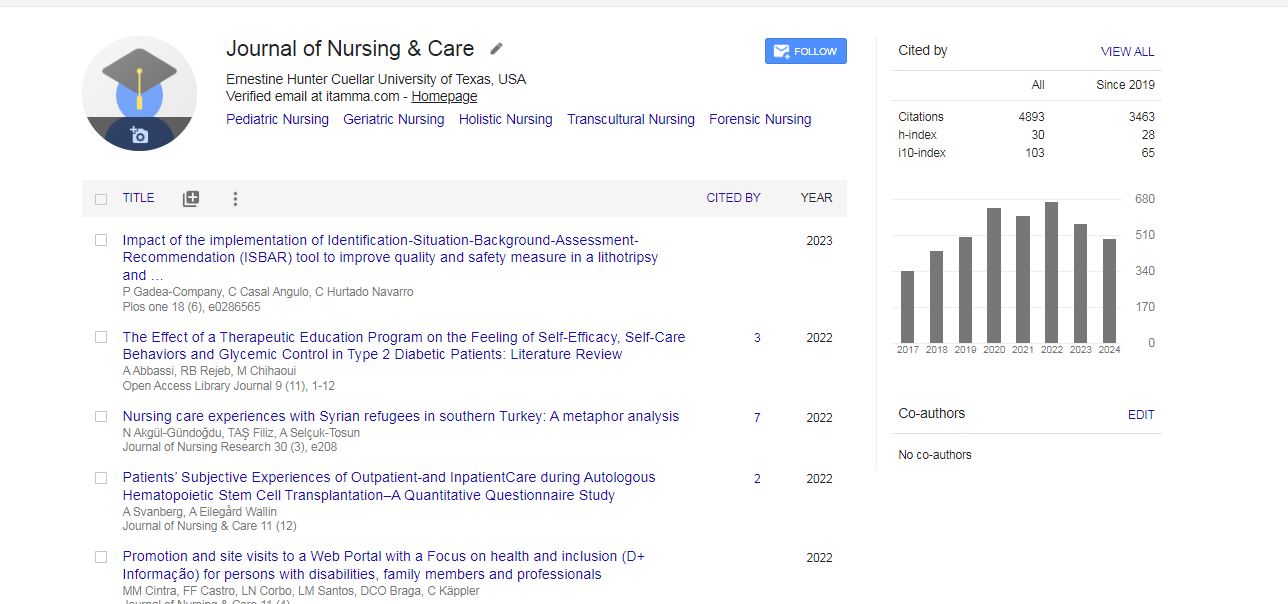
Journal of Nursing & Care received 4230 citations as per Google Scholar report