Opinion - (2025) Volume 15, Issue 5
Received: 01-Sep-2025, Manuscript No. jtese-26-184246;
Editor assigned: 03-Sep-2025, Pre QC No. P-184246;
Reviewed: 17-Sep-2025, QC No. Q-184246;
Revised: 22-Sep-2025, Manuscript No. R-184246;
Published:
29-Sep-2025
, DOI: 10.37421/2165-8064.2025.15.670
Citation: Connor, Helen. ”Textile Impacts: Towards Circular and Ethical Fashion.” J Textile Sci Eng 15 (2025):670.
Copyright: © 2025 Connor H. This is an open-access article distributed under the terms of the Creative Commons Attribution License, which permits unrestricted use, distribution and reproduction in any medium, provided the original author and source are credited.
The environmental impact of textile products is a multifaceted issue that spans their entire life cycle, from the initial extraction of raw materials to their ultimate disposal. Understanding these impacts is crucial for developing sustainable practices within the industry. Early research has focused on identifying key areas where the environmental burden is most significant, such as water consumption and greenhouse gas emissions during various manufacturing processes [1].
The textile industry, historically a major contributor to environmental degradation, is increasingly scrutinized for its ecological footprint. This has led to a growing body of research aimed at quantifying and mitigating these effects. Studies have begun to explore the specific environmental performance of different types of textiles, comparing sustainable alternatives with conventional ones across metrics like energy use, water pollution, and waste generation [2].
A significant portion of the environmental impact is attributed to the chemical processes involved in textile production, particularly dyeing and finishing. These stages often involve substantial water usage and the release of various chemicals, posing risks to ecotoxicity and human health. Research in this area focuses on quantifying these impacts and proposing cleaner technologies [3].
Furthermore, the concept of a circular economy is gaining traction as a potential solution to the textile industry's waste problem. Studies are investigating the viability of using recycled textile waste as a raw material, assessing the environmental benefits of diverting waste from landfills and reducing reliance on virgin fibers, while also acknowledging technical challenges [4].
The end-of-life phase of textile products presents another critical challenge. Landfilling, incineration, and recycling all have distinct environmental consequences, and research is actively quantifying these impacts to advocate for more sustainable waste management strategies and circular economy models [5].
Energy consumption and the associated carbon footprint are also major concerns in textile manufacturing. Studies have meticulously broken down energy inputs from raw material cultivation to final production stages for various fibers, highlighting the potential for reduction through renewable energy adoption and technological advancements [6].
Water usage, particularly in cotton cultivation and dyeing, represents another substantial environmental impact. Research quantifies both direct and indirect water consumption, emphasizing the significant water stress caused by conventional textile manufacturing and proposing water-saving strategies [7].
Beyond environmental considerations, the social dimension of textile production is equally important. Studies are analyzing labor conditions, worker safety, and community well-being throughout the supply chain, identifying areas of concern and advocating for ethical sourcing and fair labor practices [8].
Innovation in material science offers promising avenues for reducing the environmental impact of textiles. Research into novel materials, such as bio-based fibers and recycled synthetics, assesses their performance and life cycle environmental burdens compared to conventional alternatives, stressing the need for a systems-level approach to material selection [9].
Finally, consumer behavior plays a pivotal role in the overall environmental footprint of textile products. The way consumers wash, dry, and care for their garments significantly affects resource consumption and pollution, underscoring the need for consumer education and engagement to promote more sustainable practices [10].
The comprehensive life cycle assessment of textile products is a critical area of study, encompassing all stages from raw material extraction to end-of-life management. Key environmental hotspots, such as water consumption and greenhouse gas emissions during dyeing and finishing, have been identified, alongside potential mitigation strategies. The adoption of circular economy principles, including material recycling and product lifespan extension, is emphasized as vital for reducing the overall ecological footprint of the textile industry. This research underscores the necessity for improved material innovation, cleaner production technologies, and enhanced consumer awareness to foster sustainable textile consumption [1].
A detailed life cycle assessment (LCA) of sustainable textile materials has been conducted, comparing their environmental performance against conventional alternatives. This analysis quantifies impacts related to energy usage, water pollution, and waste generation. Findings suggest that while sustainable materials offer improvements, significant environmental benefits can be achieved by optimizing manufacturing processes and enhancing end-of-life scenarios, particularly through increased recycling rates. The complexity of textile LCA necessitates a holistic approach considering all product life stages [2].
The environmental impact of chemical processes in textile production, specifically dyeing and finishing, has been thoroughly investigated. This research quantifies the effects of various dyes, auxiliary chemicals, and water usage on ecotoxicity and human health. Recommendations include the adoption of cleaner dyeing technologies, such as digital printing and low-liquor ratio dyeing, along with the use of eco-friendly chemical formulations. Effective wastewater treatment is highlighted as crucial for minimizing the discharge of harmful substances [3].
The potential of utilizing recycled textile waste as a raw material for new products is being explored, assessing the environmental advantages of diverting waste from landfills and reducing the demand for virgin fibers. The study also addresses technical challenges in recycling, like fiber degradation and contamination. It recommends developing advanced sorting and recycling technologies, promoting product design for disassembly, and creating market demand for recycled textile products to advance a circular textile economy [4].
The end-of-life phase of textile products, including landfilling, incineration, and recycling, is examined to quantify the environmental consequences of each disposal method. The research advocates for a transition towards a circular economy model that prioritizes reuse, repair, and recycling. It also stresses the importance of Extended Producer Responsibility (EPR) schemes and policy interventions to encourage sustainable waste management practices in the textile sector [5].
The energy consumption and carbon footprint associated with the manufacturing of diverse textile fibers, such as cotton, polyester, and nylon, are analyzed. A detailed breakdown of energy inputs across all stages, from cultivation to spinning and weaving, is provided. The research emphasizes the potential for reducing energy demand and GHG emissions through the adoption of renewable energy sources and more efficient manufacturing technologies [6].
The water footprint of textile production, particularly concerning cotton cultivation and dyeing processes, is a significant focus. The study quantifies both blue water (freshwater withdrawal) and green water (rainwater) consumed. It highlights the considerable water stress caused by conventional textile manufacturing and proposes water-saving strategies, including the use of drought-resistant crops, water-efficient irrigation, and advanced dyeing technologies with reduced water consumption [7].
Social impacts within the textile production supply chain are analyzed, covering labor conditions, worker safety, and community well-being. Areas of concern, such as low wages, long working hours, and potential health risks from chemical exposure, are identified. The research underscores the necessity for ethical sourcing, fair labor practices, and enhanced transparency in the textile industry to ensure social sustainability alongside environmental considerations [8].
Novel materials, including bio-based fibers and recycled synthetics, are being investigated for their potential to reduce the environmental impact of textiles. Their performance characteristics and life cycle environmental burdens are assessed against conventional materials. The study emphasizes the importance of innovation in material science and sustainable design, advocating for a systems-level approach to material selection and product development [9].
Consumer behavior and product care practices are examined for their influence on the life cycle environmental footprint of textiles. The study analyzes the effects of washing, drying, and disposal habits on resource consumption and pollution. It highlights the need for consumer education and engagement to promote sustainable practices, such as washing at lower temperatures, air-drying clothes, and extending garment lifespan through proper care and repair [10].
This collection of research provides a comprehensive overview of the environmental and social impacts associated with the textile industry throughout the entire product lifecycle. Key areas of concern include resource consumption (water, energy), pollution from chemical processes (dyeing, finishing), and waste generation at the end-of-life stage. The studies advocate for a transition towards a circular economy model, emphasizing material innovation, cleaner production technologies, improved recycling infrastructure, and greater consumer awareness. Social sustainability, including fair labor practices and worker safety, is also highlighted as a critical component of responsible textile production. Addressing these multifaceted challenges requires a holistic approach involving industry, consumers, and policymakers to foster a more sustainable and ethical textile sector.
None
None
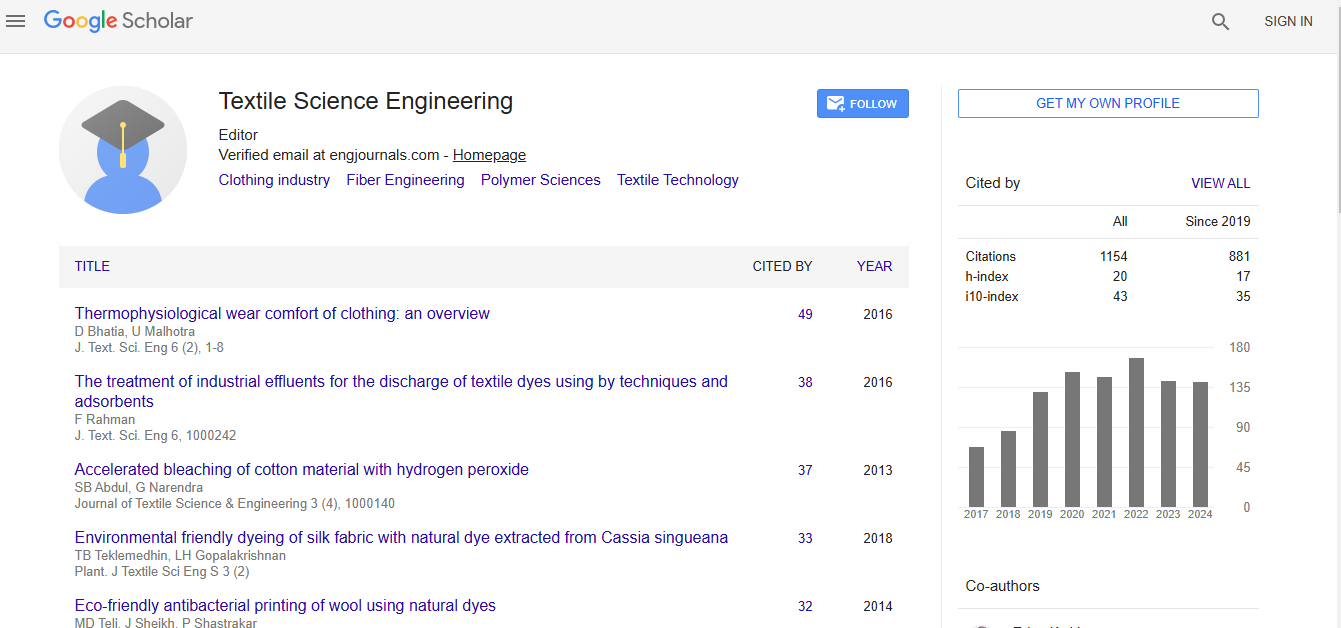
Journal of Textile Science & Engineering received 1008 citations as per Google Scholar report