Commentary - (2025) Volume 10, Issue 6
Received: 01-Dec-2025, Manuscript No. jcct-26-183281;
Editor assigned: 03-Dec-2025, Pre QC No. P-183281;
Reviewed: 17-Dec-2025, QC No. Q-183281;
Revised: 22-Dec-2025, Manuscript No. R-183281;
Published:
29-Dec-2025
, DOI: 10.37421/2577-0535.2025.9.343
Citation: Novak, Stefan. ”Targeting Cancer Stem Cells: A New Era.” J Cancer Clin Trials 10 (2025):343.
Copyright: © 2025 Novak S. This is an open-access article distributed under the terms of the Creative Commons Attribution License, which permits unrestricted use, distribution and reproduction in any medium, provided the original author and source are credited.
The landscape of cancer treatment is undergoing a profound transformation with the advent of strategies targeting cancer stem cells (CSCs), a distinct subpopulation of cells believed to be the primary drivers of tumor initiation, growth, recurrence, and metastasis. These innovative clinical trials aim to achieve a more durable and potentially curative outcome by directly confronting these resilient cells, which often evade conventional therapies [1].
The ongoing exploration of clinical trials specifically designed to eradicate cancer stem cells represents a significant paradigm shift in oncology. These trials investigate a diverse array of therapeutic modalities, encompassing immunotherapies, targeted small molecules, and sophisticated combination strategies, all united by the objective of eliminating the CSC population and thereby improving patient prognoses [2].
A critical facet of CSC biology and its implications for clinical trial design revolves around the tumor microenvironment (TME). The TME plays a pivotal role in fostering CSC survival, conferring therapeutic resistance, and promoting their metastatic potential. Consequently, strategies aimed at disrupting this supportive niche are increasingly being incorporated into trial designs for CSC elimination [3].
Advancements in immunotherapy are opening new avenues for targeting cancer stem cells. The development of novel immunotherapies, including CAR-T cell therapy and engineered cancer vaccines designed to recognize CSC-specific antigens, is a key focus. These approaches are being evaluated in early-phase clinical trials to assess their safety and efficacy in eradicating CSCs within the complex tumor ecosystem [4].
The application of targeted therapy remains a cornerstone in the clinical trial efforts to eliminate cancer stem cells. A comprehensive overview of small molecules and antibodies designed to inhibit essential CSC survival pathways, such as Wnt, Notch, and Hedgehog, highlights their significant role. The rationale behind combining these targeted agents with conventional therapies and their progress in clinical settings are being closely monitored for improved patient responses and reduced relapse rates [5].
Designing robust clinical trials that effectively target cancer stem cells presents unique challenges and opportunities. Issues such as precise patient stratification based on CSC markers, the selection of appropriate endpoints, and the development of synergistic combination therapies are critical considerations. Rigorous trial designs are essential to accurately measure the impact of CSC-directed treatments on tumor eradication and long-term survival [6].
Epigenetic mechanisms are increasingly recognized for their role in maintaining CSC properties and contributing to therapeutic resistance. This understanding is driving investigations into epigenetic modifiers as potential targets to reprogram CSCs or enhance the effectiveness of other anti-cancer treatments. Ongoing research and early clinical findings are shedding light on the potential of epigenetic drugs specifically aimed at CSCs [7].
A comprehensive review of the current landscape of clinical trials targeting cancer stem cells across various cancer types reveals diverse therapeutic strategies. These include targeting CSC surface markers, inhibiting self-renewal pathways, and leveraging the immune system, offering promising results and identifying areas for future investigation to improve patient outcomes [8].
The metabolic vulnerabilities of cancer stem cells, which differ from bulk tumor cells, are being exploited for therapeutic targeting. Current clinical trials are evaluating metabolic inhibitors and strategies designed to leverage these CSC-specific metabolic pathways to induce cell death or inhibit their self-renewal capabilities, representing an emerging area of clinical intervention [9].
Novel drug delivery systems are being explored in clinical trials to enhance the specificity of therapeutic agents directed at cancer stem cells. Advanced platforms such as nanoparticles and liposomes are being investigated for their potential to overcome CSC resistance and improve drug efficacy, with preclinical and early clinical data supporting these innovative approaches for CSC eradication [10].
The clinical pursuit of targeting cancer stem cells (CSCs) is fundamentally revolutionizing cancer treatment paradigms by focusing on the elusive cellular population responsible for tumor initiation, persistence, and spread. These clinical trials aim to achieve a definitive therapeutic advantage over conventional approaches, which often leave CSCs intact, thereby contributing to disease relapse and treatment resistance [1].
The current landscape of clinical trials dedicated to eradicating cancer stem cells involves a multifaceted approach. Researchers are investigating various therapeutic modalities, including cutting-edge immunotherapies, highly specific targeted small molecules, and innovative combination strategies, all designed to achieve complete CSC elimination and thereby enhance patient survival and prognosis [2].
The intricate relationship between the tumor microenvironment (TME) and cancer stem cell biology is a critical consideration in the design of effective clinical trials. Understanding how the TME supports CSC survival, confers resistance to therapy, and drives metastasis is leading to strategies that aim to disrupt this supportive niche, thereby making CSCs more susceptible to eradication [3].
Immunotherapy is emerging as a powerful tool in the fight against cancer stem cells. The development and evaluation of novel immunotherapeutic approaches, such as chimeric antigen receptor (CAR)-T cell therapy and engineered cancer vaccines targeting CSC-specific antigens, are gaining traction. These are being rigorously assessed in early-phase clinical trials to determine their safety and effectiveness in eliminating CSCs within the heterogeneous tumor environment [4].
Targeted therapy continues to be a central strategy in clinical trials aimed at eliminating cancer stem cells. The development of small molecules and antibodies that inhibit key CSC survival pathways, including Wnt, Notch, and Hedgehog, is a significant focus. The exploration of combining these targeted agents with standard treatments is crucial for improving patient outcomes and reducing the likelihood of relapse [5].
Designing clinical trials to effectively target cancer stem cells necessitates careful consideration of numerous factors. Challenges include precisely stratifying patients based on CSC markers, defining appropriate clinical endpoints, and developing novel combination therapies that synergize against CSCs. Rigorous trial designs are paramount for accurately assessing the true impact of these novel treatments on tumor eradication and long-term patient survival [6].
The epigenetic regulation of cancer stem cells plays a critical role in their maintenance and in conferring resistance to therapy. This understanding is paving the way for the investigation of epigenetic modifiers as potential therapeutic targets. Clinical trials are exploring the use of epigenetic drugs to reprogram CSCs or to sensitize them to other treatments, with early findings showing promise [7].
A comprehensive review of ongoing clinical trials targeting cancer stem cells across a spectrum of cancers reveals a diverse range of strategies. These strategies encompass targeting CSC surface markers, inhibiting self-renewal pathways, and harnessing the power of the immune system. The progress observed in these trials, along with identified areas for further research, underscores the substantial potential of CSC-directed therapies to significantly improve patient outcomes [8].
The distinct metabolic profiles of cancer stem cells present unique vulnerabilities that are being exploited for therapeutic gain. Current clinical trials are evaluating the efficacy of metabolic inhibitors and other strategies that target these CSC-specific metabolic pathways, aiming to induce cell death or suppress their self-renewal capacity, representing an exciting frontier in CSC-targeted therapy [9].
Novel drug delivery systems are being integrated into clinical trials to achieve targeted delivery of therapeutic agents to cancer stem cells. The potential of advanced platforms such as nanoparticles and liposomes to overcome CSC resistance and enhance drug efficacy is being explored. Preclinical and early clinical data are supporting these innovative approaches for the specific eradication of CSCs [10].
Clinical trials targeting cancer stem cells (CSCs) are revolutionizing cancer treatment by focusing on the cellular drivers of tumor initiation, recurrence, and metastasis. These trials explore diverse strategies including immunotherapy, targeted small molecules, and combination therapies to eradicate CSCs and overcome treatment resistance. The tumor microenvironment and epigenetic regulation are key areas of investigation, with ongoing research into novel drug delivery systems and metabolic targeting. Designing effective clinical trials for CSC-directed therapies presents unique challenges but holds significant promise for improving patient outcomes and achieving more durable and potentially curative results.
None
None
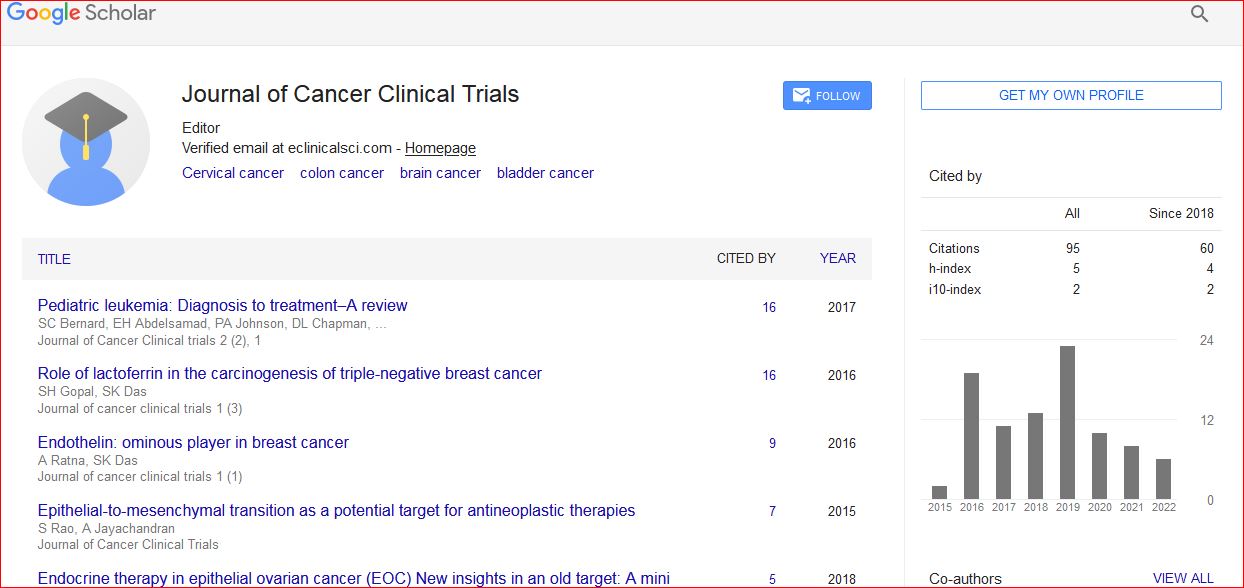
Journal of Cancer Clinical Trials received 95 citations as per Google Scholar report