Perspective - (2025) Volume 15, Issue 5
Received: 02-Oct-2025, Manuscript No. jbbs-25-174258;
Editor assigned: 06-Oct-2025, Pre QC No. P-174258;
Reviewed: 20-Oct-2025, QC No. Q-174258;
Revised: 23-Oct-2025, Manuscript No. R-174258;
Published:
30-Oct-2025
, DOI: : 10.37421/2155-9538.2025.15.502
Citation: Andersson, Lucas. ”Systems Biology: Revolutionizing Biomedical Research.” J Bioengineer & Biomedical Sci 15 (2025):502.
Copyright: © 2025 Andersson L. This is an open-access article distributed under the terms of the Creative Commons Attribution License, which permits unrestricted use, distribution and reproduction in any medium, provided the original author and source are credited.
Systems biology approaches help unlock the complexities of metabolic diseases. They highlight the integration of diverse '-omics' data, like genomics, proteomics, and metabolomics, with computational modeling to identify critical pathways, understand disease mechanisms, and suggest potential therapeutic interventions. Emphasis is on moving beyond single-gene studies to a holistic view of metabolic dysregulation[1].
Single-cell systems biology provides insights into cancer research by making huge strides. Analyzing individual cells rather than bulk tissues provides unprecedented resolution into tumor heterogeneity, progression, and treatment resistance. These approaches cover advancements in single-cell sequencing technologies and computational methods that are reshaping our understanding of cancer at its most fundamental level, paving the way for more precise therapies[2].
Machine learning integrates with systems biology, showing recent breakthroughs and persistent challenges. This explains how Machine Learning (ML) algorithms are increasingly crucial for processing vast biological datasets, identifying complex patterns, and building predictive models of biological systems. Researchers discuss applications ranging from drug discovery to personalized medicine, emphasizing the need for robust data integration and interpretation[3].
Drug discovery shifts towards a systems biology perspective, outlining how understanding biological systems as interconnected networks, rather than isolated targets, revolutionizes the process of identifying new drugs and developing existing ones. These approaches cover strategies for target identification, lead optimization, and predicting drug efficacy and toxicity by considering the drug's impact on the entire biological system[4].
The systems biology of aging and longevity explores the intricate molecular and cellular mechanisms that drive the aging process, such as genomic instability, epigenetic alterations, and mitochondrial dysfunction. Researchers discuss how a systems-level understanding is crucial for identifying potential interventions and developing therapies to extend healthy lifespan, moving from mechanistic insights to translational strategies[5].
Computational systems biology develops personalized cancer therapies, detailing how computational models, drawing on patient-specific 'omics' data, can predict drug responses, identify optimal drug combinations, and guide treatment decisions. Discussions center on the challenges of model validation and the immense potential for translating these approaches into clinical practice for more effective, individualized cancer care[6].
Systems biology of the microbiome decodes complex interactions between hosts and their microbial communities. They highlight advanced experimental and computational techniques used to map microbial networks, understand their functional impact on host health and disease, and predict how alterations in the microbiome might influence various physiological processes. The goal is to move towards manipulating these interactions for therapeutic benefit[7].
Quantitative systems biology explains how mathematical modeling and experimental quantification are essential for unraveling the dynamics of cellular signaling pathways. This discusses how these approaches allow researchers to predict cellular responses to stimuli, identify key regulatory nodes, and understand how disruptions in signaling contribute to disease. The focus is on precision and predictive power in cellular communication[8].
Integrating Artificial Intelligence (AI) with systems biology transforms drug repurposing. This describes how AI algorithms can mine vast datasets of existing drugs, disease mechanisms, and biological networks to identify new therapeutic applications for approved medications. This approach offers a faster, more cost-effective path to drug development, by leveraging known drug safety profiles and focusing on predicting efficacy within complex biological systems[9].
Single-cell multi-omics is changing systems biology, offering detailed insights. This involves simultaneously profiling multiple molecular layers, like genomics, transcriptomics, and proteomics, at the single-cell level. This offers a deeper understanding of cellular heterogeneity, developmental trajectories, and disease states, all crucial for advancing precision medicine and fundamental biological discovery[10].
Systems biology approaches help unlock the complexities of metabolic diseases. They highlight the integration of diverse '-omics' data, such as genomics, proteomics, and metabolomics, with computational modeling. This combination identifies critical pathways, helps understand disease mechanisms, and suggests potential therapeutic interventions. The emphasis is on moving beyond single-gene studies to a holistic view of metabolic dysregulation[1]. A comprehensive look at the systems biology of aging and longevity explores the intricate molecular and cellular mechanisms driving the aging process, including genomic instability, epigenetic alterations, and mitochondrial dysfunction. Researchers discuss how a systems-level understanding is crucial for identifying potential interventions and developing therapies to extend healthy lifespan, transitioning from mechanistic insights to translational strategies[5]. Furthermore, the systems biology of the microbiome focuses on decoding complex interactions between hosts and their microbial communities. Advanced experimental and computational techniques are used to map microbial networks, understand their functional impact on host health and disease, and predict how alterations in the microbiome might influence various physiological processes. The ultimate goal here is to move towards manipulating these intricate interactions for therapeutic benefit[7].
Single-cell systems biology is making significant strides in cancer research. Analyzing individual cells rather than bulk tissues provides unprecedented resolution into tumor heterogeneity, progression, and treatment resistance. It covers advancements in single-cell sequencing technologies and computational methods that are reshaping our understanding of cancer at its most fundamental level, paving the way for more precise therapies[2]. Complementing this, computational systems biology offers powerful tools for developing personalized cancer therapies. It details how computational models, drawing on patient-specific 'omics' data, can predict drug responses, identify optimal drug combinations, and guide treatment decisions. Discussions center on the challenges of model validation and the immense potential for translating these approaches into clinical practice for more effective, individualized cancer care[6]. Here's the thing: single-cell multi-omics is changing systems biology by providing incredibly detailed insights. This involves simultaneously profiling multiple molecular layers, like genomics, transcriptomics, and proteomics, at the single-cell level. What this really means is a deeper understanding of cellular heterogeneity, developmental trajectories, and disease states, all crucial for advancing precision medicine and fundamental biological discovery[10].
The synergy between machine learning and systems biology highlights recent breakthroughs and persistent challenges. Machine Learning (ML) algorithms are increasingly crucial for processing vast biological datasets, identifying complex patterns, and building predictive models of biological systems. Researchers discuss applications ranging from drug discovery to personalized medicine, emphasizing the need for robust data integration and interpretation[3]. To break down quantitative systems biology for understanding signal transduction, mathematical modeling and experimental quantification are essential for unraveling the dynamics of cellular signaling pathways. These approaches allow researchers to predict cellular responses to stimuli, identify key regulatory nodes, and understand how disruptions in signaling contribute to disease. The focus is on precision and predictive power in cellular communication[8]. Integrating Artificial Intelligence (AI) with systems biology is transforming drug repurposing. AI algorithms can mine vast datasets of existing drugs, disease mechanisms, and biological networks to identify new therapeutic applications for approved medications. This approach offers a faster, more cost-effective path to drug development, leveraging known drug safety profiles and focusing on predicting efficacy within complex biological systems[9].
What this really means for drug discovery is a shift towards a systems biology perspective. This outlines how understanding biological systems as interconnected networks, rather than isolated targets, revolutionizes the process of identifying new drugs and developing existing ones. It covers strategies for target identification, lead optimization, and predicting drug efficacy and toxicity by considering the drug's impact on the entire biological system[4]. This holistic approach ensures that the development of therapeutics accounts for the complex interplay of biological processes, leading to more effective and safer interventions in a wide range of diseases.
Systems biology is revolutionizing biomedical research by moving from single-gene studies to a holistic understanding of complex biological systems. This approach integrates diverse '-omics' data, like genomics, proteomics, and metabolomics, with computational modeling to unravel disease mechanisms and identify therapeutic interventions for conditions such as metabolic diseases, aging, and microbiome-related disorders. In cancer research, single-cell systems biology and multi-omics provide unprecedented resolution into tumor heterogeneity, progression, and treatment resistance, paving the way for precise and personalized therapies. Computational models, leveraging patient-specific data, predict drug responses and optimize treatment strategies for individualized cancer care. The field also sees significant advancements through the synergy with Artificial Intelligence (AI) and Machine Learning (ML). These algorithms are crucial for processing vast biological datasets, identifying complex patterns, and building predictive models, with applications spanning from drug discovery and repurposing to personalized medicine. Understanding biological systems as interconnected networks is transforming drug discovery, moving beyond isolated targets to predict drug efficacy and toxicity by considering systemic impact. Quantitative systems biology further enhances this by employing mathematical modeling and experimental quantification to understand signal transduction and cellular communication, focusing on precision and predictive power. Overall, systems biology, augmented by advanced computational and 'omics' technologies, offers a powerful framework for deciphering biological complexity, leading to innovative diagnostic tools and therapeutic strategies across various health challenges.
None
None
1. Hyunbin D, Kyoung-Hyun K, Yu-Seok L. "Systems Biology Approaches to Unravel the Complexity of Metabolic Diseases".Int J Mol Sci 24 (2023):3672.
Indexed at, Google Scholar, Crossref
2. Yanhua L, Song Z, Kun W. "Advancements in Single-Cell Systems Biology for Cancer Research".Front Oncol 12 (2022):846669.
Indexed at, Google Scholar, Crossref
3. Mary EJ, Thomas DS, Andrea G. "Machine Learning in Systems Biology: Recent Advances and Future Challenges".Trends Biotechnol 39 (2021):841-855.
Indexed at, Google Scholar, Crossref
4. Andrew RJ, Beth B, Emily D. "A Systems Biology Perspective on Drug Discovery and Development".Pharmacol Rev 72 (2020):711-748.
Indexed at, Google Scholar, Crossref
5. Brian KK, Ann AJ, Craig DS. "Systems Biology of Aging and Longevity: From Mechanisms to Interventions".Cell Metab 35 (2023):745-760.
Indexed at, Google Scholar, Crossref
6. Victoria E, J. JG, Hisao K. "Computational Systems Biology Approaches for Personalized Cancer Therapy".Curr Opin Syst Biol 32 (2022):100438.
Indexed at, Google Scholar, Crossref
7. Jane S, Robert G, Peter W. "Systems Biology of the Microbiome: Decoding Host-Microbe Interactions".Trends Microbiol 29 (2021):900-912.
Indexed at, Google Scholar, Crossref
8. Boris NK, Michael RB, Jan BH. "Quantitative Systems Biology for Understanding Signal Transduction".Mol Syst Biol 16 (2020):e9574.
Indexed at, Google Scholar, Crossref
9. Feixiong C, Yan L, Xin W. "Integrating Artificial Intelligence with Systems Biology for Drug Repurposing".Nat Commun 14 (2023):3005.
Indexed at, Google Scholar, Crossref
10. Hao M, Tingting L, Xiaona Y. "Single-Cell Multi-omics in Systems Biology: Technologies and Applications".Cell Discov 8 (2022):58.
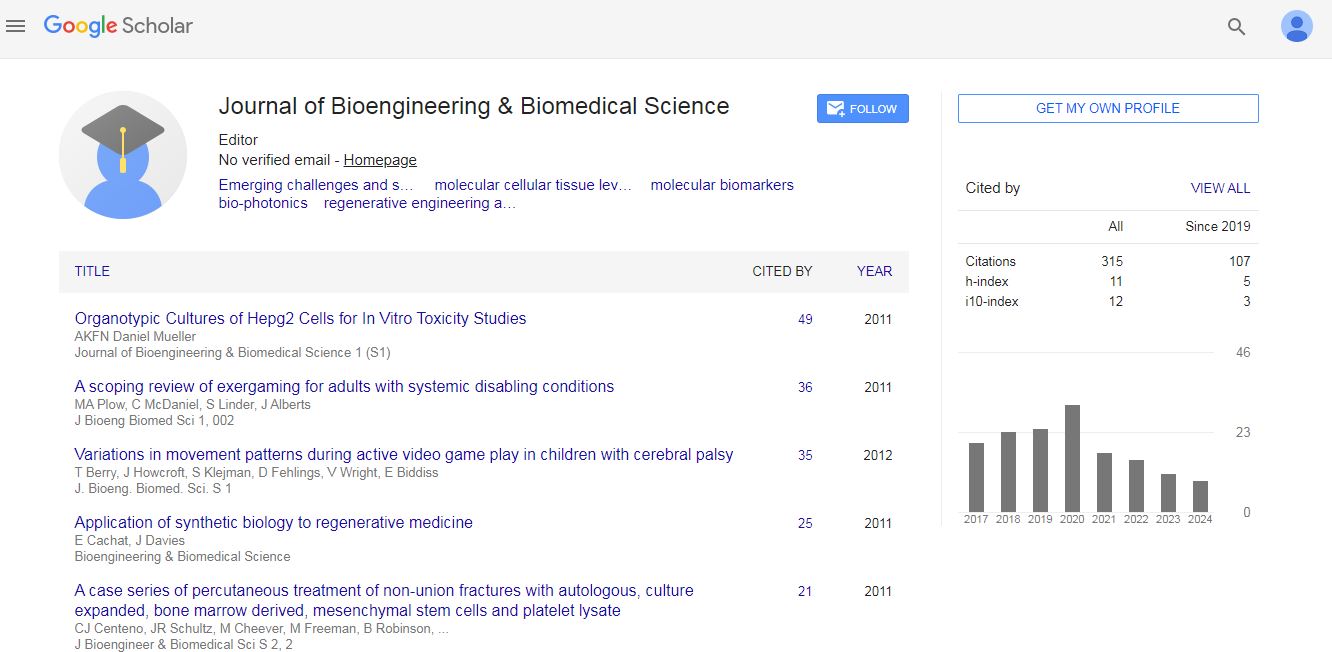
Journal of Bioengineering & Biomedical Science received 307 citations as per Google Scholar report