Perspective - (2025) Volume 11, Issue 2
Received: 31-Mar-2025, Manuscript No. aso-25-166078;
Editor assigned: 02-Apr-2025, Pre QC No. P-166078;
Reviewed: 16-Apr-2025, QC No. Q-166078;
Revised: 24-Apr-2025, Manuscript No. R-166078;
Published:
30-Apr-2025
, DOI: 10.37421/2471-2671.2025.10.163
Citation: Reeve, Roya. “Synthetic Lethality and Oncogene Targeting: A New Era in Cancer Therapeutics.” Arch Surg Oncol 10 (2025): 163.
Copyright: © 2025 Reeve R. This is an open-access article distributed under the terms of the Creative Commons Attribution License, which permits unrestricted use, distribution and reproduction in any medium, provided the original author and source are credited.
The concept of synthetic lethality has its roots in classical genetics, where interactions between gene pairs were observed to produce lethal phenotypes only when both genes were inactivated [2]. Translating this concept to cancer therapeutics relies on the observation that cancer cells often harbor specific genetic alterations, including activated oncogenes or inactivated tumor suppressor genes, which create dependencies on other genes or pathways for survival. These dependencies create “Achilles’ heels” that can be therapeutically exploited. For example, cancer cells with a mutation in one gene may become highly reliant on a parallel or compensatory pathway to maintain essential functions. Targeting such compensatory pathways in cancer cells can selectively induce cell death while sparing normal cells that retain the function of both genes. This selectivity is the cornerstone of synthetic lethality and offers a powerful approach to overcome the challenges associated with directly targeting oncogenes, which are often considered “undruggable” due to their structure or essential functions in normal tissues [3].
One of the most notable successes of synthetic lethality in cancer therapy is the development of poly (adenosine diphosphate-ribose) polymerase inhibitors for tumors with defects in DNA repair genes. In cancers with mutations in BRCA1 or BRCA2 genes, which are crucial for homologous recombination repair of DNA double-strand breaks, the inhibition of poly (adenosine diphosphate-ribose) polymerase enzymes results in the accumulation of DNA damage and cancer cell death. Normal cells, which retain functional BRCA genes, can compensate for the loss of poly (adenosine diphosphate-ribose) polymerase activity, thereby minimizing toxicity. This therapeutic approach has shown significant clinical benefit in breast and ovarian cancers harboring these genetic alterations, validating synthetic lethality as a clinically effective strategy. Beyond this example, extensive research is underway to identify other synthetic lethal interactions involving oncogenes such as RAS, MYC, and BRAF, which are frequently mutated or dysregulated in various cancers [4].
Targeting oncogene-driven vulnerabilities through synthetic lethality requires comprehensive understanding of the genetic and molecular context of tumors. Advances in high-throughput screening technologies, including RNA interference and CRISPR-Cas9-based genome editing, have accelerated the discovery of synthetic lethal gene pairs by allowing systematic interrogation of gene functions in cancer cell lines with defined oncogenic mutations. These functional genomic approaches, combined with bioinformatics analyses of tumor genomic data, facilitate the identification of candidate synthetic lethal interactions that can be translated into therapeutic targets. For instance, cancers driven by mutant RAS genes, historically difficult to target directly, have revealed synthetic lethal partners involved in pathways regulating cell cycle, metabolism, and signal transduction. Similarly, synthetic lethality screens have identified vulnerabilities in MYC-overexpressing tumors related to metabolic dependencies and DNA replication stress response. These findings provide a rich resource for developing novel drugs and combination therapies tailored to the molecular profiles of individual tumors [5].
Google Scholar Cross Ref Indexed at
Google Scholar Cross Ref Indexed at
Google Scholar Cross Ref Indexed at
Google Scholar Cross Ref Indexed at
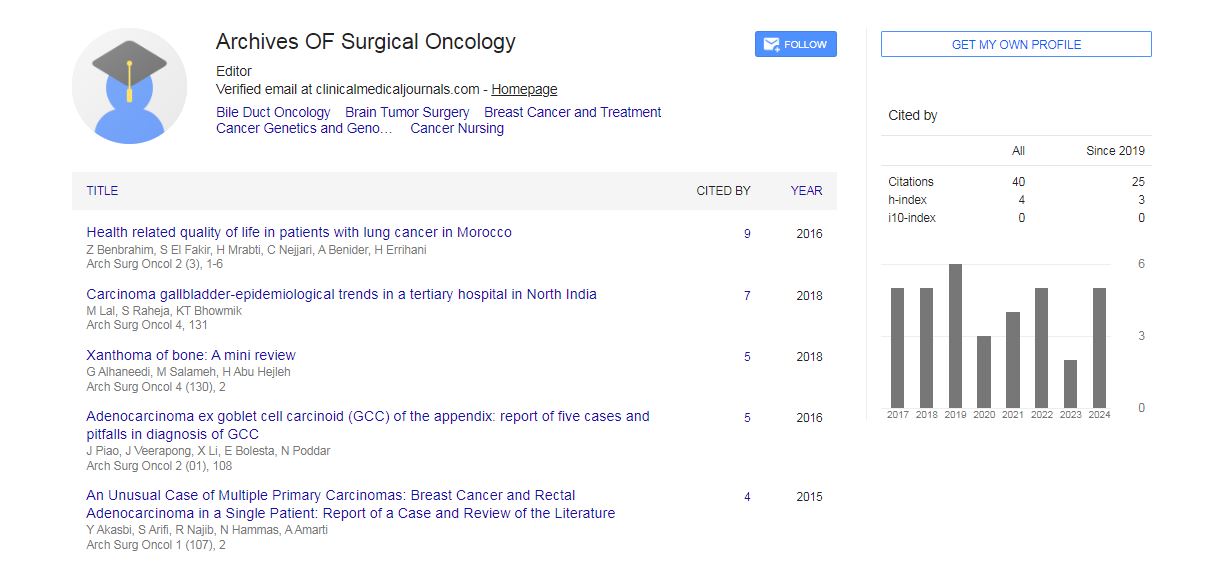
Archives of Surgical Oncology received 37 citations as per Google Scholar report