Brief Report - (2025) Volume 12, Issue 6
Received: 01-Dec-2025, Manuscript No. jreac-26-185805;
Editor assigned: 03-Dec-2025, Pre QC No. P-185805;
Reviewed: 17-Dec-2025, QC No. Q-185805;
Revised: 22-Dec-2025, Manuscript No. R-185805;
Published:
29-Dec-2025
, DOI: 10.37421/2380-2391.2025.12.465
Citation: Nair, Priya. ”Sustainable Sensing for Emerging Wastewater Contaminants.” J Environ Anal Chem 12 (2025):465.
Copyright: © 2025 Nair P. This is an open-access article distributed under the terms of the Creative Commons Attribution License, which permits unrestricted use, distribution
and reproduction in any medium, provided the original author and source are credited.
The urgent need for sophisticated analytical methodologies to address the pervasive issue of emerging contaminants in wastewater has become a paramount concern for environmental scientists and policymakers alike. These contaminants, often present at trace levels, pose significant risks to aquatic ecosystems and human health, necessitating the development of highly sensitive and selective detection techniques. The pursuit of sustainable analytical approaches is central to this endeavor, aiming to minimize environmental impact while maximizing detection efficacy. This article delves into the forefront of these advancements, exploring innovative solutions that prioritize green chemistry principles throughout the analytical process. One critical area of focus involves the development of advanced analytical techniques that are not only sensitive but also cost-effective and environmentally benign. Such methods are crucial for monitoring a wide array of pollutants, including pharmaceuticals, personal care products, and microplastics, which are increasingly detected in water bodies. The integration of cutting-edge sensor technologies with advanced chromatographic methods offers a promising avenue for achieving these goals, alongside optimized sample preparation strategies designed to reduce waste and energy consumption. The overarching objective is to ensure reliable detection while rigorously adhering to the tenets of green chemistry, thereby fostering a more sustainable approach to environmental monitoring. The realm of electrochemical sensors has seen significant progress, particularly in their application for real-time monitoring of pesticides within diverse water matrices. The development of selective and highly sensitive electrode materials, often enhanced by nanomaterial modification, is central to enabling rapid and on-site detection capabilities. Understanding the underlying electrochemical mechanisms is vital for optimizing sensor performance and for harnessing their potential in sustainable water quality management, offering immediate feedback crucial for effective pollution control. Portable spectroscopic methods are emerging as powerful tools for the on-site detection of microplastics in wastewater, offering a distinct advantage over traditional laboratory-bound analyses. Techniques such as Raman and Fourier-transform infrared (FTIR) spectroscopy, when miniaturized and coupled with advanced data processing capabilities, become highly suitable for sustainable environmental monitoring programs. These advancements facilitate field-based assessments, reducing the logistical burdens and environmental footprint associated with sample transportation and extensive laboratory work. The utilization of biosensors incorporating engineered enzymes represents another significant stride in the sustainable detection of recalcitrant pollutants like endocrine-disrupting compounds (EDCs) in wastewater. Enzymatic assays are renowned for their inherent high specificity and sensitivity, presenting a compelling sustainable alternative to conventional chemical analytical methods. Crucially, research in this area also addresses the practical challenges of sensor stability and reusability, which are indispensable for the successful implementation of these biosensing platforms in continuous monitoring systems. Mass spectrometry, a cornerstone of analytical chemistry, is undergoing transformative advancements that are enhancing its role in the sustainable profiling of emerging contaminants within complex wastewater matrices. When coupled with novel sample preparation methodologies, these advanced techniques offer comprehensive contaminant analysis. A key focus is the minimization of solvent consumption and the reduction of analytical time, while simultaneously maintaining high throughput and sensitivity, leading to the establishment of robust and sustainable analytical workflows. DNA-based sensors are emerging as highly specific tools for detecting particular emerging contaminants, such as antibiotic resistance genes, directly within wastewater samples. These molecular biosensors offer remarkable specificity and the potential for multiplexing, which contributes to a more sustainable and targeted monitoring approach. The integration of molecular biology techniques with advanced sensor technology is paving the way for the development of sophisticated early warning systems for the presence of critical contaminants. Green chromatographic methods are critically reviewed for their application in the analysis of emerging contaminants in wastewater, emphasizing their role in sustainable analytical chemistry. The core principles revolve around significantly reducing the consumption of organic solvents, the utilization of environmentally friendly mobile phases, and the implementation of miniaturized chromatographic systems. These sustainable practices are paramount for protecting precious water resources and ensuring the long-term viability of analytical monitoring programs. The field of nanotechnology is playing an increasingly pivotal role in the development of highly sensitive and selective sensors specifically designed for detecting pharmaceuticals and personal care products (PPCPs) in wastewater. The strategic use of nanoparticles and other nanomaterials significantly enhances sensor performance, offering improved detection limits and specificity. Furthermore, research is actively exploring sustainable synthesis and application strategies for these nanomaterials within environmental monitoring systems. Flow injection analysis (FIA) coupled with sensitive detection methods presents a powerful approach for the rapid and sustainable monitoring of heavy metals in wastewater. The inherent advantages of FIA, such as reduced reagent consumption and shortened analysis times, contribute significantly to developing more efficient and environmentally friendly water quality assessment strategies. This method aligns well with the broader goals of sustainable environmental management and analytical chemistry.
The scientific community is increasingly focused on developing sophisticated analytical methodologies tailored for the sustainable detection of emerging contaminants in wastewater, driven by concerns over their potential ecological and human health impacts. Advanced techniques are being explored to achieve high sensitivity and selectivity while minimizing environmental footprints, aligning with the principles of green chemistry. These efforts are critical for effectively monitoring a wide range of pollutants, including pharmaceuticals, personal care products, and microplastics, which are becoming ubiquitous in water systems. The integration of innovative sensor technologies with advanced chromatographic methods, coupled with optimized sample preparation strategies that reduce waste and energy use, represents a key pathway towards achieving sustainable and reliable environmental monitoring. A significant area of research involves the application of electrochemical sensors for the real-time monitoring of pesticides in various water matrices. The development of selective and highly sensitive electrode materials, often employing nanomaterial modifications, is crucial for enabling rapid and on-site detection. Understanding the underlying electrochemical mechanisms is essential for optimizing sensor performance and maximizing their contribution to sustainable water quality management by providing immediate feedback for pollution control. Portable spectroscopic techniques are gaining prominence for their ability to detect microplastics in wastewater directly in the field. Methods like Raman and Fourier-transform infrared (FTIR) spectroscopy, when miniaturized and integrated with advanced data processing, are proving highly effective for sustainable environmental monitoring. These techniques reduce the reliance on extensive laboratory analyses, offering a more efficient and environmentally conscious approach to sample assessment. Biosensors that utilize engineered enzymes are being developed for the sustainable detection of endocrine-disrupting compounds (EDCs) in wastewater. These enzymatic assays offer superior specificity and sensitivity compared to traditional chemical methods, positioning them as a sustainable alternative. Research also addresses the crucial aspects of sensor stability and reusability, which are vital for their practical application in continuous monitoring systems and for overall sustainability. Mass spectrometry, a powerful analytical tool, is being advanced through the development of novel sample preparation methods and sophisticated techniques for the comprehensive profiling of emerging contaminants in complex wastewater. A primary objective is to minimize solvent consumption and reduce analytical time while maintaining high throughput and sensitivity, thereby establishing robust and sustainable analytical workflows. DNA-based sensors are emerging as highly specific tools for the detection of particular emerging contaminants, such as antibiotic resistance genes, directly within wastewater. Their ability to offer high specificity and multiplexing capabilities supports a more sustainable and targeted monitoring approach. The synergy between molecular biology techniques and sensor technology is crucial for creating effective early warning systems. Green chromatographic methods are being reviewed for their application in the analysis of emerging contaminants in wastewater, with a strong emphasis on sustainability. Key strategies include minimizing organic solvent usage, employing environmentally friendly mobile phases, and utilizing miniaturized chromatographic systems. These sustainable practices are fundamental to protecting water resources and advancing analytical chemistry. Nanotechnology is significantly contributing to the development of highly sensitive and selective sensors for pharmaceuticals and personal care products (PPCPs) in wastewater. The use of nanoparticles and nanomaterials enhances sensor performance, leading to improved detection capabilities. Concurrently, research focuses on sustainable synthesis and application strategies for these nanomaterials within environmental monitoring systems. Flow injection analysis (FIA) coupled with sensitive detection methods provides a rapid and sustainable pathway for monitoring heavy metals in wastewater. FIA's advantages in reducing reagent consumption and analysis time contribute to more efficient and environmentally sound water quality assessment strategies, aligning with broader sustainability goals. Reusable and sustainable sorbent materials are being developed for the pre-concentration of emerging contaminants from wastewater before analysis. The evaluation of novel materials, such as metal-organic frameworks (MOFs) and covalent organic frameworks (COFs), is crucial for their integration into green analytical chemistry workflows, enhancing the efficiency and sustainability of contaminant removal and analysis.
This collection of research explores advanced analytical techniques and sustainable methodologies for detecting emerging contaminants in wastewater. Key areas include green analytical methods, electrochemical and DNA-based biosensors, portable spectroscopic techniques, and advanced mass spectrometry. The research emphasizes sensitivity, selectivity, cost-effectiveness, and environmental friendliness, aiming to minimize solvent consumption and waste generation. Innovations in sensor materials, such as nanomaterials and engineered enzymes, are highlighted for their improved performance and reusability. Sustainable sorbent materials and flow injection analysis are also discussed for efficient pre-concentration and rapid monitoring. The overarching goal is to develop robust, efficient, and environmentally conscious approaches for safeguarding water resources from various pollutants.
None
None
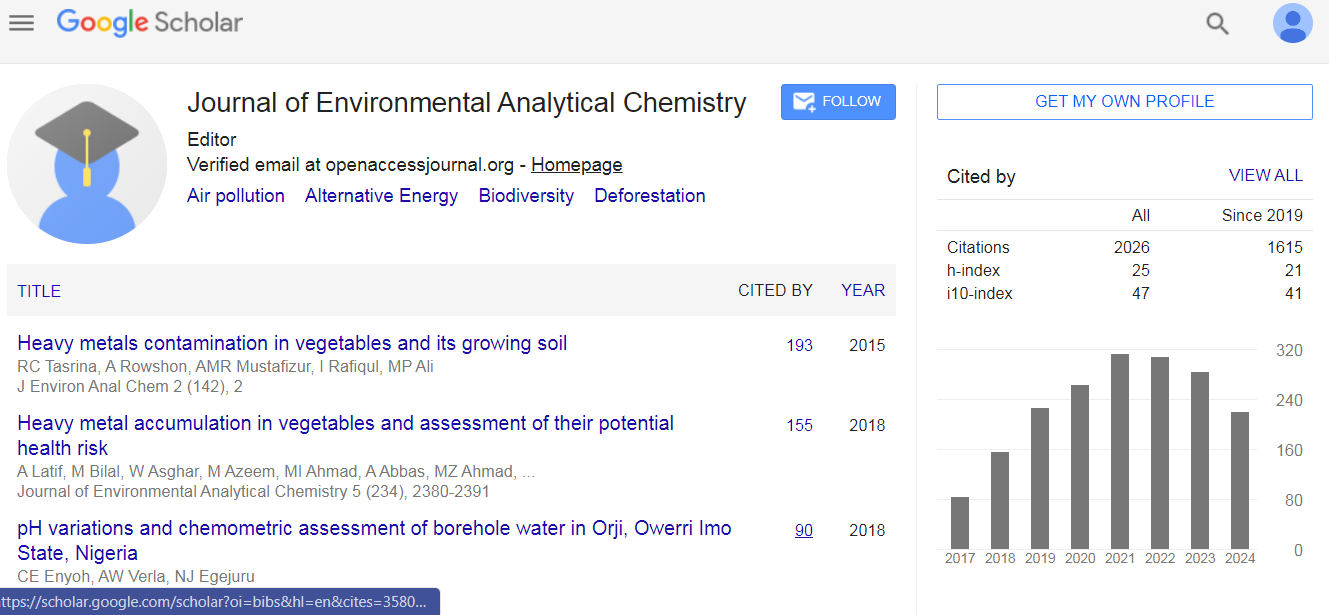
Journal of Environmental Analytical Chemistry received 1781 citations as per Google Scholar report