Opinion - (2025) Volume 11, Issue 5
Received: 01-Sep-2025, Manuscript No. aso-25-184655;
Editor assigned: 03-Sep-2025, Pre QC No. P-184655;
Reviewed: 17-Sep-2025, QC No. Q-184655;
Revised: 22-Sep-2025, Manuscript No. R-184655;
Published:
29-Sep-2025
, DOI: 10.37421/2471-2671.2025.11.190
Citation: Laurent, Sophie. ”Surgical Management Of Gastrointestinal
Malignancies: A Comprehensive Overview.” Arch Surg Oncol 11
(2025):190.
Copyright: © 2025 Laurent S. This is an open-access article distributed under the terms of the Creative Commons Attribution License, which permits unrestricted use,
distribution and reproduction in any medium, provided the original author and source are credited.
The surgical management of gastrointestinal malignancies has undergone significant evolution, driven by advancements in oncologic principles and surgical techniques. An oncologic perspective emphasizes accurate staging and tailored operative strategies, integrating neoadjuvant and adjuvant therapies to optimize outcomes. Innovations such as minimally invasive surgery, including robotic approaches, are being explored for their potential to improve recovery and reduce morbidity while maintaining oncologic safety [1].
The landscape of gastrointestinal cancer treatment is increasingly influenced by systemic therapies. Recent progress in immunotherapy and targeted agents has profoundly impacted neoadjuvant and adjuvant treatment protocols. These advancements affect surgical decision-making, potentially leading to downstaging, improved resectability, and enhanced survival rates, underscoring the synergy between surgical and medical oncology [2].
Minimally invasive surgical techniques, particularly robotic-assisted surgery, are becoming more prevalent in managing gastrointestinal cancers. The oncologic efficacy, safety, and perioperative benefits of these approaches are being compared to traditional open surgery, with a focus on addressing reconstructive challenges and adhering to oncologic principles for optimal cancer control [3].
Accurate pathological assessment and molecular profiling are foundational to personalized surgical management of gastrointestinal cancers. The pathologist and molecular biologist play a crucial role in guiding surgical decisions, selecting appropriate adjuvant therapies, and predicting patient prognosis by understanding tumor heterogeneity and biomarkers [4].
In cases of advanced or recurrent gastrointestinal malignancies, surgical management presents unique challenges. Palliative surgical interventions are employed to alleviate symptoms, improve quality of life, and prolong survival in selected patient populations, with careful consideration given to symptom control and patient selection [5].
Core principles of oncologic surgery for gastrointestinal cancers revolve around achieving complete tumor resection with adequate margins. This involves standardized surgical techniques, lymphadenectomy, and the judicious use of neoadjuvant and adjuvant therapies to optimize local and systemic control, guided by evidence-based practices [6].
The precision of surgical resection for gastrointestinal malignancies is being transformed by advanced imaging techniques and intraoperative navigation systems. Technologies like fluorescence imaging and augmented reality can enhance tumor identification, margin assessment, and the preservation of critical structures, ultimately improving oncologic outcomes and reducing complications [7].
Surgical complications following gastrointestinal cancer treatment can substantially impact patient outcomes and healthcare costs. A review of common postoperative complications, their risk factors, and strategies for prevention and management, with an emphasis on early recognition and multidisciplinary approaches, is essential to minimize morbidity [8].
The integration of neoadjuvant systemic therapy is a cornerstone in treating locally advanced gastrointestinal cancers, aiming to improve surgical resectability and outcomes. This approach involves exploring the rationale, current evidence, and future directions for neoadjuvant treatments, including chemotherapy, chemoradiation, and novel agents, within the context of surgical planning [9].
The evolving landscape of gastrointestinal cancer treatment demands a strong understanding of surgical oncology principles. Adherence to current guidelines and evidence for surgical management, focusing on optimal oncologic control and minimizing morbidity, is crucial. This is further supported by multidisciplinary tumor boards and patient stratification for personalized treatment approaches [10].
The surgical management of gastrointestinal malignancies is approached from an oncologic perspective, emphasizing precise staging and individualized operative strategies. The integration of neoadjuvant and adjuvant therapies is critical for optimizing oncological outcomes. Furthermore, advancements in minimally invasive techniques, such as robotic surgery, are being investigated for their potential to enhance patient recovery and reduce morbidity while ensuring oncologic safety [1].
Systemic therapy has emerged as a pivotal component in the multimodal management of gastrointestinal cancers, significantly altering the neoadjuvant and adjuvant treatment paradigms. The progress in areas like immunotherapy and targeted agents directly influences surgical decision-making, potentially leading to improved resectability and enhanced survival rates. This highlights the indispensable synergy between surgical expertise and medical oncology in refining treatment protocols [2].
Minimally invasive surgical approaches, particularly robotic-assisted surgery, are increasingly being adopted for gastrointestinal cancers. This trend involves a thorough exploration of the oncologic efficacy, safety, and perioperative advantages of these techniques when contrasted with open surgery. Key considerations include managing reconstructive complexities and strictly adhering to oncologic principles for effective cancer control [3].
Personalized surgical management of gastrointestinal cancers is fundamentally reliant on accurate pathological assessment and comprehensive molecular profiling. The expertise of pathologists and molecular biologists is indispensable in guiding surgical interventions, identifying suitable adjuvant therapies, and predicting patient prognosis by elucidating tumor heterogeneity and biomarkers [4].
The management of advanced or recurrent gastrointestinal malignancies poses considerable surgical challenges. In these complex scenarios, palliative surgical interventions play a vital role in symptom relief, enhancing quality of life, and extending survival for select patient groups. Strategic planning for symptom management and careful patient selection are paramount [5].
Fundamental to the surgical management of gastrointestinal cancers are the principles of oncologic resection, which prioritize complete tumor removal with clear margins. This necessitates the application of standardized surgical techniques, comprehensive lymphadenectomy, and the strategic use of neoadjuvant and adjuvant therapies to achieve optimal local and systemic tumor control, all informed by robust evidence-based practices [6].
The precision of surgical resection for gastrointestinal tumors is being revolutionized by the integration of advanced imaging technologies and intraoperative navigation systems. Tools such as fluorescence imaging and augmented reality are instrumental in improving tumor visualization, more accurately assessing margins, and preserving vital anatomical structures, thereby enhancing oncologic results and minimizing adverse events [7].
Postoperative complications following gastrointestinal cancer surgery represent a significant concern, impacting patient outcomes and healthcare resource utilization. A comprehensive understanding of common complications, their associated risk factors, and effective strategies for prevention and management, with a focus on early detection and collaborative multidisciplinary care, is crucial for mitigating morbidity [8].
The incorporation of neoadjuvant systemic therapy has become a critical strategy in the treatment of locally advanced gastrointestinal cancers, primarily aimed at improving surgical resectability and overall outcomes. This approach necessitates a detailed examination of the underlying rationale, existing clinical evidence, and future prospects for neoadjuvant treatments, including conventional and novel agents, within the framework of surgical planning and execution [9].
Given the dynamic nature of gastrointestinal cancer treatment, a thorough grasp of surgical oncology principles is indispensable. Current guidelines and evidence guiding surgical management are focused on achieving maximal oncologic control while concurrently minimizing patient morbidity. The importance of multidisciplinary tumor boards and meticulous patient stratification for personalized therapeutic strategies cannot be overstated [10].
This collection of articles explores the multifaceted surgical management of gastrointestinal malignancies. It highlights the importance of an oncologic perspective, accurate staging, and tailored surgical strategies, integrating neoadjuvant and adjuvant therapies to optimize patient outcomes. Advances in minimally invasive techniques, particularly robotic surgery, are discussed for their potential to improve recovery and reduce complications while maintaining oncologic safety. The role of systemic therapies, including immunotherapy and targeted agents, is recognized as significantly impacting surgical decision-making. Accurate pathological assessment and molecular profiling are crucial for personalized treatment. Palliative surgery addresses advanced disease, focusing on symptom relief and quality of life. Key principles of oncologic resection emphasize complete tumor removal and adequate margins. Technological innovations in imaging and navigation are enhancing surgical precision. Management of postoperative complications through early recognition and multidisciplinary approaches is vital. The integration of neoadjuvant therapy is a cornerstone for improving resectability and outcomes. Adherence to current guidelines, multidisciplinary tumor boards, and patient stratification are essential for effective management.
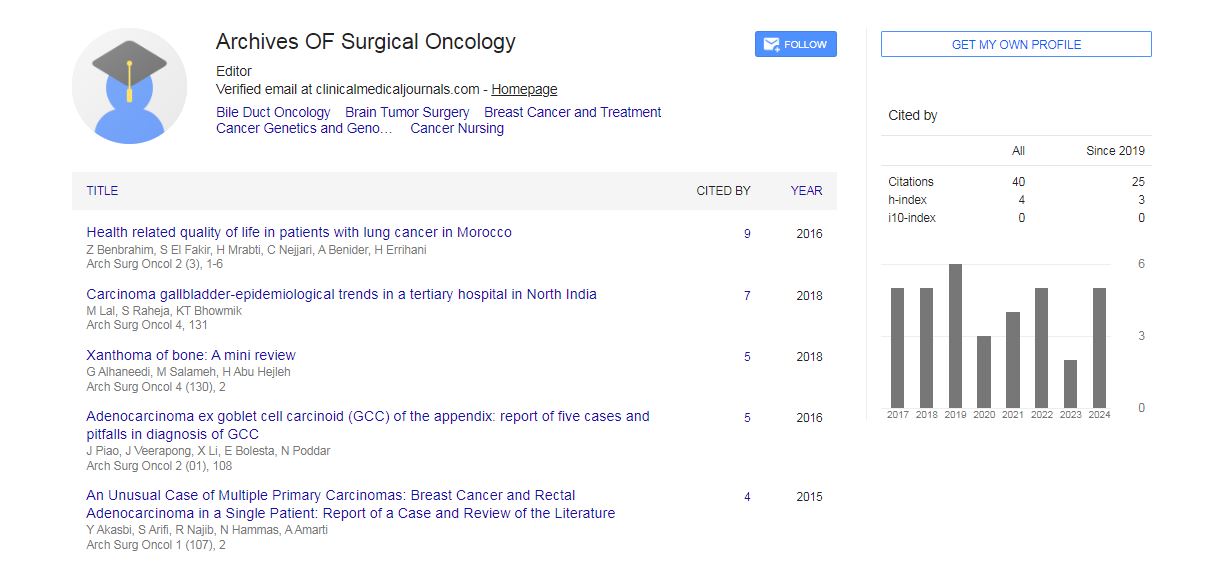
Archives of Surgical Oncology received 37 citations as per Google Scholar report