Perspective - (2025) Volume 11, Issue 4
Received: 01-Jul-2025, Manuscript No. aso-26-184640;
Editor assigned: 03-Jul-2025, Pre QC No. P-184640;
Reviewed: 17-Jul-2025, QC No. Q-184640;
Revised: 22-Jul-2025, Manuscript No. R-184640;
Published:
29-Jul-2025
, DOI: 10.37421/2471-2671.2025.11.182
Citation: Martin, Chloe. ”Surgery’s Expanding Role in Metastatic
Cancer Management.” Arch Surg Oncol 11 (2025):182.
Copyright: © 2025 Martin C. This is an open-access article distributed under the terms of the Creative Commons Attribution License, which permits unrestricted use, distribution
and reproduction in any medium, provided the original author and source are credited.
The surgical management of metastatic disease is undergoing a significant transformation, with indications for intervention continually expanding. This evolution is fueled by enhanced patient selection strategies, advancements in surgical techniques, and progress in systemic therapies, moving beyond traditional palliative or debulking procedures to increasingly consider curative intent in specific metastatic scenarios, particularly for oligometastatic disease. Evidence now demonstrates that aggressive surgical resection of metastatic sites can lead to prolonged survival and even cure in some patients, challenging the long-held notion that metastatic cancer is inherently incurable [1].
Oligometastasis, identified as an intermediate state between localized disease and widespread metastasis, is a critical area where surgical indications are broadening. Patients presenting with a limited number of metastatic lesions, often amenable to complete resection, stand to benefit substantially from aggressive surgical management, potentially achieving superior oncological outcomes compared to systemic therapy alone. The judicious selection of patients and robust multidisciplinary decision-making processes are paramount in identifying individuals who will derive the greatest benefit from these aggressive surgical approaches [2].
The role of cytoreductive surgery in managing peritoneal carcinomatosis, especially originating from ovarian and colorectal cancers, continues to be refined. Although historically associated with significant morbidity, enhancements in surgical techniques, including the integration of hyperthermic intraperitoneal chemotherapy (HIPEC), have led to improved patient outcomes and expanded the applicability of these procedures to carefully selected patients with a good performance status and minimal extraperitoneal disease [3].
Metastasectomy for limited lung metastases, particularly those originating from sarcomas and melanomas, is gaining increasing evidential support. Studies indicate that aggressive surgical resection of isolated pulmonary nodules, when complete eradication is achievable with clear margins, can significantly enhance overall survival in carefully selected patient cohorts. Furthermore, the development of minimally invasive techniques has contributed to reduced morbidity and accelerated recovery, further augmenting the attractiveness of this surgical option [4].
Surgical resection of isolated brain metastases represents a crucial component of comprehensive multidisciplinary cancer care, offering the potential for enhanced quality of life and improved survival. Advances in neurosurgical techniques, such as stereotactic radiosurgery and minimally invasive procedures, have rendered surgical intervention both safer and more efficacious for select patients. The ultimate decision to proceed with surgery is guided by a nuanced assessment of factors including tumor burden, location, patient performance status, and the overall control of the primary disease [5].
The increasing comprehension of tumor biology, coupled with the development of targeted therapies and immunotherapies, is demonstrably influencing the surgical management of metastatic disease. These systemic treatments can, in some instances, downstage metastases, rendering them surgically accessible, or effectively control micrometastatic disease, thereby augmenting the efficacy of surgical interventions in achieving durable responses. Consequently, a synergistic approach that combines systemic therapy with surgery is progressively becoming the established standard of care for a multitude of metastatic cancers [6].
For individuals diagnosed with oligometastatic colorectal cancer, aggressive surgical management encompassing both the primary tumor and all discernible metastatic lesions has shown considerable promise in improving survival rates. Research findings suggest that the complete resection of all disease sites can lead to long-term disease control and, in a proportion of patients, potential cure, underscoring the critical importance of meticulous staging and comprehensive multidisciplinary evaluation [7].
The indications for hepatic metastasectomy are expanding across various primary malignancies, particularly for isolated or limited lesions within the liver. Growing evidence supports the therapeutic benefit of hepatic resection for metastases originating from colorectal cancer, neuroendocrine tumors, and sarcomas, provided that complete eradication is feasible. Improvements in surgical techniques and perioperative care have rendered hepatic metastasectomy a safer and more effective option for a selected group of patients [8].
In the context of oligometastatic non-small cell lung cancer (NSCLC), surgery is emerging as a viable therapeutic option for carefully chosen patients, representing an area of active investigation. Systematic reviews and ongoing clinical trials indicate that aggressive local treatment, which includes the surgical resection of all identified metastatic sites, can lead to enhanced survival outcomes in patients with a limited metastatic burden and a good performance status [9].
The evolving landscape of surgical oncology for metastatic disease underscores the critical importance of precise patient selection and the seamless integration of diverse treatment modalities. Technological advancements in diagnostic imaging, surgical procedures, and a more profound understanding of tumor biology collectively empower oncologists to extend surgical interventions to a wider spectrum of patients, with the overarching aim of improving survival rates and overall quality of life [10].
The surgical management of metastatic disease is characterized by expanding indications, driven by improvements in patient selection, surgical techniques, and systemic therapies. Historically confined to palliative or debulking procedures, surgery is now increasingly employed with curative intent in select metastatic scenarios, especially oligometastatic disease, supported by evidence of prolonged survival and potential cure through aggressive resection of metastatic sites [1].
Oligometastasis, an intermediate state between localized and widespread metastatic disease, is a key focus for expanding surgical indications. Patients with a limited number of metastatic lesions, amenable to complete resection, can experience significant benefits from aggressive surgical management, potentially improving oncological outcomes beyond systemic therapy alone. Precise patient selection and multidisciplinary decision-making are essential for identifying suitable candidates [2].
Cytoreductive surgery for peritoneal carcinomatosis, particularly from ovarian and colorectal cancers, continues to be refined. Advances in surgical techniques, including hyperthermic intraperitoneal chemotherapy (HIPEC), have improved outcomes and expanded applicability to selected patients with good performance status and minimal extraperitoneal disease, despite historical associations with high morbidity [3].
Metastasectomy for limited lung metastases, especially from sarcomas and melanomas, is increasingly supported by evidence. Aggressive surgical resection of isolated pulmonary nodules, when achievable with clear margins, has been shown to significantly improve overall survival in carefully selected patients. The adoption of minimally invasive techniques has further reduced morbidity and accelerated recovery, enhancing the appeal of this approach [4].
Surgical resection of isolated brain metastases is a critical component of multidisciplinary cancer care, aiming to improve quality of life and survival. Advances in neurosurgical techniques, such as stereotactic radiosurgery and minimally invasive approaches, have made surgical intervention safer and more effective for select patients. Decisions are guided by tumor burden, location, patient performance status, and primary disease control [5].
An increasing understanding of tumor biology, alongside the development of targeted therapies and immunotherapies, is influencing surgical management of metastatic disease. Systemic treatments can downstage metastases, making them resectable, or control micrometastatic disease, enhancing surgical effectiveness for durable responses. A synergistic approach combining systemic therapy and surgery is becoming standard for many metastatic cancers [6].
For patients with oligometastatic colorectal cancer, aggressive surgical management of both the primary tumor and all detectable metastatic lesions shows promise for improved survival. Complete resection of all disease sites can lead to long-term disease control and potential cure in a subset of patients, emphasizing the importance of thorough staging and multidisciplinary evaluation [7].
The indications for liver metastasectomy are expanding, particularly for isolated or limited hepatic lesions from various primary malignancies. Evidence supports hepatic resection for metastases from colorectal cancer, neuroendocrine tumors, and sarcomas when complete eradication is possible. Improvements in surgical techniques and perioperative care have made hepatic metastasectomy safer and more effective for selected patients [8].
Oligometastatic non-small cell lung cancer (NSCLC) is an area of active investigation where surgery is emerging as a viable option for select patients. Systematic reviews and clinical trials suggest that aggressive local treatment, including surgical resection of all known metastatic sites, can improve survival in patients with limited metastatic burden and good performance status [9].
The evolving surgical oncology landscape for metastatic disease highlights the critical importance of patient selection and integration of treatment modalities. Advances in imaging, surgical techniques, and tumor biology understanding enable oncologists to offer surgical interventions to a broader patient range, aiming to enhance survival and quality of life [10].
The surgical management of metastatic disease is expanding due to improved patient selection, refined techniques, and advances in systemic therapies. Surgery is increasingly considered for curative intent in oligometastatic disease, with evidence supporting prolonged survival and potential cure through aggressive resection. Specific sites like the lungs, liver, and brain are targets for metastasectomy, while cytoreductive surgery with HIPEC shows promise for peritoneal carcinomatosis. The integration of systemic therapies with surgery is becoming standard, particularly for cancers like colorectal and non-small cell lung cancer. Technological advancements and a deeper understanding of tumor biology are enabling broader application of surgical interventions to improve patient outcomes and quality of life.
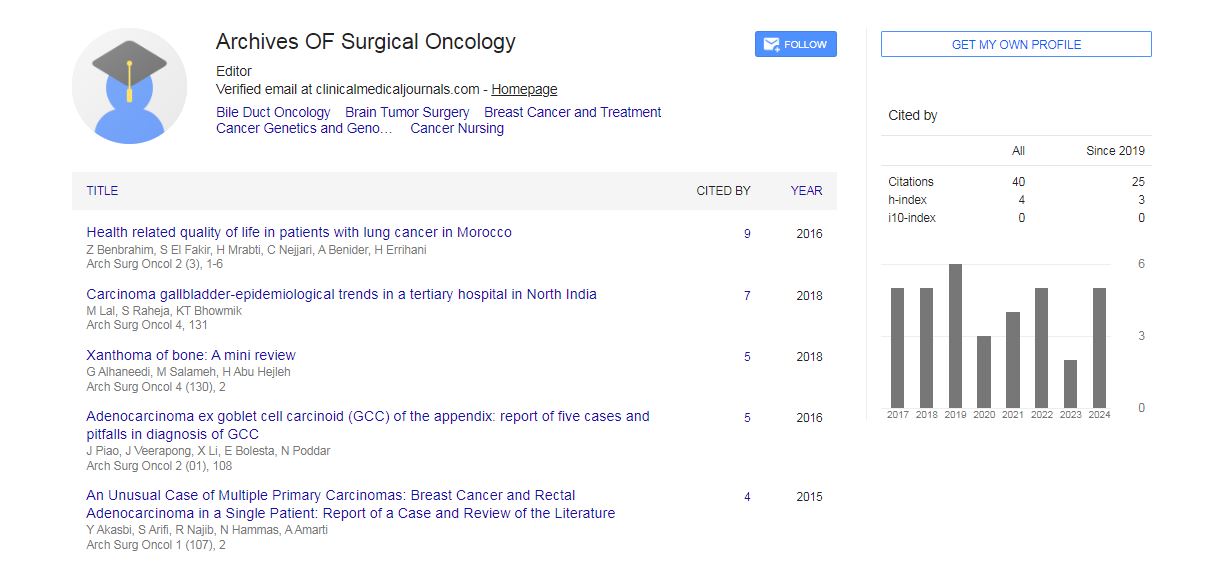
Archives of Surgical Oncology received 37 citations as per Google Scholar report