Brief Report - (2025) Volume 17, Issue 5
Received: 02-Oct-2025, Manuscript No. jbabm-26-182356;
Editor assigned: 05-Oct-2025, Pre QC No. P-182356;
Reviewed: 19-Oct-2025, QC No. Q-182356;
Revised: 23-Oct-2025, Manuscript No. R-182356;
Published:
30-Oct-2025
, DOI: 10.37421/1948-593X.2025.17.514
Citation: El-Sayed, Ahmed H.. ”Surface Plasmon Resonance: A Versatile Biomedical Tool.” J Bioanal Biomed 17 (2025):514.
Copyright: © 2025 El-Sayed H. Ahmed This is an open-access article distributed under the terms of the Creative Commons Attribution License, which permits unrestricted use, distribution and reproduction in any medium, provided the original author and source are credited.
Surface Plasmon Resonance (SPR) bioanalysis stands as a pivotal technique in contemporary biomedical research, offering label-free, real-time detection capabilities that are indispensable for understanding intricate molecular interactions. This advanced method plays a crucial role across diverse fields, including the highly competitive arenas of drug discovery and the development of novel diagnostic tools, while also fundamentally contributing to basic biological studies. The inherent advantage of SPR lies in its capacity to precisely quantify binding kinetics and affinities without the necessity for secondary labeling, a feature that significantly accelerates and streamlines research workflows, making it a cornerstone for efficient scientific advancement [1].
The inherent sensitivity of SPR to minute alterations in the refractive index immediately surrounding a sensor surface is the foundation of its ability to detect subtle biomolecular binding events. This characteristic is particularly beneficial for the detailed study of interactions characterized by low affinity, a common scenario in the screening of extensive small molecule libraries during the critical phases of drug development. Ongoing innovations in SPR instrumentation are continuously pushing the boundaries of its performance, leading to substantial enhancements in its speed, overall throughput, and its capacity for multiplexed analysis, thereby further broadening its already considerable utility in various research settings [2].
In the realm of diagnostics, SPR biosensors are rapidly evolving into indispensable tools for the swift and highly sensitive identification of specific biomarkers associated with a wide spectrum of diseases, ranging from infectious agents to various forms of cancer. The label-free nature of SPR assays inherently simplifies the complex process of assay development and demonstrably reduces the crucial turnaround times for results, factors that are of paramount importance in the demanding environment of clinical settings, enabling faster patient diagnosis and treatment decisions [3].
The application of SPR technology within the field of immunology is remarkably extensive and continues to expand, facilitating the detailed characterization of critical antibody-antigen interactions, precise epitope mapping, and the thorough study of immune complex formation. The profound insights gained from these investigations are invaluable for the rational design and development of effective vaccines and for a deeper understanding of complex immune responses, both in health and disease states [4].
Surface Plasmon Resonance has unequivocally established itself as a foundational technology in the demanding and highly iterative process of drug discovery. It empowers researchers to rapidly screen vast compound libraries, meticulously evaluating binding affinities and crucial kinetic parameters against specific target proteins of interest. This high-throughput screening capability is not merely advantageous but absolutely essential for the efficient identification of promising lead compounds and the subsequent optimization of drug candidates for therapeutic potential [5].
The strategic integration of microfluidic systems with SPR technology represents a significant advancement, leading to substantial enhancements in overall assay performance. This synergy is achieved through enabling exceptionally precise sample handling and a marked reduction in the consumption of valuable reagents. Such integration is particularly advantageous for applications that inherently require minimal sample volumes or demand automated, continuous monitoring of interactions over extended periods [6].
A key strength of SPR lies in its unique ability to quantify not just the presence of binding, but also the kinetics â?? specifically, the on-rate and off-rate â?? of biomolecular interactions. This provides a much deeper and more nuanced understanding of biological mechanisms compared to simple binding detection methods. This detailed kinetic data is critically important for accurately assessing drug efficacy and predicting the duration of therapeutic action, guiding the development of more effective pharmaceuticals [7].
SPR has proven to be an instrumental technique in the detailed study of protein-protein interactions, which are fundamental to virtually all cellular signaling pathways and biological functions. A comprehensive understanding of these complex interactions at the molecular level is a critical prerequisite for the successful identification of novel therapeutic targets for a vast array of diseases, offering new avenues for intervention [8].
The ongoing development and refinement of novel SPR sensor surfaces have dramatically improved the technique's capabilities. Notably, surfaces functionalized with advanced nanomaterials have demonstrated a significant enhancement in both sensitivity and a reduction in unwanted non-specific binding. This progress allows for the reliable detection of analytes even at extremely low concentrations, pushing the limits of detection in biological assays [9].
Surface Plasmon Resonance Imaging (SPRI) offers a powerful approach by enabling multiplexed detection and the simultaneous analysis of molecular interactions across an entire sensor surface. This capability dramatically increases the throughput for a wide range of applications, including the construction and analysis of complex antibody arrays and the large-scale screening of potential drug compounds, thereby accelerating discovery pipelines [10].
Surface Plasmon Resonance (SPR) bioanalysis has emerged as a premier methodology in modern biomedical research due to its intrinsic label-free and real-time detection capabilities, making it an exceptionally powerful instrument for elucidating complex molecular interactions. This technique is paramount for gaining a deeper understanding of the intricate mechanisms underlying drug discovery, the development of sensitive diagnostics, and the pursuit of fundamental biological insights. Its distinctive ability to accurately quantify binding kinetics and affinities without the need for any secondary labeling significantly expedites research workflows, establishing it as an indispensable tool for efficient scientific exploration [1].
The remarkable sensitivity of SPR to even the slightest variations in the refractive index adjacent to a sensor surface underpins its capacity to reliably detect biomolecular binding events. This inherent characteristic is especially valuable when investigating interactions characterized by low affinity, a common challenge encountered during the extensive screening of small molecule libraries in the context of drug development. Continuous advancements in the instrumentation designed for SPR are consistently enhancing its operational speed, overall throughput, and its sophisticated ability to perform multiplexed analyses, thereby continually expanding its practical utility across a broader scientific landscape [2].
Within the critical domain of diagnostics, SPR biosensors are undergoing rapid development and are poised to become vital for the prompt and highly sensitive identification of specific biomarkers associated with a diverse array of diseases, including but not limited to infectious agents and various forms of cancer. The inherent label-free nature of SPR assays considerably simplifies the intricate process of assay development and leads to a substantial reduction in the time required to obtain results, two factors that are of utmost importance in the rigorous demands of clinical settings, facilitating timely patient care [3].
The application of SPR technology in the field of immunology is both extensive and profoundly impactful, providing essential capabilities for the detailed characterization of crucial antibody-antigen interactions, the precise mapping of epitopes, and the thorough investigation of immune complex formation. The invaluable insights derived from these studies are instrumental in the rational design of effective vaccines and for advancing our fundamental understanding of complex immune responses, crucial for both health and disease management [4].
Surface Plasmon Resonance has solidified its position as a cornerstone technology within the multifaceted discipline of drug discovery. It empowers researchers with the ability to efficiently screen extensive compound libraries, meticulously assessing binding affinity and critical kinetic parameters against specific target proteins. This high-throughput screening capability is fundamentally essential for the successful identification of promising lead compounds and the subsequent optimization of potential drug candidates, accelerating the journey from discovery to therapeutic application [5].
The integration of microfluidic technologies with SPR platforms has yielded significant improvements in assay performance by enabling highly precise sample handling and substantially reducing the consumption of precious reagents. This synergistic approach is particularly beneficial for applications that necessitate the use of minimal sample volumes or require automated, continuous monitoring of molecular interactions over extended periods, optimizing resource utilization and experimental efficiency [6].
One of the most significant strengths of SPR is its unparalleled ability to quantitatively measure the kinetics, specifically the association and dissociation rates (on-rate and off-rate), of biomolecular interactions. This provides a far more profound understanding of biological mechanisms than simple qualitative binding detection. This detailed kinetic data is critically important for accurately predicting drug efficacy and determining the duration of its action, crucial parameters in pharmaceutical development [7].
SPR has played an instrumental role in the detailed investigation of protein-protein interactions, which are fundamental to nearly all cellular signaling pathways and biological functions. A thorough understanding of these complex molecular interactions is a prerequisite for identifying effective therapeutic targets for a wide spectrum of human diseases, opening new avenues for treatment development [8].
The continuous innovation in SPR sensor surface design, particularly the incorporation of advanced nanomaterials, has led to substantial improvements in both sensitivity and the reduction of non-specific binding. This advancement allows for the reliable detection of analytes at remarkably low concentrations, pushing the boundaries of detection limits in various bioanalytical applications [9].
Surface Plasmon Resonance Imaging (SPRI) provides a powerful capability for multiplexed detection, enabling the simultaneous analysis of molecular interactions across an entire sensor surface. This significantly enhances the throughput for numerous applications, including the development of antibody arrays and the comprehensive screening of drug candidates, thereby accelerating the pace of discovery in these fields [10].
Surface Plasmon Resonance (SPR) is a label-free, real-time bioanalytical technique crucial for studying molecular interactions in drug discovery, diagnostics, and fundamental biology. Its sensitivity to refractive index changes allows for the detection of low-affinity interactions and the screening of compound libraries. SPR biosensors are being developed for rapid disease biomarker detection, and the technique is extensively used in immunology for characterizing antibody-antigen interactions and in vaccine development. SPR enables the quantitative analysis of binding kinetics, providing deeper insights into biological mechanisms and drug efficacy. Advancements in SPR include microfluidic integration for improved assay performance and the use of nanomaterials to enhance sensitivity. SPR imaging (SPRI) further increases throughput for multiplexed analyses. Overall, SPR is a versatile and powerful tool accelerating research across various biomedical fields.
None
None
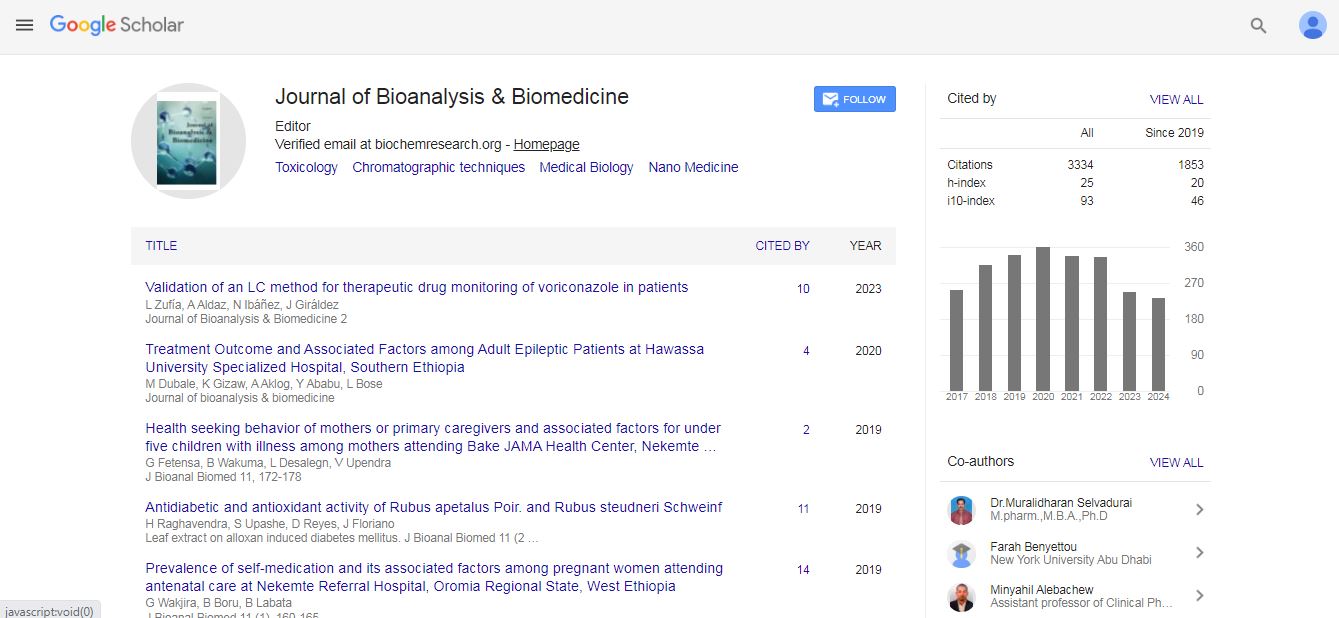
Journal of Bioanalysis & Biomedicine received 3099 citations as per Google Scholar report