Opinion - (2025) Volume 16, Issue 4
Received: 01-Aug-2025, Manuscript No. jbsbe-26-183307;
Editor assigned: 04-Aug-2025, Pre QC No. P-183307;
Reviewed: 18-Aug-2025, QC No. Q-183307;
Revised: 22-Aug-2025, Manuscript No. R-183307;
Published:
29-Aug-2025
, DOI: 10.37421/2165-6210.2025.16.513
Citation: El-Sayed, Ahmed. ”Surface Functionalization: Advancing Biosensor Technology.” J Biosens Bioelectron 16 (2025):513.
Copyright: © 2025 El-Sayed A. This is an open-access article distributed under the terms of the Creative Commons Attribution License, which permits unrestricted use, distribution and reproduction in any medium, provided the original author and source are credited.
Surface functionalization represents a cornerstone in the advancement of biosensor technology, critically influencing their performance metrics such as selectivity, sensitivity, and operational stability. This approach allows for the tailored modification of transducer surfaces to enhance their affinity and interaction with specific biomolecular targets, thereby improving the overall efficacy of diagnostic and monitoring systems. The diverse range of immobilization techniques available offers significant flexibility in designing biosensors for a myriad of applications. One prominent area of investigation involves exploring various immobilization techniques, including covalent attachment, adsorption, and entrapment, for biomolecules onto transducer surfaces. These methods differ in their reversibility, the stability they confer to the immobilized biomolecules, and their compatibility with different biomolecule types and transducer materials. The choice of technique profoundly impacts the biosensor's long-term performance and its resistance to environmental interference [1].
The realm of supramolecular chemistry has emerged as a powerful paradigm for sophisticated surface functionalization in biosensor development. This field leverages non-covalent interactions, such as host-guest complexation and self-assembly, to achieve precise and reversible immobilization of biomolecules. These strategies offer a versatile platform for creating highly organized and functionalized sensor interfaces, minimizing non-specific binding and enhancing signal transduction efficiency [2].
Nanomaterials have revolutionized biosensor design, particularly in enhancing signal amplification through functionalized surfaces. Materials like quantum dots, gold nanoparticles, and metal-organic frameworks (MOFs) provide exceptionally high surface-to-volume ratios and tunable properties. Their integration into sensor architectures facilitates the creation of enhanced interfaces, leading to substantial improvements in detection limits and response times for a variety of analytes [3].
Electrochemical methods offer a direct and label-free approach for biosensor surface functionalization. By utilizing electrochemical principles, biomolecules can be effectively immobilized onto electrode surfaces, enabling real-time monitoring of biological events without the need for labeling. This methodology is attractive due to its inherent simplicity and broad compatibility with diverse transducer platforms, making it a valuable tool for developing advanced biosensing systems [4].
Carbon-based nanomaterials, most notably graphene and its derivatives, have garnered significant attention for their exceptional electronic and physical properties, making them highly effective for biosensor surface functionalization. Strategies for modifying graphene surfaces with antibodies, enzymes, and nucleic acids are being actively pursued to create biosensors with heightened sensitivity for a wide array of analytes. Their unique characteristics facilitate robust and efficient immobilization of biomolecular recognition elements [5].
Plasma-based surface functionalization presents itself as a rapid, dry, and highly versatile method for modifying biosensor interfaces. This technique allows for the introduction of specific functional groups onto surfaces, thereby enabling the efficient immobilization of biological recognition elements. The application of various plasma treatments is particularly useful for generating stable, biocompatible, and highly reactive sensor surfaces essential for sensitive biomolecular detection [6].
Bioconjugation strategies form the bedrock of surface functionalization in biosensor development, particularly for achieving stable covalent attachment of biomolecules. A wide array of bioconjugation chemistries, including EDC/NHS coupling, click chemistry, and maleimide-thiol reactions, are employed to create robust and specific sensor surfaces. These methods are crucial for the development of highly reliable diagnostic devices [7].
The incorporation of stimuli-responsive polymers into biosensor surface functionalization introduces dynamic and controllable sensing capabilities. These polymers, which can alter their conformation or properties in response to external stimuli like pH, temperature, or specific analyte binding, enable modulation of biomolecule interactions and signal output. This offers novel avenues for the creation of intelligent and adaptive diagnostic systems [8].
Metal-organic frameworks (MOFs), characterized by their unique porous structures and extensive surface areas, are emerging as exceptional platforms for biosensor surface functionalization. Their ability to immobilize enzymes and antibodies effectively leads to enhanced stability and catalytic activity, paving the way for highly sensitive detection of biomarkers. The tunability of MOF structures further amplifies their potential in biosensing applications [9].
Surface functionalization is a pivotal aspect of biosensor engineering, fundamentally dictating the performance characteristics of these devices, including their ability to discern targets with high specificity and sensitivity, as well as their long-term stability in complex environments. The strategic modification of transducer surfaces is essential for optimizing the capture and detection of target analytes, making it a critical area of research and development in the field of diagnostics and monitoring. Various immobilization techniques are explored for attaching biomolecules to transducer surfaces, ranging from direct covalent bonding and passive adsorption to more complex methods like entrapment within matrices. Each technique presents a unique set of advantages and disadvantages concerning biomolecule activity, surface stability, and the potential for non-specific interactions. Understanding and selecting the appropriate method is crucial for tailoring biosensor performance to specific applications, such as disease detection or environmental monitoring [1].
Supramolecular chemistry provides an advanced toolkit for designing sophisticated biosensor surfaces through precise biomolecule immobilization. By employing principles of molecular recognition and self-assembly, such as host-guest interactions, researchers can create highly organized and functional interfaces. This approach minimizes non-specific binding events and ensures efficient signal transduction, leading to biosensors with enhanced specificity and sensitivity, ideal for complex biological samples [2].
Nanomaterials are increasingly integrated into biosensor architectures to amplify detection signals via surface functionalization. The high surface-to-volume ratios and tunable surface chemistries of materials like quantum dots, gold nanoparticles, and MOFs enable the development of enhanced interfaces. These nanomaterials contribute significantly to lowering detection limits and accelerating response times, thereby improving the overall performance and utility of biosensing platforms [3].
Electrochemical approaches offer a direct and label-free avenue for biosensor surface functionalization, allowing for the immobilization of biomolecules onto electrode surfaces. This methodology facilitates real-time monitoring of biological interactions without the need for secondary labeling steps. The simplicity and versatility of electrochemical functionalization make it compatible with a wide range of transducer types and amenable to developing user-friendly biosensing devices [4].
Graphene and its derivatives are recognized for their unique electronic and physical properties, making them highly suitable for biosensor surface functionalization. Strategies focused on modifying graphene surfaces with biomolecular recognition elements such as antibodies, enzymes, and nucleic acids are actively being developed. This enables the creation of biosensors with enhanced sensitivity for detecting a broad spectrum of analytes, addressing diverse diagnostic needs [5].
Plasma-assisted surface functionalization offers a rapid, dry, and adaptable method for modifying biosensor interfaces. This technique utilizes various plasma treatments to introduce specific functional groups onto surfaces, facilitating the efficient immobilization of biological recognition elements. The ability to create stable and biocompatible surfaces makes plasma functionalization a valuable tool for developing robust biosensing platforms [6].
Bioconjugation strategies are fundamental to achieving stable and specific immobilization of biomolecules on biosensor surfaces, typically through covalent attachment. A variety of bioconjugation chemistries, including EDC/NHS coupling, click chemistry, and maleimide-thiol reactions, are employed to construct robust sensor surfaces. These methods are critical for developing highly reliable and accurate biosensors for diagnostic purposes [7].
Stimuli-responsive polymers represent an innovative class of materials for biosensor surface functionalization, enabling dynamic and controllable sensing mechanisms. Polymers that respond to environmental changes like pH, temperature, or the presence of specific analytes can modulate biomolecule binding and signal output. This adaptability opens new possibilities for developing sophisticated biosensing devices with enhanced functionality [8].
Metal-organic frameworks (MOFs) are highly effective platforms for biosensor surface functionalization due to their porous structures and large surface areas. Their capacity to immobilize biomolecules like enzymes and antibodies leads to improved stability and heightened catalytic activity, which are essential for sensitive biomarker detection. MOFs offer a versatile foundation for advanced biosensing applications [9].
This collection of research highlights diverse surface functionalization strategies crucial for advancing biosensor technology. Techniques explored include traditional immobilization methods like covalent attachment and adsorption, alongside advanced approaches utilizing supramolecular chemistry, nanomaterials (quantum dots, gold nanoparticles, MOFs, graphene), electrochemical mediation, plasma treatments, bioconjugation chemistries, and stimuli-responsive polymers. The primary goal across these studies is to enhance biosensor performance by improving selectivity, sensitivity, stability, and signal amplification. These functionalization methods aim to create more efficient and reliable biosensing platforms for applications in disease detection, environmental monitoring, and clinical diagnostics.
None
None
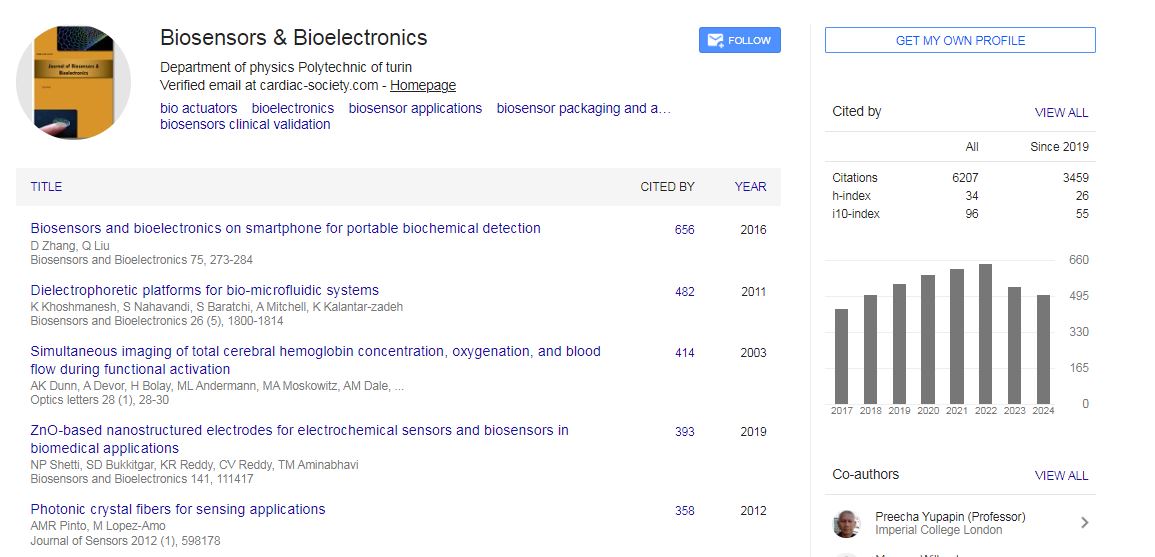
Biosensors & Bioelectronics received 6207 citations as per Google Scholar report