Perspective - (2025) Volume 16, Issue 3
Received: 02-Jun-2025, Manuscript No. csj-26-183444;
Editor assigned: 04-Jun-2025, Pre QC No. P-183444;
Reviewed: 18-Jun-2025, QC No. Q-183444;
Revised: 23-Jun-2025, Manuscript No. R-183444;
Published:
30-Jun-2025
, DOI: 10.37421/2160-3494.2025.16.461
Citation: Mokoena, Naledi. ”Surface And Interface Engineering: Unlocking Nanomaterial Functionalities.” Chem Sci J 16 (2025):461.
Copyright: © 2025 Mokoena N. This is an open-access article distributed under the terms of the Creative Commons Attribution License, which permits unrestricted use, distribution and reproduction in any medium, provided the original author and source are credited.
The fundamental role of surface and interface phenomena in dictating the functionality of nanomaterials is increasingly recognized, impacting diverse areas such as catalysis, sensing, and biological interactions. Controlled surface chemistry and engineered interfaces are paramount for tailoring nanomaterial properties for specific applications, including nanomedicine and energy storage. Advanced characterization techniques are essential for understanding these nanoscale interactions [1].
The catalytic performance of metal oxide nanomaterials is strongly influenced by their surface defects and interface structures. Tuning these surface characteristics offers a viable route for designing more efficient heterogeneous catalysts with enhanced selectivity and activity in oxidation reactions [2].
Surface functionalization of quantum dots is a critical strategy for improving their stability and tuning their optical properties, particularly for bioimaging applications. Specific surface ligands can prevent aggregation and enhance fluorescence quantum yield, leading to brighter and more stable probes for in vivo imaging, thereby underscoring the importance of surface chemistry for biological utility [3].
The interface between graphene and metal nanoparticles plays a crucial role in the electrochemical sensing of biomolecules. The unique electronic coupling at this interface significantly enhances electron transfer, enabling highly sensitive and selective detection of analytes and showcasing the power of interface engineering in sensor design [4].
In metal-organic frameworks (MOFs), surface chemistry profoundly affects gas adsorption and separation capabilities. Modifying surface functional groups within MOF pores can alter their affinity for specific gases, allowing for precise separation of gas mixtures, such as CO2 from N2, highlighting the importance of controllable surface properties [5].
The surface plasmon resonance properties of gold nanoparticles are extensively explored for sensing applications. Modifications to the nanoparticle surface can enhance the sensitivity of refractive index-based detection, leading to improved performance in optical sensing platforms by leveraging their interaction with surrounding molecules at the interface [6].
Interfacial effects in perovskite solar cells are critical for optimizing device efficiency. Surface treatments of perovskite nanocrystals, particularly passivation of surface defects through specific organic molecules, significantly reduce charge recombination, leading to higher power conversion efficiencies [7].
Surface modifications of carbon nanotubes are being investigated for enhanced drug delivery applications. Grafting specific polymers onto the nanotube surface improves biocompatibility and enables targeted delivery of therapeutic agents, emphasizing the pivotal role of surface chemistry in developing effective nanocarriers [8].
The interfacial properties of two-dimensional materials, such as MoS2, are crucial for electronic device applications. The surface termination and defects at the MoS2 interface significantly influence its electrical conductivity and stability, providing vital insights for designing next-generation electronic components based on these materials [9].
Surface capping agents play a significant role in modulating the photocatalytic activity of TiO2 nanoparticles. Specific capping molecules can alter surface energy and charge separation efficiency, leading to substantially enhanced performance in applications like water splitting and pollutant degradation [10].
Surface and interface phenomena are fundamental to the functionality of nanomaterials, significantly impacting their catalytic activity, sensing capabilities, and biological interactions. The controlled manipulation of surface chemistry and the engineering of interfaces are critical for tailoring nanomaterial properties for specific applications, ranging from nanomedicine to energy storage. The advancement of understanding in this field is heavily reliant on sophisticated characterization techniques designed to probe these nanoscale interactions [1].
In the realm of catalysis, the properties of metal oxide nanomaterials are intricately linked to their surface defects and the nature of interfaces between different oxide phases. By precisely tuning these surface characteristics, researchers can develop more effective heterogeneous catalysts that exhibit improved selectivity and activity in various oxidation reactions [2].
For bioimaging applications, the surface functionalization of quantum dots is a key strategy to enhance their stability and fine-tune their optical properties. The judicious selection of surface ligands is essential for preventing aggregation and maximizing fluorescence quantum yield, resulting in brighter and more robust probes suitable for in vivo imaging, thereby highlighting the critical role of surface chemistry in biological contexts [3].
The interface between graphene and metal nanoparticles has emerged as a vital component in the development of electrochemical biosensors. The unique electronic coupling occurring at this interface promotes efficient electron transfer, which is instrumental in achieving high sensitivity and selectivity in the detection of various biomolecules, thereby demonstrating the significant potential of interface engineering in sensor design [4].
Metal-organic frameworks (MOFs) exhibit tunable gas adsorption and separation properties that are largely governed by their surface chemistry. By modifying the surface functional groups within the MOF pores, it becomes possible to precisely control their affinity for different gases, facilitating selective separation of mixtures such as CO2 from N2 and underscoring the importance of controllable surface characteristics [5].
Surface plasmon resonance (SPR) in gold nanoparticles is a phenomenon that can be effectively harnessed for sensing applications. Interface engineering, specifically through surface modifications, can lead to enhanced sensitivity in refractive index-based detection methods, ultimately improving the performance of optical sensing platforms by optimizing the interaction between the nanoparticles and their surrounding environment [6].
In the field of solar energy, interfacial effects within perovskite solar cells are crucial for maximizing device efficiency. The passivation of surface defects in perovskite nanocrystals, typically achieved through treatment with specific organic molecules, plays a vital role in reducing charge recombination and thereby increasing power conversion efficiencies [7].
For advanced therapeutic applications, the surface functionalization of carbon nanotubes is being explored to improve drug delivery systems. By attaching specific polymer chains to the nanotube surface, researchers can enhance biocompatibility and enable targeted delivery of therapeutic agents, emphasizing the indispensable role of surface chemistry in the design of effective nanocarriers [8].
The study of interfacial properties in two-dimensional materials, such as molybdenum disulfide (MoS2), is gaining significant attention for applications in next-generation electronics. The surface termination and the presence of defects at the MoS2 interface critically influence its electrical conductivity and overall stability, offering valuable insights for the design of advanced electronic components [9].
In photocatalysis, the effectiveness of TiO2 nanoparticles is notably influenced by the surface capping agents employed. The selection of appropriate capping molecules can modulate the surface energy and improve charge separation efficiency, leading to substantial enhancements in photocatalytic activity for processes such as water splitting and pollutant degradation [10].
This collection of research highlights the critical importance of surface and interface engineering in nanomaterials. Studies demonstrate how tailored surface chemistry and interfaces enhance catalytic activity, sensing capabilities, and biological interactions. Specific examples include improved catalysts through interface engineering in metal oxides, enhanced bioimaging probes via quantum dot surface functionalization, and ultrasensitive biosensors utilizing graphene-metal nanoparticle interfaces. Furthermore, controlled surface properties are crucial for gas separation in MOFs, enhanced SPR sensing with gold nanoparticles, and efficient perovskite solar cells through interface passivation. Surface modifications of carbon nanotubes improve drug delivery, while interfacial effects in 2D materials are vital for advanced electronics. Finally, surface capping agents significantly boost the photocatalytic activity of TiO2 nanoparticles. Across these diverse applications, manipulating the nanoscale surface and interfaces is key to unlocking advanced material functionalities.
None
None
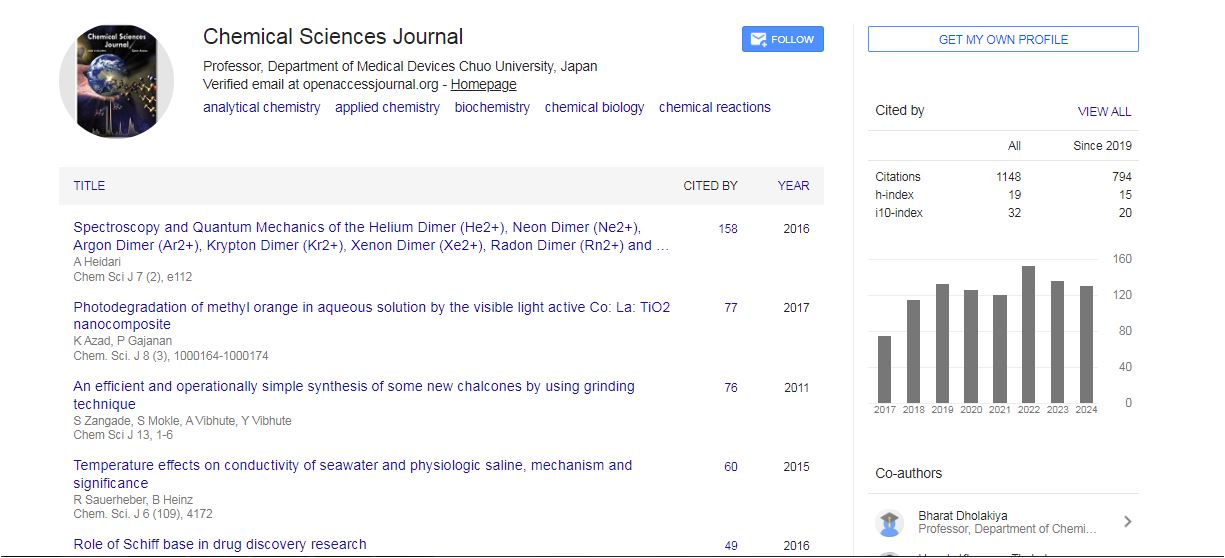
Chemical Sciences Journal received 912 citations as per Google Scholar report