Commentary - (2025) Volume 11, Issue 6
Received: 03-Nov-2025, Manuscript No. OHCR-25-167870;
Editor assigned: 05-Nov-2025, Pre QC No. P-167870;
Reviewed: 17-Nov-2025, QC No. Q-167870;
Revised: 22-Nov-2025, Manuscript No. R-167870;
Published:
29-Nov-2025
, DOI: 10.37421/2471-8726.2025.11.211
Citation: Edelstein, Duangthip. “Stem Cells and Tissue Engineering in Cosmetic Oral Rehabilitation.” Oral Health Case Rep 11 (2025): 211.
Copyright: © 2025 Edelstein D. This is an open-access article distributed under the terms of the Creative Commons Attribution License, which permits unrestricted use, distribution and reproduction in any medium, provided the original author and source are credited.
Cosmetic oral rehabilitation has undergone significant advancements due to innovations in regenerative medicine, particularly the integration of stem cells and tissue engineering. Traditional dental treatments often focus on restoring function and aesthetics using synthetic materials, yet they frequently fall short of mimicking the natural biological structure and function of oral tissues. In contrast, regenerative strategies harness the body's inherent capacity to heal and regenerate, offering a more holistic and durable approach. Stem cells, with their ability to differentiate into various cell types, present a compelling solution for reconstructing dental tissues including gingiva, periodontal ligament, dentin, and alveolar bone. Tissue engineering, by combining scaffolds, biologically active molecules, and cells, supports tissue regeneration in a controlled and effective manner. This biological foundation holds promising potential for transforming cosmetic dental outcomes [1].
The convergence of stem cell biology and tissue engineering technologies is redefining the possibilities in aesthetic dentistry. Cosmetic concerns such as tooth loss, gingival recession, and jawbone atrophy can significantly impact a patientâ??s self-esteem and quality of life. Traditional prosthetics and grafts can only go so far in terms of integration, appearance, and long-term success. However, regenerative approaches aim to restore both form and function at the cellular level. Mesenchymal stem cells derived from dental pulp, periodontal ligament, and other oral tissues are increasingly being studied for their regenerative capabilities. When combined with biocompatible scaffolds and signaling molecules, these stem cells have shown great promise in facilitating natural tissue regrowth and improved aesthetic outcomes. These developments mark a paradigm shift from conventional restorative practices to biologically driven rehabilitation [2].
Stem cells are undifferentiated cells capable of self-renewal and differentiation into specialized cell types, making them a cornerstone in regenerative dentistry. In cosmetic oral rehabilitation, Mesenchymal Stem Cells (MSCs) are the most frequently studied due to their ability to form osteoblasts, fibroblasts, cementoblasts, and other relevant cells. These MSCs can be sourced from various oral tissues, including dental pulp, periodontal ligament, and apical papilla, or even from extraoral tissues like adipose tissue and bone marrow. Their multipotent nature allows them to regenerate periodontal structures and alveolar bone, both essential for maintaining facial aesthetics and oral function. In addition, induced Pluripotent Stem Cells (iPSCs) are gaining attention for their broader differentiation potential and less ethical concern compared to embryonic stem cells. However, their clinical use still requires extensive evaluation. In the cosmetic context, stem cells help in maintaining natural contours and volume, especially following tooth extraction or trauma, thereby supporting more aesthetically pleasing restorations. Stem cells can also promote vascularization and innervation in regenerated tissues, which contributes to their functional integration. Recent studies highlight their role not only in hard tissue regeneration but also in soft tissue healing, which is equally vital for smile aesthetics. Overall, stem cells are redefining how cosmetic oral rehabilitation can achieve both beauty and biological compatibility [3].
Tissue engineering involves the strategic combination of cells, scaffolds, and signaling molecules to promote tissue regeneration. In cosmetic oral rehabilitation, this triad enables clinicians to recreate the complex architecture of oral tissues rather than merely replacing them with inert materials. Scaffolds provide a temporary structure where cells can proliferate, differentiate, and produce extracellular matrix, ultimately forming new tissue. These scaffolds are typically made from biocompatible materials like collagen, polylactic acid, or hydroxyapatite, and can be either natural or synthetic. They are often engineered to degrade at a controlled rate, allowing for gradual replacement by native tissue. Growth factors such as Bone Morphogenetic Proteins (BMPs), Fibroblast Growth Factors (FGFs), and Vascular Endothelial Growth Factor (VEGF) are used to stimulate cellular activity and tissue development. When combined with stem cells, scaffolds help guide the cells to differentiate and organize into functional tissues, including bone, periodontal ligament, and soft gingival tissue. This integration improves not only the aesthetic outcome but also the longevity and stability of dental prostheses. Advanced fabrication technologies like 3D bioprinting are being explored to create patient-specific scaffolds that match the defect morphology with high precision. Ultimately, tissue engineering enhances cosmetic oral rehabilitation by enabling personalized, biologically functional, and visually harmonious restorations [4].
Clinical applications of stem cells and tissue engineering in cosmetic dentistry are progressing from experimental stages to more routine integration in advanced practices. Procedures such as socket preservation, sinus lifts, and ridge augmentation are increasingly incorporating stem cell-laden scaffolds to promote bone regeneration and preserve alveolar structure. This not only maintains facial contour but also provides a stable foundation for implant placement. In gingival augmentation, tissue-engineered constructs are being used to restore natural gingival appearance and symmetry, which is crucial for an aesthetic smile line. Furthermore, bioengineered dental pulp tissues are under development for revitalizing endodontically treated teeth, offering a natural look and feel. Techniques involving platelet-rich fibrin and stem cell-derived exosomes are being studied to accelerate healing and improve tissue integration post-operatively. These regenerative strategies offer solutions that are less invasive, reduce morbidity, and improve predictability in cosmetic outcomes. However, the translation from laboratory research to clinical implementation still faces hurdles, including regulatory approvals, cost, and standardization of protocols. Long-term studies are also needed to evaluate the stability and safety of regenerated tissues. Nonetheless, early clinical results are promising, showing enhanced tissue quality and better patient satisfaction. As techniques become more refined and accessible, regenerative therapies are poised to become mainstream in cosmetic oral rehabilitation, offering truly biological solutions to aesthetic challenges [5].
Google Scholar Cross Ref Indexed at
Google Scholar Cross Ref Indexed at
Google Scholar Cross Ref Indexed at
Google Scholar Cross Ref Indexed at
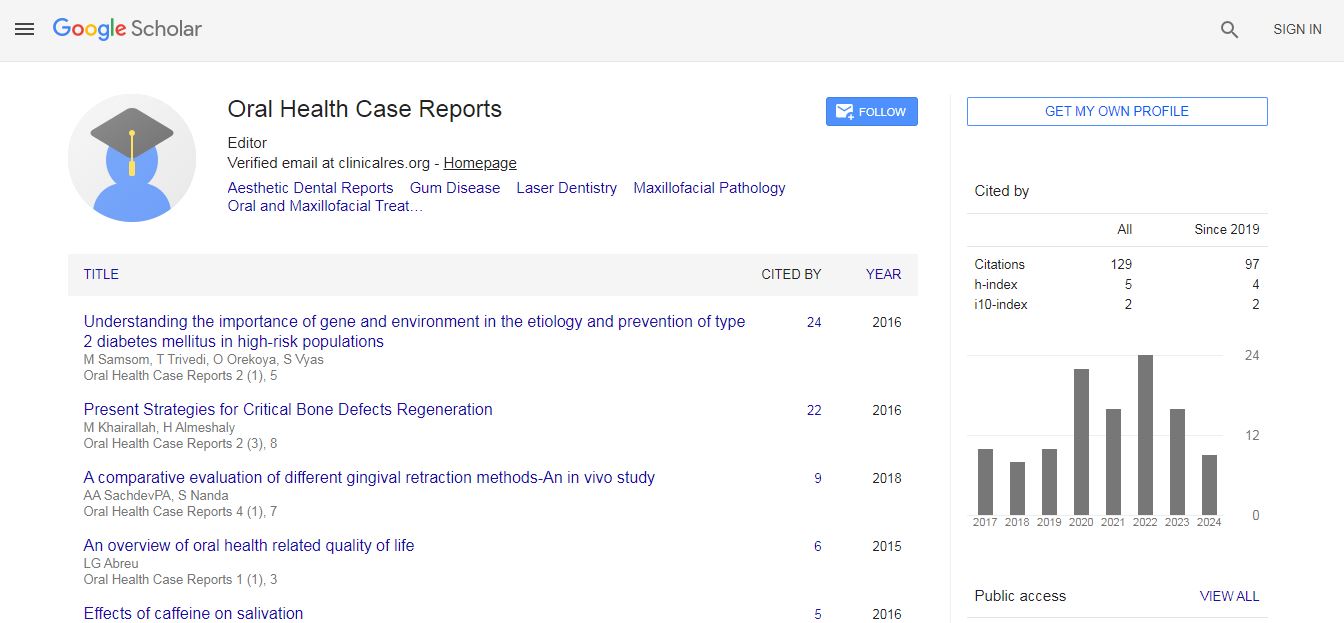
Oral Health Case Reports received 120 citations as per Google Scholar report