Perspective - (2025) Volume 9, Issue 4
Received: 01-Jul-2025, Manuscript No. jma-26-184606;
Editor assigned: 03-Jul-2025, Pre QC No. P-184606;
Reviewed: 17-Jul-2025, QC No. Q-184606;
Revised: 22-Jul-2025, Manuscript No. R-184606;
Published:
29-Jul-2025
, DOI: 10.37421/2684-4265.2025.09.395
Citation: Okeke, Daniel. ”Stem Anatomy: Morphological Basis of Medicinal Plants.” J Morphol Anat 09 (2025):395.
Copyright: © 2025 Okeke D. This is an open-access article distributed under the terms of the Creative Commons Attribution License, which permits unrestricted use, distribution and reproduction in any medium, provided the original author and source are credited.
The intricate field of ethnobotany has long recognized the therapeutic potential of medicinal plants, often relying on traditional knowledge passed down through generations. Modern scientific inquiry is increasingly delving into the underlying mechanisms of these remedies, with plant anatomy emerging as a crucial area of investigation. Understanding the structural features of a plant can offer profound insights into its chemical composition and, consequently, its medicinal efficacy. This study aims to systematically explore the anatomical characteristics of plant stems and their correlation with reported ethnomedicinal uses across various plant species. By examining features such as vascular bundle arrangement, the presence of specialized secretory structures, and the composition of ground tissues, researchers are beginning to uncover a morphological basis for traditional healing practices. This approach not only validates existing uses but also opens avenues for discovering novel therapeutic applications. The diverse array of medicinal plants employed globally presents a rich tapestry of anatomical adaptations, each potentially contributing to a unique suite of bioactive compounds and pharmacological activities. Comparative anatomical studies are paramount in unraveling these complex relationships, providing a scientific foundation for the continued exploration of plant-based medicines. The investigation into the comparative stem anatomy of several medicinal plants, for instance, reveals how structural variations in their tissues, such as vascular bundle arrangement and pith characteristics, correlate with their ethnomedicinal uses, highlighting specific anatomical features that may contribute to the production or storage of bioactive compounds, offering a morphological basis for understanding their therapeutic properties and emphasizing the importance of anatomical examination in validating and potentially discovering new medicinal applications [1].
Similarly, research into the anatomical adaptations in the stems of plants used for wound healing, focusing on features like lignification and cell wall thickness, suggests that these structural elements might influence the plants' resilience, antimicrobial properties, or wound-closing capabilities, with comparative approaches revealing common anatomical traits indicative of efficacy in topical applications [2].
Another study examines the stem anatomy of plants traditionally employed for treating inflammatory conditions, highlighting the role of specific cell types like collenchyma and sclerenchyma in providing structural support and potentially influencing the release of anti-inflammatory compounds, with comparative analysis helping identify anatomical markers associated with anti-inflammatory potential [3].
Furthermore, investigations into the secretory structures within the stems of aromatic medicinal plants, such as resin ducts and oil glands, are crucial for the accumulation of essential oils, which are central to many medicinal applications, elucidating how the arrangement and type of secretory elements differ across species and relate to their scent profiles and therapeutic uses [4].
The exploration of secondary growth patterns and vascular tissue formation in the stems of woody medicinal plants emphasizes how variations in cambial activity and secondary xylem and phloem development contribute to structural integrity and the accumulation of secondary metabolites over time, providing insights into how stem age and structure might influence medicinal potency [5].
Research also investigates the role of parenchyma cells in the stem, particularly their involvement in storage of medicinal compounds, comparing the morphology and distribution of parenchyma tissue in plants used for various ailments, suggesting that storage capacity and type within these cells may dictate the concentration and accessibility of active constituents [6].
Studies examining the structural adaptations of stems in plants known for their diuretic properties focus on vascular bundle arrangement and the characteristics of the pith, hypothesizing that these features might facilitate water transport or the synthesis and excretion of relevant compounds, with comparative analysis aiming to identify anatomical correlates of diuretic activity [7].
Other investigations explore the development and composition of the epidermis and cortex in medicinal plant stems, focusing on features like trichomes and stomata, and how these superficial structures might play a role in defense mechanisms or in the uptake and synthesis of medicinal agents [8].
Additionally, research focuses on comparative anatomical features of stems in plants used for digestive disorders, examining vascular tissue arrangement and ground tissue characteristics, along with specialized structures involved in the production or modulation of digestive enzymes or compounds that soothe the gastrointestinal tract [9].
Finally, investigations into the stem anatomy of plants with known anti-malarial properties specifically look at vascular bundle organization and cellular composition, proposing that these structural features might be related to the production or sequestration of anti-malarial compounds, or enhance the plant's survival in its natural habitat, indirectly contributing to its medicinal efficacy [10].
The comparative stem anatomy of medicinal plants offers a rich vein of research for understanding the basis of their therapeutic properties. Studies have revealed a significant correlation between specific anatomical features within plant stems and their ethnomedicinal applications, providing a tangible link between morphology and bioactivity. For instance, the arrangement of vascular bundles, a fundamental aspect of stem structure, has been shown to vary considerably among medicinal plants and has been linked to their diverse uses, including wound healing and the treatment of inflammatory conditions [1].
The presence and characteristics of secretory canals and oil glands are also crucial, particularly in aromatic plants, as these structures are vital for the accumulation of essential oils and other volatile compounds responsible for scent and therapeutic effects [4].
The pith, the central core of the stem, and its cellular composition can also play a role in storage of medicinal compounds or in facilitating physiological processes related to plant health and resilience [1, 7]. Furthermore, the types and arrangement of supportive tissues, such as collenchyma and sclerenchyma, are important for structural integrity and can influence the availability of secondary metabolites that possess medicinal properties [3, 9]. The study of secondary growth in woody medicinal plants, including the development of secondary xylem and phloem, is vital for understanding how plants accumulate valuable secondary metabolites over time and how stem age impacts their medicinal potency [5].
The epidermis and cortex, the outermost layers of the stem, also harbor important features like trichomes and stomata, which can be involved in plant defense mechanisms or in the absorption and synthesis of medicinal agents [8].
Parenchyma cells, widely distributed throughout the stem, are particularly noted for their role in storing medicinal compounds, with their morphology and distribution influencing the concentration and accessibility of active constituents [6].
The presence of intercellular spaces in the stem has been hypothesized to be related to water transport and the excretion of compounds, particularly in plants with diuretic properties [7].
The lignification of cell walls and the overall thickness of these walls can contribute to a plant's resilience and may be associated with antimicrobial or wound-healing capabilities [2].
The meticulous examination of these anatomical variations across different plant species provides a robust framework for validating traditional medicinal knowledge and for potentially identifying new therapeutic uses for plants based on their structural adaptations. This anatomical perspective complements phytochemical analyses by offering a deeper understanding of how plants produce, store, and deliver their medicinal compounds. The intricate interplay between a plant's internal structure and its external applications is a compelling area of research that continues to enrich our understanding of phytotherapy. The comparative stem anatomy of several medicinal plants shows how structural variations correlate with ethnomedicinal uses, offering a morphological basis for understanding therapeutic properties [1].
Anatomical adaptations in plant stems used for wound healing, such as lignification and cell wall thickness, may influence resilience and antimicrobial properties [2].
Stem anatomy of plants used for inflammatory conditions highlights the role of cell types like collenchyma and sclerenchyma in support and compound release [3].
Secretory structures in aromatic medicinal plant stems, like resin ducts, are crucial for essential oil accumulation [4].
Secondary growth patterns and vascular tissue development in woody medicinal plants contribute to structural integrity and metabolite accumulation [5].
Parenchyma cells in stems are involved in storing medicinal compounds, affecting concentration and accessibility of active constituents [6].
Structural adaptations in stems of diuretic plants, including vascular bundle arrangement and pith characteristics, may facilitate water transport or compound synthesis [7].
The epidermis and cortex of medicinal plant stems, with features like trichomes, can be involved in defense or synthesis of medicinal agents [8].
Anatomical features of stems in plants used for digestive disorders, such as vascular and ground tissue arrangement, relate to compound production for gastrointestinal soothing [9].
Stem anatomy of plants with anti-malarial properties, including vascular bundle organization, might relate to compound production or plant survival [10].
This compilation of research explores the relationship between the stem anatomy of medicinal plants and their traditional uses. Studies highlight how structural features such as vascular bundle arrangement, secretory structures, and cell types like parenchyma, collenchyma, and sclerenchyma correlate with a plant's medicinal properties. Specific adaptations in stems are linked to wound healing, anti-inflammatory effects, the production of essential oils, storage of medicinal compounds, and diuretic or anti-malarial activities. The research emphasizes the importance of anatomical examination in validating traditional knowledge and identifying potential new medicinal applications, offering a morphological basis for understanding plant-based therapies.
None
None
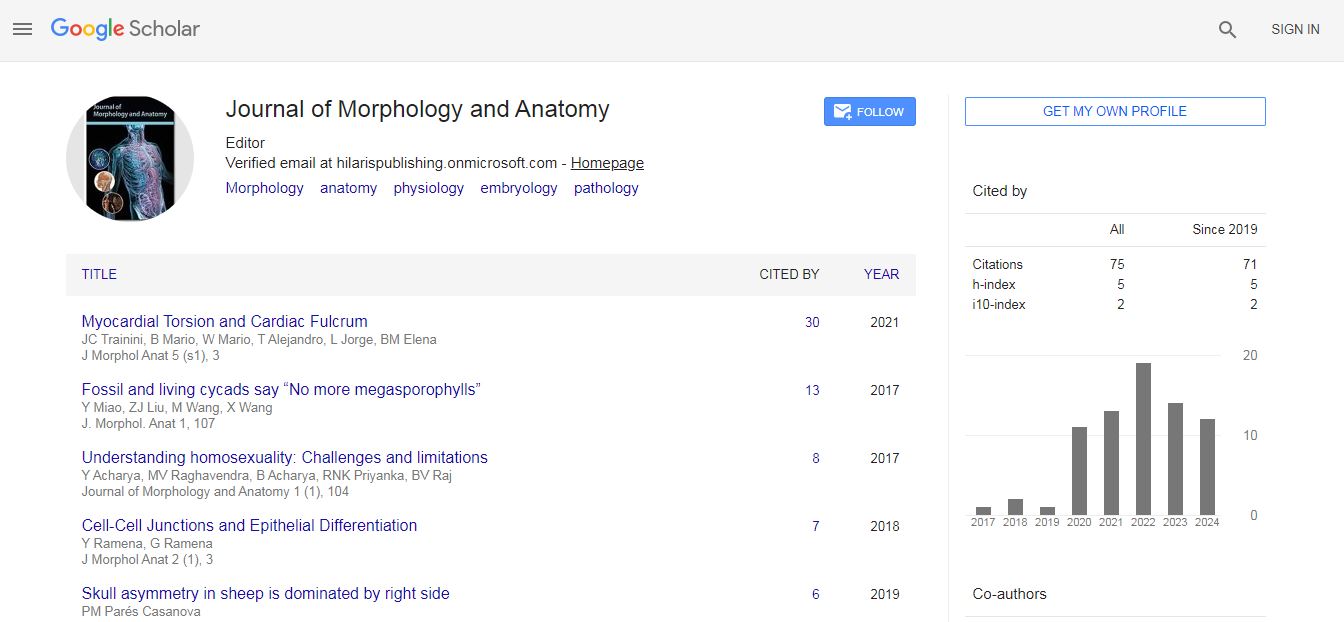
Journal of Morphology and Anatomy received 63 citations as per Google Scholar report