Perspective - (2025) Volume 18, Issue 6
Received: 28-Oct-2025, Manuscript No. jcsb-25-176472;
Editor assigned: 03-Nov-2025, Pre QC No. P-176472;
Reviewed: 11-Nov-2025, QC No. Q-176472;
Revised: 18-Nov-2025, Manuscript No. R-176472;
Published:
25-Nov-2025
, DOI: 10.37421/0974-7230.2025.18.615
Citation: Horváth, Viktor. ”SRT: Unraveling Biology with Spatial Precision.” J Comput Sci Syst Biol 18 (2025):615.
Copyright: © 2025 Horváth V. This is an open-access article distributed under the terms of the Creative Commons Attribution License, which permits unrestricted use, distribution and reproduction in any medium, provided the original author and source are credited.
Spatially resolved transcriptomics (SRT) has emerged as a transformative technology, enabling unprecedented insights into cellular architecture and molecular functions within tissues. This powerful approach allows researchers to map gene expression directly within specific cellular locations, providing a critical spatial context to biological processes and disease states. For instance, a detailed spatial atlas of the human liver has uncovered a previously unappreciated zonation of both hepatocytes and non-parenchymal cells [1].
This high-resolution mapping further reveals how metabolic functions and various disease states correlate precisely with distinct cellular locations and their interactions, marking a crucial advance in understanding complex organ physiology and pathology in a spatial context. SRT has also been instrumental in dissecting the intricate pathology of Alzheimer's disease at a high resolution [2].
This research successfully identified specific cell types and molecular changes spatially associated with amyloid plaques and neurofibrillary tangles, offering new insights into disease progression and pointing to potential therapeutic targets by mapping gene expression within distinct lesion areas. Beyond disease pathology, technological advancements are continually refining the capabilities of spatial transcriptomics, such as an improved in situ sequencing method that enables precise RNA analysis directly within fixed tissue sections [3].
This innovation offers enhanced sensitivity and throughput for spatial transcriptomics, empowering researchers to map gene expression with single-cell resolution in preserved biological samples, opening new avenues for understanding tissue organization and disease mechanisms. The technique has been applied comprehensively to developmental biology, exemplified by generating an extensive atlas of gene expression patterns during human lung development and in derived organoids [4].
This work specifically highlights key molecular pathways and intricate cell-cell interactions that guide lung morphogenesis, providing critical insights into developmental biology and establishing a robust platform for modeling lung diseases. The scope of SRT extends to understanding fundamental biological niches, effectively mapping gene expression programs within the human intestinal stem cell niche [5].
The findings delineate the precise molecular characteristics of distinct cell types and their spatial organization, which are essential for maintaining tissue homeostasis and regeneration, offering crucial insights into intestinal biology and diseases like inflammatory bowel disease and cancer. Similarly, groundbreaking studies have employed SRT to construct a high-resolution molecular and cellular atlas of the developing human heart [6].
This atlas maps the gene expression programs within various cardiac cell types and their spatial organization, revealing complex multicellular ecosystems critical for heart formation and function, offering fundamental insights into congenital heart diseases and strategies for regenerative medicine. Understanding reproductive biology has also greatly benefited from this technology, with a detailed spatial transcriptomic map of human placentation revealing complex cellular interactions and gene expression profiles across different developmental stages [7].
This research delineates the molecular mechanisms underpinning placental function and potential dysregulation in pregnancy complications, offering new insights for diagnostics and therapies. The progression of chronic conditions, such as liver fibrosis, has also been illuminated through spatial transcriptomics [8].
This research dissected the molecular and cellular changes during liver fibrosis progression, identifying a shared tissue remodeling program, including activation of hepatic stellate cells and immune cell infiltration, revealing crucial spatially-defined gene expression patterns that drive fibrotic changes and offer potential targets for therapeutic intervention. Further comprehensive analyses include a detailed spatial transcriptomic study of human kidney development and disease states [9].
This study identifies distinct gene expression patterns and cellular organizations within various renal structures, uncovering new insights into nephrogenesis and the molecular basis of kidney pathologies, thereby paving the way for targeted therapies. The utility of spatially resolved transcriptomics also extends to neuroscience, where a review highlights its transformative potential in dissecting brain function and disease [10].
It discusses various techniques and their applications in mapping gene expression within distinct brain regions, identifying cell types, and understanding neural circuits and pathology in conditions like neurodegeneration and psychiatric disorders. Collectively, these studies underscore the profound impact of spatial transcriptomics in revolutionizing our understanding of biological complexity across diverse tissues and disease contexts.
Spatially resolved transcriptomics (SRT) stands as a pivotal advancement in biological research, offering an unprecedented ability to profile gene expression while preserving critical tissue architecture. This innovative technology has illuminated complex biological processes and disease mechanisms across multiple human organs. For example, applying SRT to the human liver has revealed a unique cellular architecture, including a previously unappreciated zonation of both hepatocytes and non-parenchymal cells [1]. This work provided a high-resolution spatial atlas, detailing how metabolic functions and disease states are intrinsically linked to specific cellular locations and interactions, serving as a critical step toward a deeper understanding of organ physiology and pathology in a spatial context. The utility of SRT extends profoundly into neurological disorders, where it has been used to dissect the complex pathology of Alzheimer's disease at high resolution [2]. This research successfully identified specific cell types and molecular changes spatially associated with amyloid plaques and neurofibrillary tangles, thereby offering new insights into disease progression and pinpointing potential therapeutic targets by mapping gene expression within distinct lesion areas.
The continuous evolution of methodologies in this field is also noteworthy. An improved in situ sequencing method, for instance, now allows for precise RNA analysis directly within fixed tissue sections [3]. This advancement is particularly significant as it offers enhanced sensitivity and throughput for spatial transcriptomics, empowering researchers to map gene expression with single-cell resolution even in preserved biological samples. This opens significant new avenues for understanding tissue organization and the progression of various diseases. Such methodological rigor supports comprehensive studies in developmental biology, as demonstrated by the generation of an exhaustive atlas of gene expression patterns during human lung development and in derived organoids [4]. This particular study highlighted key molecular pathways and crucial cell-cell interactions that guide lung morphogenesis, furnishing critical insights into developmental biology and providing a robust platform for modeling lung diseases.
Furthermore, SRT has been instrumental in characterizing specialized tissue microenvironments crucial for health and disease. This includes its application to comprehensively map the gene expression programs within the human intestinal stem cell niche [5]. The findings from this work meticulously delineate the molecular characteristics of distinct cell types and their spatial organization, which are essential for maintaining tissue homeostasis and regeneration. This offers crucial insights into intestinal biology and a range of diseases, such as inflammatory bowel disease and cancer. Parallelly, a groundbreaking study utilized spatial transcriptomics to construct a high-resolution molecular and cellular atlas of the developing human heart [6]. This atlas effectively maps the gene expression programs within various cardiac cell types and their spatial organization, unveiling complex multicellular ecosystems vital for heart formation and function. This work yields fundamental insights into congenital heart diseases and informs regenerative medicine strategies.
The impact of SRT is also evident in understanding processes vital for human reproduction and the progression of chronic organ damage. A detailed spatial transcriptomic map of human placentation, for example, revealed complex cellular interactions and gene expression profiles across different developmental stages [7]. This research delineates the molecular mechanisms underpinning placental function and identifies potential dysregulation in pregnancy complications, offering new insights for diagnostics and therapies. In the context of chronic disease, spatial transcriptomics has dissected the molecular and cellular changes during liver fibrosis progression [8]. This study identified a shared tissue remodeling program, including the activation of hepatic stellate cells and immune cell infiltration, revealing crucial spatially-defined gene expression patterns that drive fibrotic changes and offering potential targets for therapeutic intervention.
Finally, the application of spatial transcriptomics has extended to other vital organs and broad reviews. A detailed spatial transcriptomic analysis of human kidney development and various disease states has been conducted [9]. This research identifies the distinct gene expression patterns and cellular organizations within various renal structures, uncovering new insights into nephrogenesis and the molecular basis of kidney pathologies, thereby paving the way for targeted therapies. A comprehensive review underscores the transformative potential of spatially resolved transcriptomics in dissecting brain function and disease [10]. It discusses various techniques and their applications in mapping gene expression within distinct brain regions, identifying specific cell types, and understanding neural circuits and pathology in conditions like neurodegeneration and psychiatric disorders. Together, these diverse applications highlight SRT as an indispensable tool for advancing our understanding of biological systems at an unprecedented spatial and molecular resolution.
Spatially resolved transcriptomics (SRT) is revolutionizing biology by enabling the mapping of gene expression within tissues, providing crucial spatial context to cellular architecture and function. Studies using SRT have profoundly advanced our understanding across diverse biological systems. This includes mapping the human liver's cellular zonation, correlating metabolic functions and disease states with specific cellular locations [1]. SRT has also been vital in dissecting Alzheimer's disease pathology, identifying cell types and molecular changes linked to plaques and tangles, offering new therapeutic insights [2]. Methodological improvements, such as enhanced in situ sequencing, allow for precise RNA analysis in fixed tissues with single-cell resolution, expanding research capabilities into tissue organization and disease [3]. Developmental biology has greatly benefited, with SRT generating atlases of human lung development, revealing key molecular pathways and cell-cell interactions [4], and constructing a high-resolution atlas of the developing human heart, detailing multicellular ecosystems critical for cardiac formation and function [6]. Beyond development, SRT has elucidated critical biological niches, like the human intestinal stem cell niche, mapping gene expression programs that maintain homeostasis and regeneration [5]. It has also provided detailed insights into human placentation, revealing cellular interactions and gene expression profiles across developmental stages [7]. Furthermore, SRT has illuminated disease progression, identifying tissue remodeling programs in liver fibrosis [8] and discerning distinct gene expression patterns in human kidney development and disease [9]. Its potential in neuroscience is significant, aiding in understanding brain function, neural circuits, and pathology in conditions like neurodegeneration [10]. Collectively, these works underscore SRT's indispensable role in unraveling complex biological phenomena with unprecedented spatial and molecular precision.
None
None
Ramya R, Ditte ADR, Andrew LNL. "Spatially resolved transcriptomics reveals unique cellular architecture of the human liver".Cell 185 (2022):978-991.e17.
Indexed at, Google Scholar, Crossref
Sheng-Han C, Cheng-Min C, Tzu-Wei C. "Spatially resolved transcriptomics of Alzheimer's disease pathology".Sci Adv 8 (2022):eabl9380.
Indexed at, Google Scholar, Crossref
Josefin V, Fredrik BK, Jonas F. "In situ sequencing for RNA analysis in fixed tissue sections".Science 381 (2023):887-891.
Indexed at, Google Scholar, Crossref
Nancy JH, Timothy EE, Stephanie KT. "Spatially resolved transcriptomics of the human developing lung and pluripotent stem cell-derived lung organoids".Dev Cell 58 (2023):2049-2067.e9.
Indexed at, Google Scholar, Crossref
Andrew LNL, Daniela MJMB, Michael GGPMFA. "Spatially resolved transcriptomics identifies gene expression programs of the human intestinal stem cell niche".Nat Cell Biol 23 (2021):799-810.
Indexed at, Google Scholar, Crossref
Min H, Andrew LNL, Daniela MJMB. "Spatially resolved transcriptomics reveals a multicellular ecosystem in the developing human heart".Nature 624 (2023):641-648.
Indexed at, Google Scholar, Crossref
Andrew LNL, Abha KRRS, Ditte ADR. "Spatially resolved transcriptomics of human placentation".Nature 608 (2022):794-802.
Indexed at, Google Scholar, Crossref
Chao Z, Sixu X, Zhigang S. "Spatially resolved transcriptomics reveals a common tissue remodeling program in liver fibrosis progression".Cell Res 32 (2022):374-388.
Indexed at, Google Scholar, Crossref
Yuxin L, Melanie HHT, Kim BSL. "Spatially resolved transcriptomics of human kidney development and disease".Cell Stem Cell 28 (2021):1198-1216.e7.
Indexed at, Google Scholar, Crossref
Jun C, Patrick HO, Catherine TS. "Spatially resolved transcriptomics for understanding brain function and disease".Nat Neurosci 26 (2023):954-964.
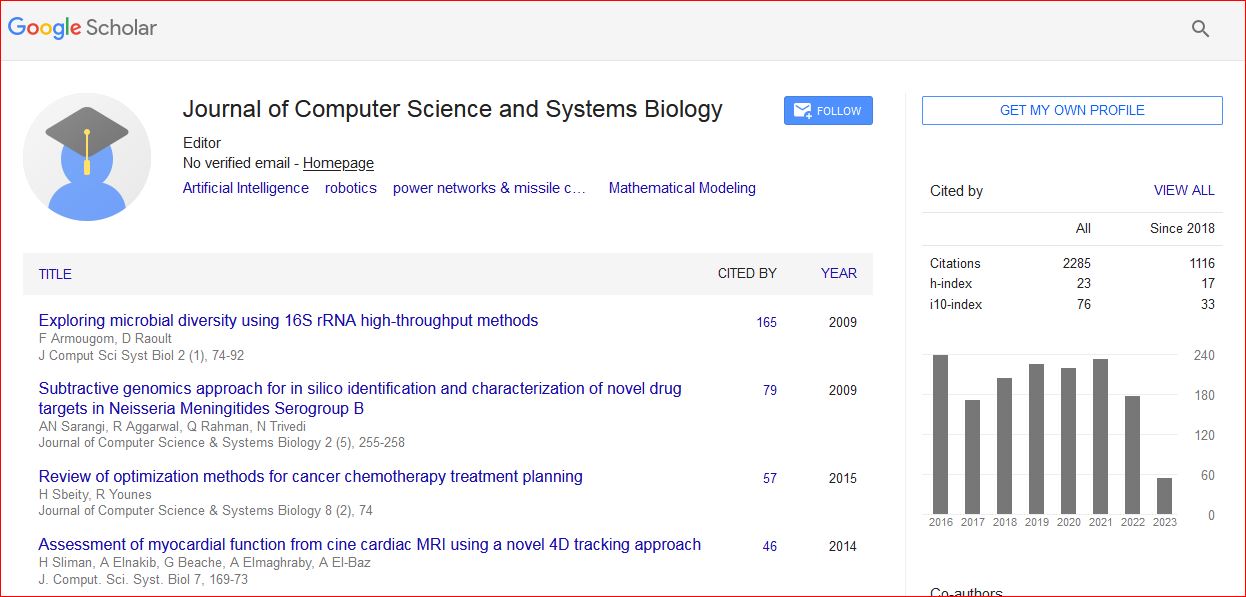
Journal of Computer Science & Systems Biology received 2279 citations as per Google Scholar report